

Product appearance can vary naturally. Confirm the exact item and size in the product details.
1 view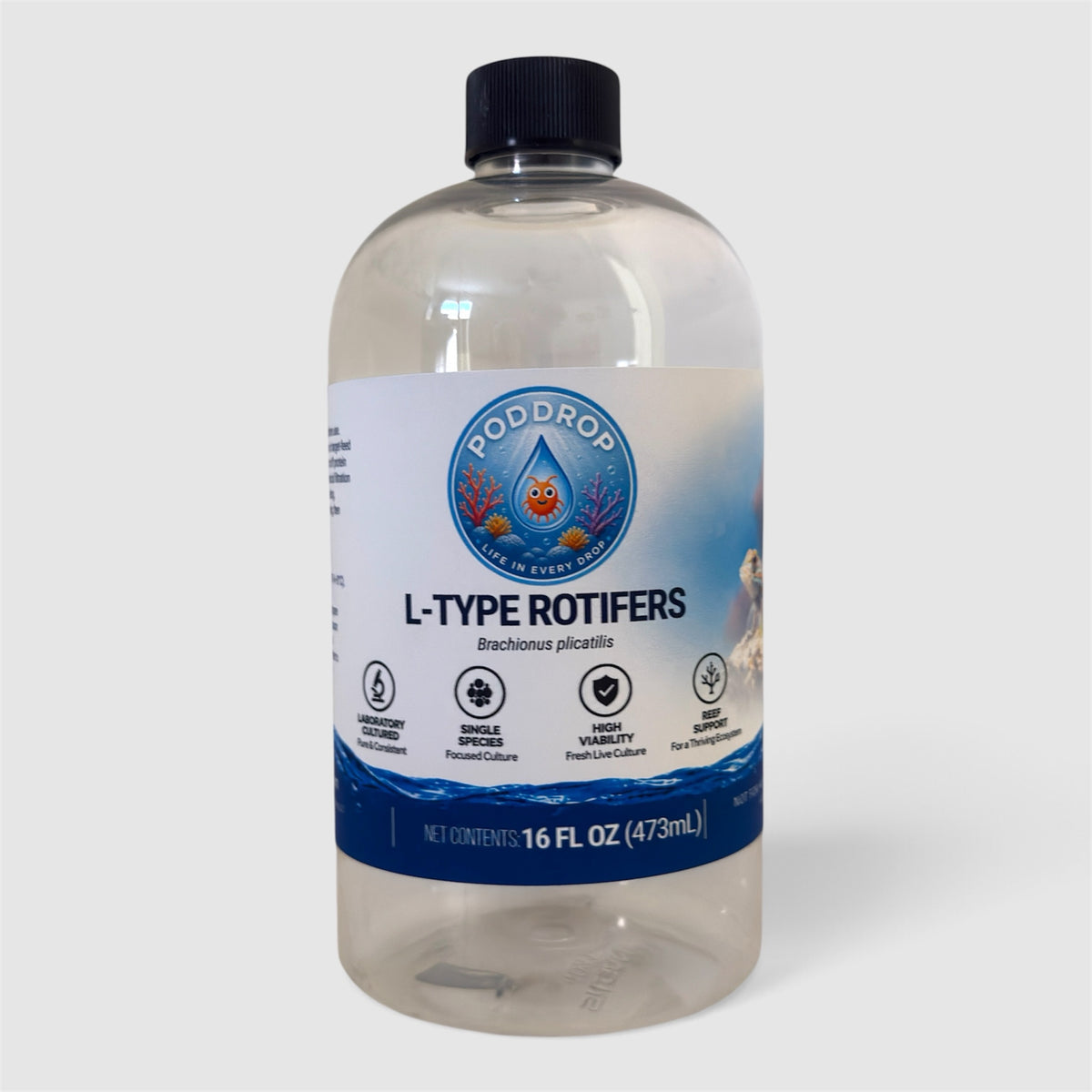
Know what you are adding
A clear role for every culture.
Use this profile to confirm the organism, relative scale, behavior, and intended application before choosing a size or purchase schedule.
It matches the job.
You need a live zooplankton small enough for coral polyps, filter feeders, or larval fish, and you are prepared to gut-load it with phytoplankton and re-dose.
The profile misses the goal.
Your goal is a self-sustaining population in rockwork and sand for mandarins, wrasses, or pipefish; choose a live copepod culture instead.
Go deeper before ordering
Explore the Knowledge Hub
Know what you are adding
Culture details, care & handling
Species notes, how to add it, storage and live-arrival guidance for this culture, all in one place.
Key benefits & applications
Live L-type rotifer culture (Brachionus plicatilis) for supplemental reef and larval feeding
Average lorica size near 240 µm, between phytoplankton and copepod nauplii, suited to coral polyps and larval fish
Slow, steady swimmers that stay suspended in the water column longer than settling frozen foods
Can be used as starter material for a home rotifer culture fed with live phytoplankton
Species highlights
Brachionus plicatilis (L-type) is the large, cooler-water morphotype of the marine rotifer species complex and the most widely used live first feed in marine finfish hatcheries. Lorica length is roughly 130–340 µm. It is euryhaline, tolerating full-strength seawater for feeding and reproducing fastest at 15–25 ppt and 18–26 °C. This description is a taxonomic and behavioral identification, not a claim of superior nutrition or guaranteed aquarium performance. Density and life-stage distribution vary among live culture bottles.
Nutritional profile
Rotifers are non-selective filter feeders, and their value to corals and fish depends almost entirely on what they ate in the hours before feeding. Gut-loading with live phytoplankton (Nannochloropsis for EPA, Isochrysis or Tisochrysis lutea for DHA) before dosing is the single most important handling step.
PodDrop does not guarantee fixed percentages of protein, lipid, EPA, DHA, amino acids, carotenoids, or vitamins unless a current product-specific laboratory analysis is published. Use as supplemental live prey within a varied feeding program, not as a complete diet or a treatment for health, color, immunity, or disease.
How to add or use
1. Unpack promptly and inspect the sealed bottle under a light; a healthy culture shows a fine, slowly swirling haze.
2. Add a small volume of live phytoplankton to the bottle 30–60 minutes before dosing so the rotifers carry a fresh gut load.
3. Reduce return and flow pumps for 15–30 minutes. Dose after lights-out when polyps are extended, or target-feed NPS corals and filter feeders with a pipette. A common starting point is 10–20 mL per 25 gallons, two or three times a week.
4. For a culture, start at 20–50 rotifers per mL in new saltwater at 18–22 ppt with gentle aeration, feed live phytoplankton to a light tint two or three times a day, and harvest through a 50–60 µm sieve once the culture is dense.
5. Rotifers do not establish in a reef tank; plan to re-dose. Monitor livestock and water quality after introduction.
Storage & care
Use the live culture promptly. Until use, keep the bottle refrigerated (about 4–8 °C), loosely capped, protected from direct sun and temperature extremes, and gently invert it once a day. Do not freeze. A small addition of live phytoplankton helps maintain the culture while it is held.
Holding time and feeding requirements depend on density, temperature, and handling, so do not apply a generic multi-day storage promise. Use clean tools and avoid introducing aquarium water into the original container.
Live Arrival Policy
PodDrop’s Live Arrival Policy covers the condition of eligible live products at the carrier’s first delivery attempt. If a culture appears nonviable, materially leaking, missing, or incorrect because of a PodDrop packing or fulfillment error, contact PodDrop within 2 hours of the carrier’s recorded delivery time.
Keep the culture and all original packaging. Before adding, transferring, feeding, or discarding the product, provide your order number, delivery timestamp, a concise description, and clear photographs or video showing the culture in its original container, the shipping box and insulation, any damage or unusual condition, and the shipping label.
PodDrop reviews each report using the order record, carrier tracking, delivery conditions, packaging, documentation, and reported handling after delivery. If a claim is approved, PodDrop may provide a replacement of the affected item or store credit, depending on the circumstances and current product availability.
Coverage does not guarantee establishment, reproduction, continued survival, feeding response, aquarium performance, or compatibility after receipt. Read the complete Live Arrival Policy for eligibility requirements, exclusions, and submission instructions.
Shipping schedule
Orders containing live products ship on PodDrop’s published live-product schedule using the carrier service stated at checkout. PodDrop may delay dispatch when weather or carrier conditions create an avoidable live-shipping risk.
Because live products are perishable, they are not returnable after shipment. Qualifying delivery-condition reports are governed by the current Live Arrival Policy and its 2-hour documentation requirement. Request order changes before fulfillment begins.
Responsible handling
Cultured and packed at PodDrop’s Arizona aquaculture facility (AQ License #91). This facility statement is not a claim that a culture is axenic, sterile, pathogen-free, parasite-free, or free of every incidental organism unless a current lot-specific test states otherwise.
Wash hands after handling, use dedicated culture tools when possible, prevent cross-contamination among cultures, and never release aquarium organisms or culture water into natural waterways. Follow all applicable local rules.
Gut-load before you dose
Pair rotifers with live phytoplankton.
A rotifer delivers whatever it ate in the last hour. Add Nannochloropsis for EPA or Isochrysis for DHA to the bottle before feeding, and use the same strains to keep a culture going.
Shop live phytoplankton-
Nannochloropsis oculata Live Phytoplankton – Green Reef Phyto
Regular price From $20.00Regular price -
Tetraselmis chui Live Phytoplankton – Motile Green Algae
Regular price From $20.00Regular price -
Chaetoceros calcitrans Live Phytoplankton – Marine Diatom
Regular price From $20.00Regular price -
Isochrysis galbana Live Phytoplankton – Copepod & Reef Feed
Regular price From $24.00Regular price


