Surface-associated habitat
Tisbe primarily uses rockwork, substrate, and other surfaces rather than remaining continuously suspended in the water column.
$0.00 USD
Product appearance can vary naturally. Confirm the exact item and size in the product details.
2 viewsCULTURED IN ARIZONA • LICENSE AQ91
Save up to 15% with Auto Ship. Choose your delivery schedule below. Skip or cancel anytime.
Live cultures ship Monday–Wednesday by insulated 2-day service.
Couldn't load pickup availability
Product overview
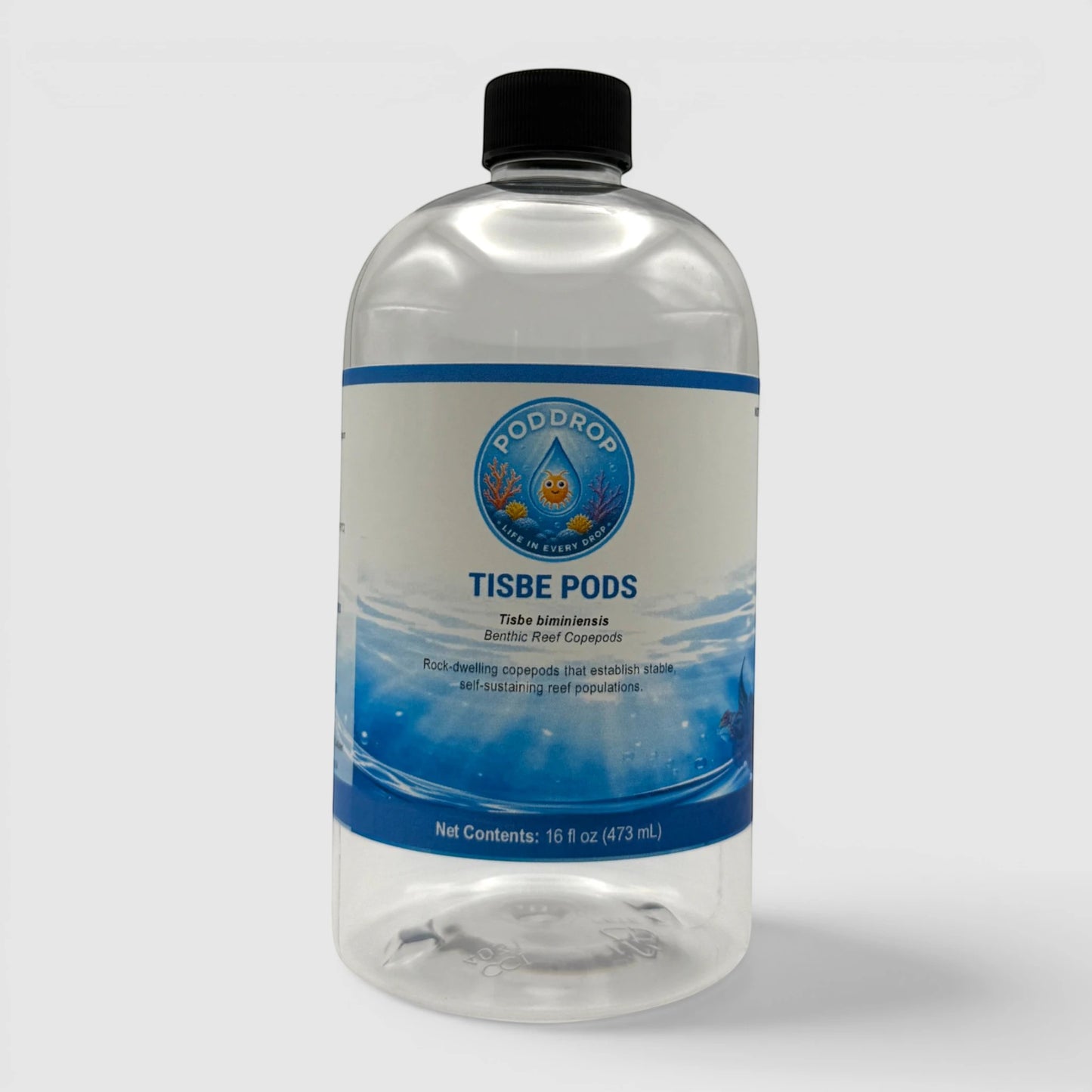
Small harpacticoid pods that work your rock and sand. PodDrop Tisbe biminiensis is a small, surface-associated harpacticoid commonly maintained in live-feed cultures, cultured fresh in Arizona.
How it compares: smaller than Tigriopus californicus, and a harpacticoid complement to the cyclopoid Apocyclops panamensis. Give pods shelter with our Copepod Hotel.
How to use
Ships live, fresh from Arizona. Every order goes out on our weekly live-culture dispatch schedule and is covered by our Live Arrival Policy.
Keep your pods fed: add a live phytoplankton culture to your order.
Tisbe biminiensis is a live cultured marine copepod offered as supplemental prey for compatible aquarium animals and as starter material for a separate culture or refugium. It is a small surface-associated harpacticoid copepod commonly maintained in live-feed cultures. Actual behavior, visibility, persistence, and suitability vary with the aquarium and the animals present.
This product can add live-prey movement and life-stage variety to a feeding program. Use it alongside an appropriate varied diet. Establishment, reproduction, continued survival, feeding response, coloration, and other aquarium outcomes are not guaranteed.
Each bottle contains a living culture prepared at PodDrop’s Arizona aquaculture facility. Organism density and life-stage distribution naturally vary. Follow the current label, storage directions, and Live Arrival Policy.

WHY THIS CULTURE
Tisbe is a small, primarily benthic harpacticoid copepod suited to rockwork, substrate, and protected refugium habitat. It is a strong fit when the goal is reef seeding and persistent microfauna support.
Tisbe primarily uses rockwork, substrate, and other surfaces rather than remaining continuously suspended in the water column.
Well suited to introducing a defined benthic copepod into systems with porous habitat and protected areas such as refugiums.
Different life stages provide live prey at small relative sizes; actual persistence depends on predation pressure, habitat, and available food.
Can be used as one component of a more diverse microfauna strategy alongside compatible phytoplankton and complementary copepod species.
You want a small, surface-associated copepod for rockwork, substrate, refugium seeding, and ongoing microfauna support.
Your priority is a comparatively large, highly visible adult prey item or a primarily pelagic live-feed species.
CULTURE PROFILE
Use this profile as a fast biological check before moving into detailed handling, comparison, and research notes.
FROM BOTTLE TO SYSTEM
Live cultures are biological products. The most useful receiving and use guidance is specific to the organism and the role you expect it to perform.
WHAT’S INSIDE THE BOTTLE?
A live copepod culture can contain multiple life stages. Visibility varies by species, life stage, density, bottle position, lighting, and whether organisms are swimming or resting on surfaces.
WHERE IT FITS
Rockwork, substrate, bottle walls, and protected refugium surfaces are more representative habitat than continuous open-water swimming.
Bring the shipment inside after delivery and inspect the package and culture condition.
Choose the display, rockwork, refugium, or culture vessel that matches the species profile and intended use.
Introduce the culture in a way that gives the organisms access to appropriate habitat while limiting unnecessary immediate removal or predation.
Provide appropriate habitat and compatible food sources. Establishment and persistence depend on system conditions and are not guaranteed.
UNDER THE MICROSCOPE
Copepod cultures may include nauplii, copepodites, and adults. The smaller stages can be difficult to see without magnification, and some species spend significant time on surfaces.
Larger adults may be visible as moving points, while smaller stages can be easy to miss.
Useful for confirming movement, body shape, and multiple life stages in a sample.
Relative size and behavior matter: a Tisbe bottle will not look the same as a Tigriopus or pelagic calanoid culture.
Use movement, life-stage expectations, and the species profile together. A live culture should not be judged only by what is obvious in the unopened bottle.
COMPARE THE PROFILE
Tisbe, Tigriopus, and Apocyclops illustrate why “copepods” are not one interchangeable product. Relative size, habitat use, and swimming behavior change the best application.
| Profile | Tisbe | Tigriopus | Apocyclops |
|---|---|---|---|
| Relative adult profile | Small | Larger | Small–medium |
| Primary habitat | Benthic / surfaces | Surfaces / culture vessel | Mixed zones |
| Movement | Crawling + short bursts | Active, visible bursts | Active swimming |
| Strong use case | Reef seeding / refugium | Visible prey / culture work | Reef + propagation |
Know what you are adding
Product-specific metafields appear here when available, with practical fallback guidance for every item.
PodDrop’s Live Arrival Policy covers the condition of eligible live products at the carrier’s first delivery attempt. If a culture appears nonviable, materially leaking, missing, or incorrect because of a PodDrop packing or fulfillment error, contact PodDrop within 2 hours of the carrier’s recorded delivery time.
Keep the culture and all original packaging. Before adding, transferring, feeding, or discarding the product, provide your order number, delivery timestamp, a concise description, and clear photographs or video showing the culture in its original container, the shipping box and insulation, any damage or unusual condition, and the shipping label.
PodDrop reviews each report using the order record, carrier tracking, delivery conditions, packaging, documentation, and reported handling after delivery. If a claim is approved, PodDrop may provide a replacement of the affected item or store credit, depending on the circumstances and current product availability.
Coverage does not guarantee establishment, reproduction, continued survival, feeding response, aquarium performance, or compatibility after receipt. Read the complete Live Arrival Policy for eligibility requirements, exclusions, and submission instructions.
RECEIVING & TECHNICAL NOTES
Keep the purchasing experience simple at the top of the page, then make the deeper handling and technical information easy to find when a customer needs it.
Inspect the culture on arrival before adding, feeding, or discarding it. If there is an arrival concern, document the condition promptly under the published Live Arrival Policy.
Live Arrival Policy →Copepod performance and persistence depend on species, life stage, prey size, habitat, feeding, predation pressure, and culture conditions. Use the species guide for a more technical profile.
Research & professional use →Build the feeding loop
A compatible microalgae can support a copepod-feeding routine. Compare cell profile and intended application before choosing the strain.
Shop live phytoplankton →VERIFIED CUSTOMER FEEDBACK