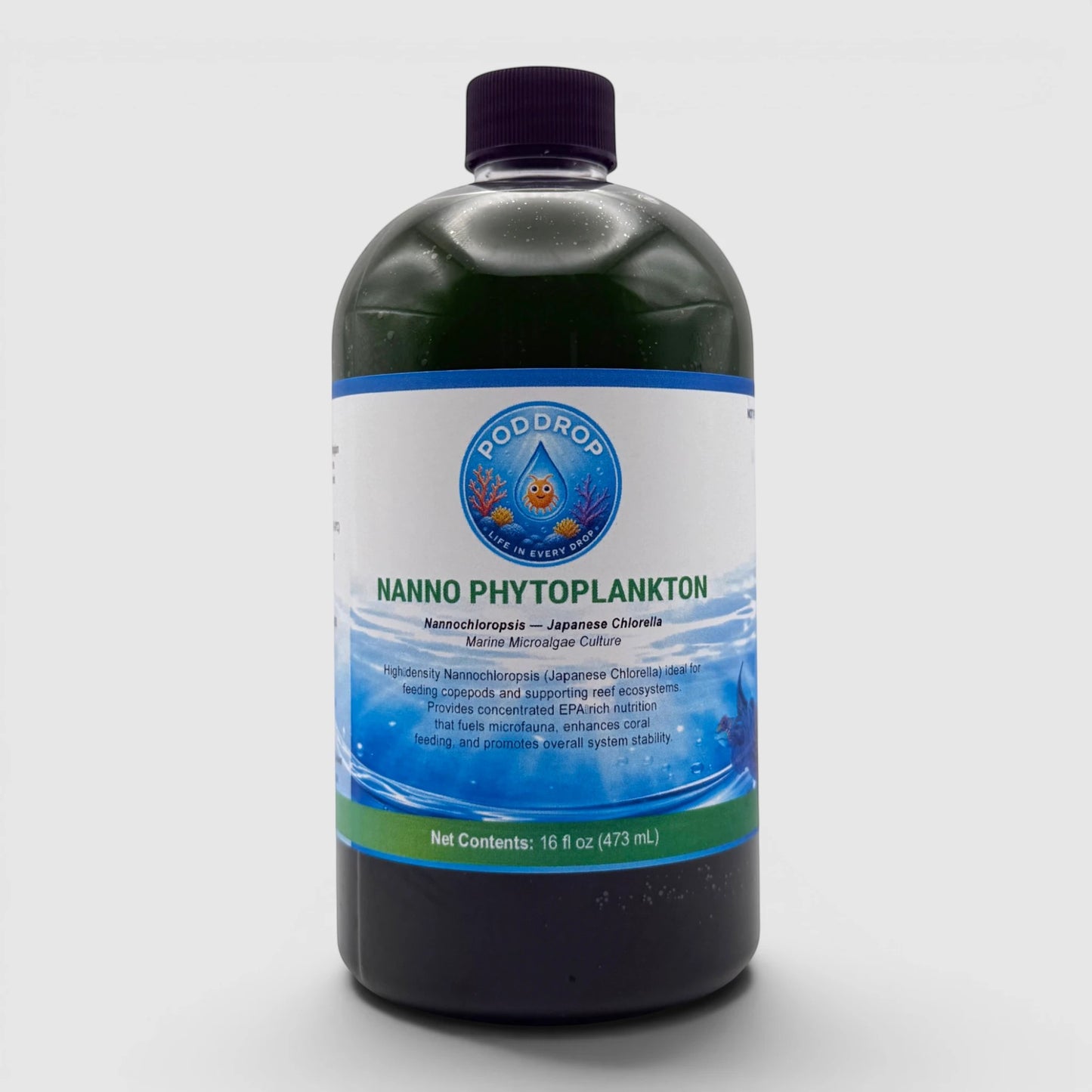
Nanochloropsis Japanese Chlorella Phytoplankton Culture
Couldn't load pickup availability
Product Overview
Nanochloropsis (often called Japanese Chlorella) is a powerhouse marine microalga known for its extremely small 2–4 micron cell size, intense green pigmentation, and industry‑leading EPA omega‑3 content. With 30–40% of total fatty acids as EPA and 40–50% protein by dry weight, this species delivers the ideal nutritional profile for copepods, rotifers, larval fish, and filter‑feeding invertebrates. Its rapid growth rate and dense biomass production make it the gold‑standard foundation species for marine live‑feed systems.
Unlike freshwater Chlorella, Nanochloropsis features a robust cell wall that resists rupture, locking nutrients inside the cell until consumed by zooplankton or filter feeders. This prevents nutrient leaching and supports efficient nutrient export in reef aquaria by converting dissolved nitrates and phosphates into stable cellular biomass. Its tiny size ensures accessibility to even the smallest nauplii, SPS corals, clams, sponges, and other fine‑particle feeders.
Delivered as a living, actively dividing culture, Nanochloropsis arrives ready to fuel copepod reproduction, stabilize nutrient levels, and strengthen the base of your reef’s natural food web from the moment it enters the system.

Explore detailed care instructions, specifications, and policies below
Highest EPA omega‑3 content of any phytoplankton
Essential for copepod reproduction, larval fish development, and overall system vitality.
Ultra‑small 2–4 micron cell size
Perfect for nauplii, SPS corals, clams, sponges, and other fine‑particle feeders.
Exceptional nutrient export capability
Actively consumes nitrates and phosphates, locking them into biomass rather than releasing them back into the water.
Supports dense copepod populations
Ideal primary feed for Tisbe, Apocyclops, Oithona, and other marine copepods.
Highly stable in the water column
Suspends well, allowing maximum feeding opportunity for corals and microfauna.
Arrives alive and actively dividing
Ready to immediately support feeding, nutrient control, and microfauna growth.
Highest EPA omega‑3 content of any phytoplankton
Essential for copepod reproduction, larval fish development, and overall system vitality.
Ultra‑small 2–4 micron cell size
Perfect for nauplii, SPS corals, clams, sponges, and other fine‑particle feeders.
Exceptional nutrient export capability
Actively consumes nitrates and phosphates, locking them into biomass rather than releasing them back into the water.
Supports dense copepod populations
Ideal primary feed for Tisbe, Apocyclops, Oithona, and other marine copepods.
Highly stable in the water column
Suspends well, allowing maximum feeding opportunity for corals and microfauna.
Arrives alive and actively dividing
Ready to immediately support feeding, nutrient control, and microfauna growth.
Marine microalga with extremely small, non‑motile cells ideal for nauplii and fine‑particle feeders.
Richest EPA source among phytoplankton, supporting copepod fecundity and larval fish survival.
40–50% protein by dry weight, providing dense, high‑quality nutrition.
2–4 micron spherical cells ensure universal accessibility across reef organisms.
Thick, resilient cell wall prevents nutrient leakage and enhances nutrient export efficiency.
Fast‑growing, stable culture that produces dense, productive biomass.
Delivered as a living marine culture, ready to feed and clean the system immediately.
Marine microalga with extremely small, non‑motile cells ideal for nauplii and fine‑particle feeders.
Richest EPA source among phytoplankton, supporting copepod fecundity and larval fish survival.
40–50% protein by dry weight, providing dense, high‑quality nutrition.
2–4 micron spherical cells ensure universal accessibility across reef organisms.
Thick, resilient cell wall prevents nutrient leakage and enhances nutrient export efficiency.
Fast‑growing, stable culture that produces dense, productive biomass.
Delivered as a living marine culture, ready to feed and clean the system immediately.
Nanochloropsis is prized for its exceptionally high EPA omega‑3 content, representing 30–40% of total fatty acids—a critical component for copepod reproduction, nauplii development, and larval fish health. With 40–50% protein by dry weight, it provides a concentrated amino acid source ideal for enriching zooplankton and supporting coral metabolic needs.
Its deep green coloration comes from chlorophyll‑a, which contributes to antioxidant support and overall tissue vitality in corals and filter feeders. While lower in pigments like carotenoids compared to other species, its unmatched EPA density makes it the cornerstone of marine live‑feed nutrition.
The species’ thick cell wall keeps nutrients locked inside the cell until consumed, preventing leaching and making Nanochloropsis uniquely effective for nutrient export. This combination of high EPA, strong protein content, and stable cellular structure makes it the most widely used phytoplankton in marine aquaculture worldwide.
Nanochloropsis is prized for its exceptionally high EPA omega‑3 content, representing 30–40% of total fatty acids—a critical component for copepod reproduction, nauplii development, and larval fish health. With 40–50% protein by dry weight, it provides a concentrated amino acid source ideal for enriching zooplankton and supporting coral metabolic needs.
Its deep green coloration comes from chlorophyll‑a, which contributes to antioxidant support and overall tissue vitality in corals and filter feeders. While lower in pigments like carotenoids compared to other species, its unmatched EPA density makes it the cornerstone of marine live‑feed nutrition.
The species’ thick cell wall keeps nutrients locked inside the cell until consumed, preventing leaching and making Nanochloropsis uniquely effective for nutrient export. This combination of high EPA, strong protein content, and stable cellular structure makes it the most widely used phytoplankton in marine aquaculture worldwide.
Dosing: Shake bottle gently before use to redistribute cells. Add directly to refugium, sump, or display tank during low-flow periods for optimal distribution.
Refugium Addition: Dose near copepod populations for direct feeding. Daily dosing supports robust copepod reproduction and population density.
Display Tank: Broadcast dose in evening hours when corals extend polyps. Water may show slight reddish tint that clears within hours.
Recommended Dosage: Start with 5-10ml per 25 gallons daily for maintenance. Increase to 15-25ml per 25 gallons for systems with dense copepod cultures or heavy filter feeder loads.
Breeding Systems: Dose 2-4 times daily for intensive rotifer and copepod production systems requiring premium nutrition.
Dosing: Shake bottle gently before use to redistribute cells. Add directly to refugium, sump, or display tank during low-flow periods for optimal distribution.
Refugium Addition: Dose near copepod populations for direct feeding. Daily dosing supports robust copepod reproduction and population density.
Display Tank: Broadcast dose in evening hours when corals extend polyps. Water may show slight reddish tint that clears within hours.
Recommended Dosage: Start with 5-10ml per 25 gallons daily for maintenance. Increase to 15-25ml per 25 gallons for systems with dense copepod cultures or heavy filter feeder loads.
Breeding Systems: Dose 2-4 times daily for intensive rotifer and copepod production systems requiring premium nutrition.
Upon Arrival: Refrigerate immediately at 35-45°F. Shake gently before opening to redistribute cells.
Refrigerated Storage: Keeps for 2-4 weeks when properly refrigerated. Check for fresh ocean smell and deep red coloration.
Viability Check: Healthy cultures appear deep red in color. Off smell, gray or brown coloration, or settling without resuspension indicates declining viability.
Shake Before Use: Cells settle naturally—always shake gently to redistribute before dosing.
Avoid Freezing: Never freeze phytoplankton cultures as this destroys cell structure and nutritional value.
Upon Arrival: Refrigerate immediately at 35-45°F. Shake gently before opening to redistribute cells.
Refrigerated Storage: Keeps for 2-4 weeks when properly refrigerated. Check for fresh ocean smell and deep red coloration.
Viability Check: Healthy cultures appear deep red in color. Off smell, gray or brown coloration, or settling without resuspension indicates declining viability.
Shake Before Use: Cells settle naturally—always shake gently to redistribute before dosing.
Avoid Freezing: Never freeze phytoplankton cultures as this destroys cell structure and nutritional value.
All PodDrop phytoplankton cultures are guaranteed to arrive alive and viable. Our Rhodomonas cruentum is shipped fresh and concentrated for immediate use. If your culture arrives compromised (off smell, unusual color, or dead cells), contact us within 2 hours of delivery with photos for replacement or refund. We use insulated shipping to maintain culture viability during transit.
Shipping: Monday-Wednesday via UPS 2nd Day Air for fast, reliable delivery. Arizona aquaculture license #91 ensures legal, biosecure cultures. Includes insulation and cold packs for temperature protection.
Weather Delays: We monitor conditions and may hold orders during extreme temperatures to ensure culture viability.
Returns: Live phytoplankton cannot be returned once shipped due to perishable nature. Contact us before shipping for order modifications.
Tracking: Confirmation email sent when your order ships with UPS tracking number.
Shipping: Monday-Wednesday via UPS 2nd Day Air for fast, reliable delivery. Arizona aquaculture license #91 ensures legal, biosecure cultures. Includes insulation and cold packs for temperature protection.
Weather Delays: We monitor conditions and may hold orders during extreme temperatures to ensure culture viability.
Returns: Live phytoplankton cannot be returned once shipped due to perishable nature. Contact us before shipping for order modifications.
Tracking: Confirmation email sent when your order ships with UPS tracking number.
PodDrop operates as a licensed Arizona aquaculture facility (AQ License #91) following strict biosecurity and handling protocols. Our Rhodomonas cruentum cultures are:
Raised in isolated, contamination-controlled systems
Free from harmful bacteria, parasites, and competing algae species
Packaged in food-grade, sealed containers for biosecurity
Shipped in compliance with USDA and state aquaculture regulations
Premium monoculture strains maintained for consistent quality and nutrition
Sustainably produced without environmental impact
Proper Handling: Refrigerate immediately upon arrival. Shake gently before each use. Never release culture water into natural waterways. Dispose of packaging responsibly.
PodDrop operates as a licensed Arizona aquaculture facility (AQ License #91) following strict biosecurity and handling protocols. Our Rhodomonas cruentum cultures are:
Raised in isolated, contamination-controlled systems
Free from harmful bacteria, parasites, and competing algae species
Packaged in food-grade, sealed containers for biosecurity
Shipped in compliance with USDA and state aquaculture regulations
Premium monoculture strains maintained for consistent quality and nutrition
Sustainably produced without environmental impact
Proper Handling: Refrigerate immediately upon arrival. Shake gently before each use. Never release culture water into natural waterways. Dispose of packaging responsibly.
Trusted by Reefers Nationwide
-
Ships Fresh Mon–Wed
-
USA Aquacultured
-
Free Shipping on $55+
-
Secure Checkout & Payment