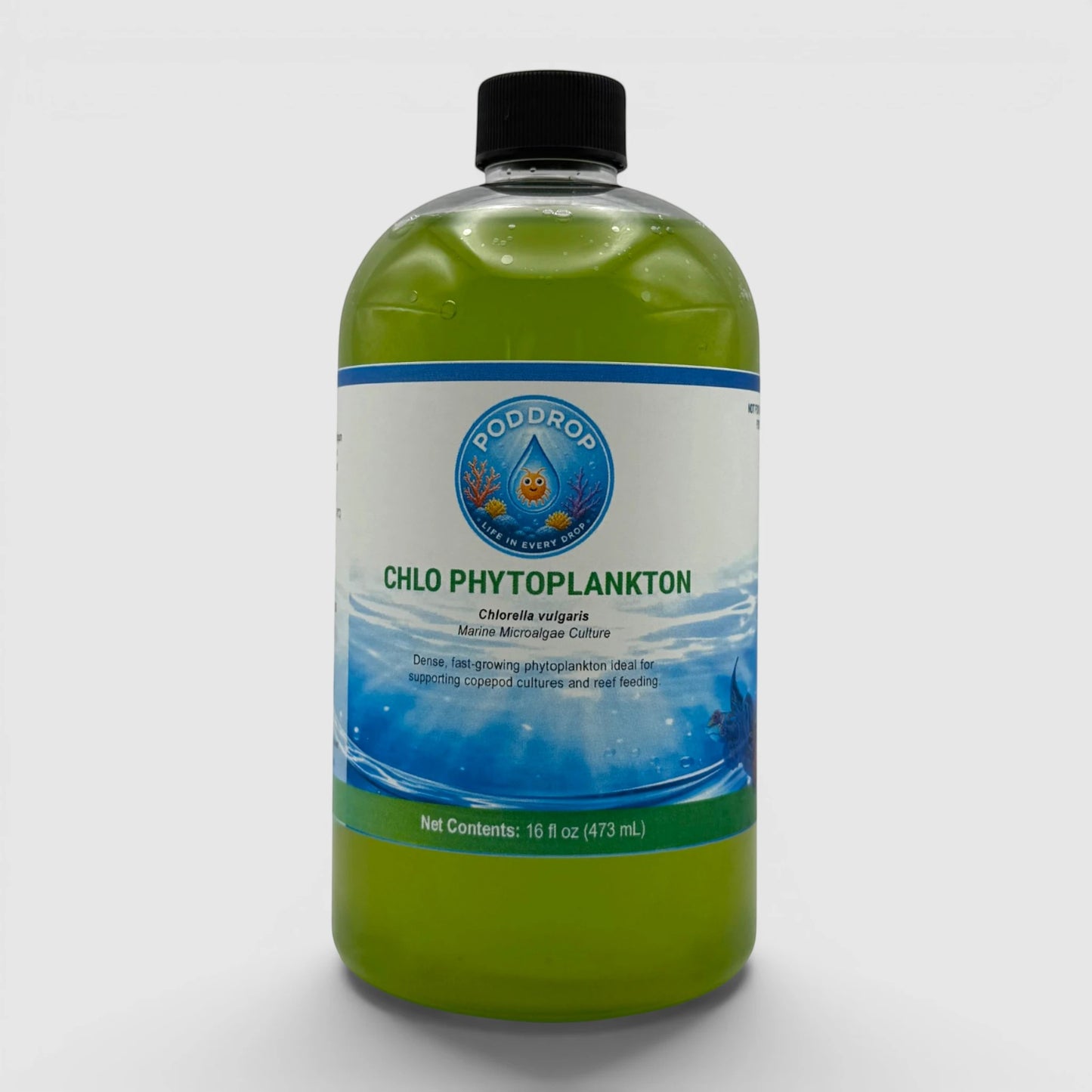
Chlorella vulgaris Phytoplankton Culture
Couldn't load pickup availability
Product Overview
Chlorella vulgaris is a nutrient‑dense freshwater microalga known for its deep green pigmentation, exceptional chlorophyll content, and highly digestible cell structure. These 2–10 micron cells deliver a balanced profile of proteins, vitamins, and carotenoids that support growth, coloration, and immune function across a wide range of aquatic organisms. With 40–60% protein by dry weight and naturally high levels of chlorophyll‑a and lutein, Chlorella provides a powerful nutritional boost for both freshwater and marine systems.
Unlike tougher marine species, Chlorella vulgaris features a softer, more accessible cell wall that makes it ideal for gut‑loading zooplankton such as rotifers and daphnia, as well as for direct feeding of corals, clams, sponges, and other filter feeders. Its dense pigment load enhances fluorescence and tissue vitality, while its vitamin‑rich biomass supports metabolic health and recovery in stressed or growing organisms.
In reef aquariums, Chlorella functions as a versatile supplemental phyto that enriches the water column, fuels microfauna, and contributes to a more diverse planktonic ecosystem. Its stability and rapid growth rate make it a reliable component in multi‑species blends or as a standalone feed for systems needing a chlorophyll‑heavy nutritional source. Delivered as a living, actively dividing culture, Chlorella vulgaris arrives ready to enhance coloration, support zooplankton enrichment, and strengthen overall system biodiversity from day one.

Explore detailed care instructions, specifications, and policies below
Enhances coral coloration and fluorescence
High chlorophyll‑a and carotenoid levels boost pigment density, supporting richer greens, yellows, and overall tissue vibrancy in SPS, LPS, and soft corals.
Highly digestible nutrition for microfauna
Softer freshwater cell walls make Chlorella exceptionally accessible to copepods, rotifers, and other zooplankton, improving enrichment and reproductive output.
Supports immune function and tissue repair
Vitamin‑rich biomass (B‑complex, C, E, K) and antioxidant pigments help corals and invertebrates recover from stress, fragging, or environmental fluctuations.
Feeds a wide range of filter feeders
Ideal for clams, sponges, feather dusters, gorgonians, and other fine‑particle feeders that benefit from small, nutrient‑dense cells.
Promotes biodiversity in the water column
Provides a stable food source for microfauna communities, strengthening the base of the reef’s natural food web.
Excellent for multi‑species phyto blends
Balances EPA‑heavy species like Nannochloropsis with chlorophyll‑rich, protein‑dense nutrition, creating a more complete feeding profile.
Enhances coral coloration and fluorescence
High chlorophyll‑a and carotenoid levels boost pigment density, supporting richer greens, yellows, and overall tissue vibrancy in SPS, LPS, and soft corals.
Highly digestible nutrition for microfauna
Softer freshwater cell walls make Chlorella exceptionally accessible to copepods, rotifers, and other zooplankton, improving enrichment and reproductive output.
Supports immune function and tissue repair
Vitamin‑rich biomass (B‑complex, C, E, K) and antioxidant pigments help corals and invertebrates recover from stress, fragging, or environmental fluctuations.
Feeds a wide range of filter feeders
Ideal for clams, sponges, feather dusters, gorgonians, and other fine‑particle feeders that benefit from small, nutrient‑dense cells.
Promotes biodiversity in the water column
Provides a stable food source for microfauna communities, strengthening the base of the reef’s natural food web.
Excellent for multi‑species phyto blends
Balances EPA‑heavy species like Nannochloropsis with chlorophyll‑rich, protein‑dense nutrition, creating a more complete feeding profile.
Freshwater microalga with highly digestible cells, making it ideal for enriching zooplankton such as rotifers, daphnia, and copepods.
Deep green pigmentation driven by high chlorophyll‑a and lutein, supporting coral fluorescence, tissue vitality, and antioxidant defense.
Protein‑dense biomass (40–60% by dry weight) delivering balanced amino acids, vitamins, and minerals for broad nutritional support.
Small 2–10 micron cell size ensures accessibility to SPS, LPS, soft corals, clams, sponges, gorgonians, and other fine‑particle filter feeders.
Vitamin‑rich profile (B‑complex, C, E, K) enhances immune function, metabolic health, and recovery from stress or fragging.
Excellent blend component that complements EPA‑rich species like Nannochloropsis by adding chlorophyll‑heavy, carotenoid‑rich nutrition.
Freshwater microalga with highly digestible cells, making it ideal for enriching zooplankton such as rotifers, daphnia, and copepods.
Deep green pigmentation driven by high chlorophyll‑a and lutein, supporting coral fluorescence, tissue vitality, and antioxidant defense.
Protein‑dense biomass (40–60% by dry weight) delivering balanced amino acids, vitamins, and minerals for broad nutritional support.
Small 2–10 micron cell size ensures accessibility to SPS, LPS, soft corals, clams, sponges, gorgonians, and other fine‑particle filter feeders.
Vitamin‑rich profile (B‑complex, C, E, K) enhances immune function, metabolic health, and recovery from stress or fragging.
Excellent blend component that complements EPA‑rich species like Nannochloropsis by adding chlorophyll‑heavy, carotenoid‑rich nutrition.
Chlorella vulgaris is renowned for its exceptionally dense nutritional composition, delivering a balanced spectrum of proteins, pigments, vitamins, and minerals that support growth, coloration, and metabolic health across reef organisms. With 40–60% protein by dry weight, Chlorella provides a complete amino acid profile ideal for enriching zooplankton and feeding filter‑feeding invertebrates.
Its signature deep‑green coloration comes from high chlorophyll‑a and lutein concentrations, supplying powerful antioxidant protection that enhances coral fluorescence and tissue vitality. These pigments also support photosynthetic symbionts, making Chlorella a valuable supplement for stressed or recovering corals.
The species contains a broad suite of B‑complex vitamins, along with vitamins C, E, and K, which contribute to immune function, cellular repair, and overall resilience. Essential minerals such as iron, magnesium, and potassium further support metabolic processes in both zooplankton and corals.
With moderate lipid content and a naturally soft, digestible cell structure, Chlorella vulgaris delivers highly accessible nutrition that fuels microfauna reproduction and enriches the base of the reef food web. This balanced profile makes it an ideal complement to EPA‑rich species like Nannochloropsis, rounding out multi‑species phyto blends with chlorophyll‑heavy, vitamin‑dense biomass.
Chlorella vulgaris is renowned for its exceptionally dense nutritional composition, delivering a balanced spectrum of proteins, pigments, vitamins, and minerals that support growth, coloration, and metabolic health across reef organisms. With 40–60% protein by dry weight, Chlorella provides a complete amino acid profile ideal for enriching zooplankton and feeding filter‑feeding invertebrates.
Its signature deep‑green coloration comes from high chlorophyll‑a and lutein concentrations, supplying powerful antioxidant protection that enhances coral fluorescence and tissue vitality. These pigments also support photosynthetic symbionts, making Chlorella a valuable supplement for stressed or recovering corals.
The species contains a broad suite of B‑complex vitamins, along with vitamins C, E, and K, which contribute to immune function, cellular repair, and overall resilience. Essential minerals such as iron, magnesium, and potassium further support metabolic processes in both zooplankton and corals.
With moderate lipid content and a naturally soft, digestible cell structure, Chlorella vulgaris delivers highly accessible nutrition that fuels microfauna reproduction and enriches the base of the reef food web. This balanced profile makes it an ideal complement to EPA‑rich species like Nannochloropsis, rounding out multi‑species phyto blends with chlorophyll‑heavy, vitamin‑dense biomass.
Chlorella vulgaris can be added directly to the display tank, refugium, or sump to enrich the water column and support microfauna. Because the cells are small, soft, and highly digestible, they remain suspended long enough for corals, clams, sponges, and zooplankton to feed efficiently.
For best results, dose with pumps and filtration running so the culture disperses evenly throughout the system. Regular additions help maintain a stable planktonic food web, fuel copepod reproduction, and provide continuous nutritional support for filter feeders. Consistent use also enhances coral coloration and overall system biodiversity by supplying a steady source of chlorophyll‑rich, vitamin‑dense microalgae.
Chlorella vulgaris can be added directly to the display tank, refugium, or sump to enrich the water column and support microfauna. Because the cells are small, soft, and highly digestible, they remain suspended long enough for corals, clams, sponges, and zooplankton to feed efficiently.
For best results, dose with pumps and filtration running so the culture disperses evenly throughout the system. Regular additions help maintain a stable planktonic food web, fuel copepod reproduction, and provide continuous nutritional support for filter feeders. Consistent use also enhances coral coloration and overall system biodiversity by supplying a steady source of chlorophyll‑rich, vitamin‑dense microalgae.
Upon Arrival: Refrigerate immediately at 35-45°F. Shake vigorously before opening—cells settle very densely.
Refrigerated Storage: Keeps for 3-6 weeks when properly refrigerated. Hardy nature provides longer shelf life than delicate flagellates.
Viability Check: Healthy cultures appear bright green with thick consistency. Off smell or gray-brown coloration indicates declining viability.
Shake Before Use: Cells settle extremely densely—always shake vigorously to redistribute before dosing.
Avoid Freezing: Never freeze phytoplankton cultures as this destroys cell structure and nutritional value.
Upon Arrival: Refrigerate immediately at 35-45°F. Shake vigorously before opening—cells settle very densely.
Refrigerated Storage: Keeps for 3-6 weeks when properly refrigerated. Hardy nature provides longer shelf life than delicate flagellates.
Viability Check: Healthy cultures appear bright green with thick consistency. Off smell or gray-brown coloration indicates declining viability.
Shake Before Use: Cells settle extremely densely—always shake vigorously to redistribute before dosing.
Avoid Freezing: Never freeze phytoplankton cultures as this destroys cell structure and nutritional value.
All PodDrop phytoplankton cultures are guaranteed to arrive alive and viable. Our Nannochloropsis oculata is shipped fresh and concentrated for immediate use. If your culture arrives compromised (off smell, unusual color, or dead cells), contact us within 2 hours of delivery with photos for replacement or refund. We use insulated shipping to maintain culture viability during transit.
Shipping: Monday-Wednesday via UPS 2nd Day Air for fast, reliable delivery. Arizona aquaculture license #91 ensures legal, biosecure cultures. Includes insulation and cold packs for temperature protection.
Weather Delays: We monitor conditions and may hold orders during extreme temperatures to ensure culture viability.
Returns: Live phytoplankton cannot be returned once shipped due to perishable nature. Contact us before shipping for order modifications.
Tracking: Confirmation email sent when your order ships with UPS tracking number.
Shipping: Monday-Wednesday via UPS 2nd Day Air for fast, reliable delivery. Arizona aquaculture license #91 ensures legal, biosecure cultures. Includes insulation and cold packs for temperature protection.
Weather Delays: We monitor conditions and may hold orders during extreme temperatures to ensure culture viability.
Returns: Live phytoplankton cannot be returned once shipped due to perishable nature. Contact us before shipping for order modifications.
Tracking: Confirmation email sent when your order ships with UPS tracking number.
PodDrop operates as a licensed Arizona aquaculture facility (AQ License #91) following strict biosecurity and handling protocols. Our Nannochloropsis oculata cultures are:
Raised in isolated, contamination-controlled systems
Free from harmful bacteria, parasites, and competing algae species
Packaged in food-grade, sealed containers for biosecurity
Shipped in compliance with USDA and state aquaculture regulations
Premium strains maintained for consistent quality and nutrition
Sustainably produced without environmental impact
Proper Handling: Refrigerate immediately upon arrival. Shake vigorously before each use. Never release culture water into natural waterways. Dispose of packaging responsibly.
PodDrop operates as a licensed Arizona aquaculture facility (AQ License #91) following strict biosecurity and handling protocols. Our Nannochloropsis oculata cultures are:
Raised in isolated, contamination-controlled systems
Free from harmful bacteria, parasites, and competing algae species
Packaged in food-grade, sealed containers for biosecurity
Shipped in compliance with USDA and state aquaculture regulations
Premium strains maintained for consistent quality and nutrition
Sustainably produced without environmental impact
Proper Handling: Refrigerate immediately upon arrival. Shake vigorously before each use. Never release culture water into natural waterways. Dispose of packaging responsibly.
Trusted by Reefers Nationwide
-
Ships Fresh Mon–Wed
-
USA Aquacultured
-
Free Shipping on $55+
-
Secure Checkout & Payment