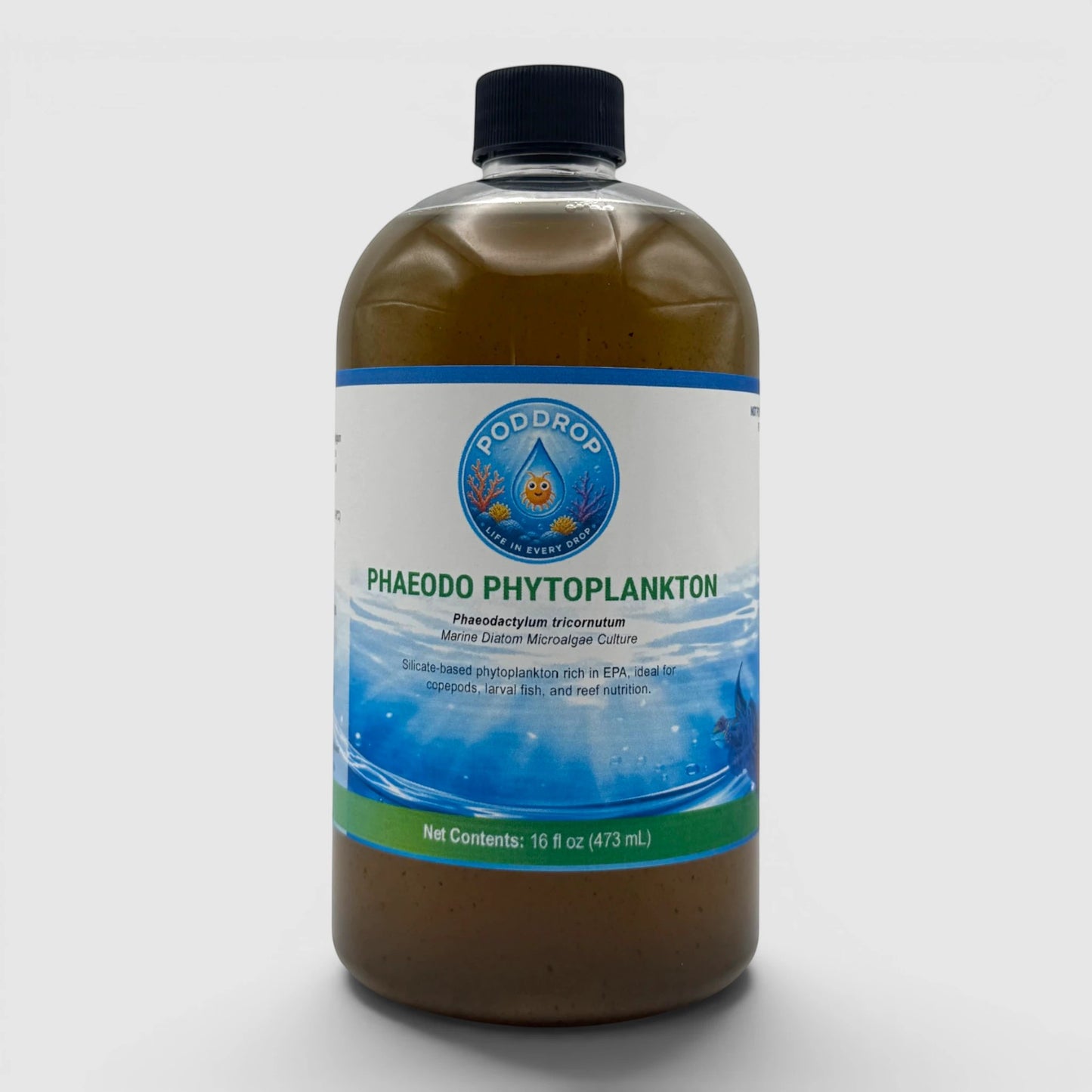
Phaeodactylum tricornutum live phytoplankton
Couldn't load pickup availability
Product Overview
Phaeodactylum tricornutum is a highly digestible, high‑EPA marine diatom that delivers exceptional fatty acid enrichment in a uniquely soft, silica‑reduced package. These 6–12 micron golden‑brown cells provide one of the strongest EPA profiles in aquaculture while remaining far easier to digest than traditional heavily‑silicified diatoms. The result is a powerhouse microalgae species ideal for calanoid copepods, larval fish, bivalves, and reef systems requiring premium omega‑3 nutrition.
Unlike rigid diatoms such as Chaetoceros, P. tricornutum features minimal frustule formation and flexible morphotypes—fusiform, oval, and triradiate—allowing superior assimilation by copepod nauplii and filter‑feeding corals. Its soft cell structure enables rapid nutrient release, making it one of the most efficient EPA delivery systems available for both aquaculture and reef aquaria.
For reef keepers seeking maximum enrichment value with minimal silicate impact, P. tricornutum fills the gap between green flagellates like Nannochloropsis and larger diatoms. High fucoxanthin levels support antioxidant protection, improved coloration, and enhanced resilience against light stress. The species remains suspended in the water column for extended periods, ensuring consistent availability to copepods, filter feeders, and corals.
Phaeodactylum tricornutum

Explore detailed care instructions, specifications, and policies below
High‑Value EPA Enrichment:
Phaeodactylum tricornutum delivers one of the strongest EPA profiles of any phytoplankton species, supplying essential omega‑3 fatty acids that support coral membrane stability, coloration, and resilience under high‑light conditions. SPS and LPS corals both benefit from the rapid assimilation of these lipids due to the species’ reduced silica content and soft cell structure.
Superior Digestibility for Corals & Copepods:
Unlike heavily silicified diatoms, P. tricornutum features minimal frustule formation, allowing corals, copepods, and filter feeders to break down and absorb nutrients with exceptional efficiency. This makes it a preferred diatom for systems where nutrient uptake speed and bioavailability matter.
Supports Robust Copepod Populations:
The 6–12 micron cell size and high EPA concentration make P. tricornutum an ideal feed for calanoid copepods, harpacticoids, and nauplii. Regular dosing strengthens copepod reproduction, egg quality, and nauplii development—directly benefiting reef fish that rely on live microcrustaceans, such as mandarins, anthias, and wrasses.
Enhances Coral Coloration & Stress Resistance:
Fucoxanthin, the golden‑brown carotenoid characteristic of diatoms, provides antioxidant protection that helps corals maintain pigmentation and resist photoinhibition. This pigment supports deeper browns, golds, and warm tones in both SPS and LPS corals while improving overall tissue vitality.
Improves Water Column Stability & Nutrient Balance:
Active uptake of nitrate, phosphate, and CO₂ contributes to a more stable reef environment. P. tricornutum remains suspended in the water column longer than many green algae, ensuring consistent availability to filter feeders and reducing the likelihood of rapid sedimentation.
Minimal Silicate Impact Compared to Other Diatoms:
Because P. tricornutum forms only light silica structures, it introduces far less silicate into reef systems than traditional diatoms like Chaetoceros. This makes it a safer choice for aquarists who want the benefits of diatom nutrition without fueling nuisance diatom films on glass and substrate.
High‑Value EPA Enrichment:
Phaeodactylum tricornutum delivers one of the strongest EPA profiles of any phytoplankton species, supplying essential omega‑3 fatty acids that support coral membrane stability, coloration, and resilience under high‑light conditions. SPS and LPS corals both benefit from the rapid assimilation of these lipids due to the species’ reduced silica content and soft cell structure.
Superior Digestibility for Corals & Copepods:
Unlike heavily silicified diatoms, P. tricornutum features minimal frustule formation, allowing corals, copepods, and filter feeders to break down and absorb nutrients with exceptional efficiency. This makes it a preferred diatom for systems where nutrient uptake speed and bioavailability matter.
Supports Robust Copepod Populations:
The 6–12 micron cell size and high EPA concentration make P. tricornutum an ideal feed for calanoid copepods, harpacticoids, and nauplii. Regular dosing strengthens copepod reproduction, egg quality, and nauplii development—directly benefiting reef fish that rely on live microcrustaceans, such as mandarins, anthias, and wrasses.
Enhances Coral Coloration & Stress Resistance:
Fucoxanthin, the golden‑brown carotenoid characteristic of diatoms, provides antioxidant protection that helps corals maintain pigmentation and resist photoinhibition. This pigment supports deeper browns, golds, and warm tones in both SPS and LPS corals while improving overall tissue vitality.
Improves Water Column Stability & Nutrient Balance:
Active uptake of nitrate, phosphate, and CO₂ contributes to a more stable reef environment. P. tricornutum remains suspended in the water column longer than many green algae, ensuring consistent availability to filter feeders and reducing the likelihood of rapid sedimentation.
Minimal Silicate Impact Compared to Other Diatoms:
Because P. tricornutum forms only light silica structures, it introduces far less silicate into reef systems than traditional diatoms like Chaetoceros. This makes it a safer choice for aquarists who want the benefits of diatom nutrition without fueling nuisance diatom films on glass and substrate.
High‑EPA Golden Diatom:
Phaeodactylum tricornutum is one of the most efficient EPA producers in marine aquaculture, delivering premium omega‑3 enrichment for copepods, larval fish, and corals without the heavy silica load of traditional diatoms.
Soft, Highly Digestible Cell Structure:
Reduced frustule formation makes this diatom far easier for corals, copepods, and filter feeders to break down, ensuring rapid nutrient absorption and superior bioavailability compared to heavily silicified species.
Ideal Particle Size for Copepods & Corals:
At 6–12 microns, P. tricornutum sits in the perfect feeding range for calanoid copepods, nauplii, SPS corals, and fine‑particle filter feeders. Its flexible morphotypes improve capture efficiency across multiple reef organisms.
Fucoxanthin‑Rich Antioxidant Profile:
The golden‑brown pigmentation provides powerful antioxidant protection, supporting coral coloration, tissue health, and resilience under high‑light or high‑PAR conditions.
Minimal Silicate Impact in Reef Systems:
Unlike chain‑forming diatoms, P. tricornutum introduces very little silicate, making it a reef‑safe diatom option that won’t fuel nuisance diatom films on glass or substrate.
Stays Suspended for Extended Feeding Windows:
High‑EPA Golden Diatom:
Phaeodactylum tricornutum is one of the most efficient EPA producers in marine aquaculture, delivering premium omega‑3 enrichment for copepods, larval fish, and corals without the heavy silica load of traditional diatoms.
Soft, Highly Digestible Cell Structure:
Reduced frustule formation makes this diatom far easier for corals, copepods, and filter feeders to break down, ensuring rapid nutrient absorption and superior bioavailability compared to heavily silicified species.
Ideal Particle Size for Copepods & Corals:
At 6–12 microns, P. tricornutum sits in the perfect feeding range for calanoid copepods, nauplii, SPS corals, and fine‑particle filter feeders. Its flexible morphotypes improve capture efficiency across multiple reef organisms.
Fucoxanthin‑Rich Antioxidant Profile:
The golden‑brown pigmentation provides powerful antioxidant protection, supporting coral coloration, tissue health, and resilience under high‑light or high‑PAR conditions.
Minimal Silicate Impact in Reef Systems:
Unlike chain‑forming diatoms, P. tricornutum introduces very little silicate, making it a reef‑safe diatom option that won’t fuel nuisance diatom films on glass or substrate.
Stays Suspended for Extended Feeding Windows:
Phaeodactylum tricornutum is renowned for its exceptionally high EPA concentration, making it one of the most valuable diatoms in marine aquaculture. Its 20–35% EPA content (as a percentage of total fatty acids) positions it as a premier omega‑3 source for copepods, larval fish, bivalves, and reef corals. The species’ reduced silica frustule allows for rapid digestion and efficient nutrient transfer—organisms can assimilate its lipids and proteins far more easily than heavily silicified diatoms.
The 20–30% total lipid content provides a dense supply of long‑chain polyunsaturated fatty acids essential for neural development, membrane stability, and larval survival. While DHA is present only in trace amounts, the EPA dominance makes P. tricornutum a cornerstone enrichment species for calanoid copepods and early larval stages of marine fish.
Protein levels typically range from 35–45% dry weight, offering a complete amino acid profile that supports tissue growth, metabolic function, and reproductive output. The presence of fucoxanthin, the signature golden‑brown diatom carotenoid, adds antioxidant protection that benefits both larval organisms and corals under high‑light conditions.
As a diatom, P. tricornutum contains minimal silica compared to chain‑forming species, improving digestibility while still providing the structural pigments and biochemical pathways characteristic of diatoms. Its vitamin and mineral composition includes B‑complex vitamins, vitamin E, vitamin K, and essential trace elements such as iron, manganese, and zinc—nutrients that directly support larval development and coral vitality.
This balanced nutritional profile makes P. tricornutum one of the most efficient and versatile microalgae species for both aquaculture and reef aquaria, delivering high‑value enrichment without the drawbacks of heavy silica loading.
Phaeodactylum tricornutum is renowned for its exceptionally high EPA concentration, making it one of the most valuable diatoms in marine aquaculture. Its 20–35% EPA content (as a percentage of total fatty acids) positions it as a premier omega‑3 source for copepods, larval fish, bivalves, and reef corals. The species’ reduced silica frustule allows for rapid digestion and efficient nutrient transfer—organisms can assimilate its lipids and proteins far more easily than heavily silicified diatoms.
The 20–30% total lipid content provides a dense supply of long‑chain polyunsaturated fatty acids essential for neural development, membrane stability, and larval survival. While DHA is present only in trace amounts, the EPA dominance makes P. tricornutum a cornerstone enrichment species for calanoid copepods and early larval stages of marine fish.
Protein levels typically range from 35–45% dry weight, offering a complete amino acid profile that supports tissue growth, metabolic function, and reproductive output. The presence of fucoxanthin, the signature golden‑brown diatom carotenoid, adds antioxidant protection that benefits both larval organisms and corals under high‑light conditions.
As a diatom, P. tricornutum contains minimal silica compared to chain‑forming species, improving digestibility while still providing the structural pigments and biochemical pathways characteristic of diatoms. Its vitamin and mineral composition includes B‑complex vitamins, vitamin E, vitamin K, and essential trace elements such as iron, manganese, and zinc—nutrients that directly support larval development and coral vitality.
This balanced nutritional profile makes P. tricornutum one of the most efficient and versatile microalgae species for both aquaculture and reef aquaria, delivering high‑value enrichment without the drawbacks of heavy silica loading.
Dosing: Shake bottle gently before use. Add directly to refugium, sump, or display tank during low-flow periods for best distribution.
Refugium Addition: Dose near copepod populations for direct feeding. Daily dosing supports continuous copepod reproduction.
Display Tank: Broadcast dose in evening hours when corals extend polyps. Water may show slight cloudiness that clears within hours.
Recommended Dosage: Start with 5-10ml per 25 gallons daily. Adjust based on copepod populations and coral response. Higher doses (20-30ml per 25 gallons) for systems with dense copepod cultures or filter feeders.
Breeding Systems: Dose 2-3 times daily for rotifer and copepod production systems.
Dosing: Shake bottle gently before use. Add directly to refugium, sump, or display tank during low-flow periods for best distribution.
Refugium Addition: Dose near copepod populations for direct feeding. Daily dosing supports continuous copepod reproduction.
Display Tank: Broadcast dose in evening hours when corals extend polyps. Water may show slight cloudiness that clears within hours.
Recommended Dosage: Start with 5-10ml per 25 gallons daily. Adjust based on copepod populations and coral response. Higher doses (20-30ml per 25 gallons) for systems with dense copepod cultures or filter feeders.
Breeding Systems: Dose 2-3 times daily for rotifer and copepod production systems.
Upon Arrival: Refrigerate immediately at 35-45°F. Shake gently before opening to redistribute cells.
Refrigerated Storage: Keeps for 2-4 weeks when properly refrigerated. Check for fresh ocean smell and red-pink coloration.
Viability Check: Healthy cultures appear red-pink in color. Off smell or color change indicates declining viability.
Shake Before Use: Cells settle naturally—always shake gently to redistribute before dosing.
Avoid Freezing: Never freeze phytoplankton cultures as this destroys cell structure and nutritional value.
Upon Arrival: Refrigerate immediately at 35-45°F. Shake gently before opening to redistribute cells.
Refrigerated Storage: Keeps for 2-4 weeks when properly refrigerated. Check for fresh ocean smell and red-pink coloration.
Viability Check: Healthy cultures appear red-pink in color. Off smell or color change indicates declining viability.
Shake Before Use: Cells settle naturally—always shake gently to redistribute before dosing.
Avoid Freezing: Never freeze phytoplankton cultures as this destroys cell structure and nutritional value.
All PodDrop phytoplankton cultures are guaranteed to arrive alive and viable. Our Rhodomonas lens is shipped fresh and concentrated for immediate use. If your culture arrives compromised (off smell, unusual color, or dead cells), contact us within 12 hours of delivery with photos for replacement or refund. We use insulated shipping to maintain culture viability during transit.
Shipping: Monday-Wednesday via UPS 2nd Day Air for fast, reliable delivery. Arizona aquaculture license #91 ensures legal, biosecure cultures. Includes insulation and cold packs for temperature protection.
Weather Delays: We monitor conditions and may hold orders during extreme temperatures to ensure culture viability.
Returns: Live phytoplankton cannot be returned once shipped due to perishable nature. Contact us before shipping for order modifications.
Tracking: Confirmation email sent when your order ships with UPS tracking number.
Shipping: Monday-Wednesday via UPS 2nd Day Air for fast, reliable delivery. Arizona aquaculture license #91 ensures legal, biosecure cultures. Includes insulation and cold packs for temperature protection.
Weather Delays: We monitor conditions and may hold orders during extreme temperatures to ensure culture viability.
Returns: Live phytoplankton cannot be returned once shipped due to perishable nature. Contact us before shipping for order modifications.
Tracking: Confirmation email sent when your order ships with UPS tracking number.
PodDrop operates as a licensed Arizona aquaculture facility (AQ License #91) following strict biosecurity and handling protocols. Our Rhodomonas lens cultures are:
Raised in isolated, contamination-controlled systems
Free from harmful bacteria, parasites, and competing algae species
Packaged in food-grade, sealed containers for biosecurity
Shipped in compliance with USDA and state aquaculture regulations
Monoculture strains maintained for consistent quality and nutrition
Sustainably produced without environmental impact
Proper Handling: Refrigerate immediately upon arrival. Shake gently before each use. Never release culture water into natural waterways. Dispose of packaging responsibly.
PodDrop operates as a licensed Arizona aquaculture facility (AQ License #91) following strict biosecurity and handling protocols. Our Rhodomonas lens cultures are:
Raised in isolated, contamination-controlled systems
Free from harmful bacteria, parasites, and competing algae species
Packaged in food-grade, sealed containers for biosecurity
Shipped in compliance with USDA and state aquaculture regulations
Monoculture strains maintained for consistent quality and nutrition
Sustainably produced without environmental impact
Proper Handling: Refrigerate immediately upon arrival. Shake gently before each use. Never release culture water into natural waterways. Dispose of packaging responsibly.
Trusted by Reefers Nationwide
-
Ships Fresh Mon–Wed
-
USA Aquacultured
-
Free Shipping on $55+
-
Secure Checkout & Payment