

What is the Reef Food Chain? Understanding Its Importance
Coral reefs look like colorful underwater cities, bursting with life and mystery. Now picture this, every inch of these reefs depends on an invisible system where energy moves from tiny algae all the way up to sharks, and only about 10 percent of energy makes it from one level to the next. Most people fixate on the bright fish and coral, yet the biggest story is hiding in plain sight. The reef food chain is not just a food list, it is a network so tightly connected that removing one piece could send shockwaves through the entire ecosystem.
Table of Contents
- Defining The Reef Food Chain: Key Components And Relationships
- The Importance Of The Reef Food Chain For Marine Biodiversity
- How Energy Flows Through The Reef Food Chain: Primary Producers To Predators
- Human Impact On The Reef Food Chain: Challenges And Solutions
Quick Summary
| Takeaway | Explanation |
|---|---|
| Protect primary producers to sustain ecosystems | Primary producers like phytoplankton are essential for energy transfer and the overall health of marine ecosystems. |
| Recognize the importance of biodiversity | Biodiversity helps ensure ecosystem resilience and adaptability, making balanced food chains crucial for environmental stability. |
| Address human impacts to enhance reef survival | Mitigating overfishing, pollution, and climate change can help protect the delicate balance of reef food chains. |
| Support symbiotic relationships for ecosystem health | Complex interdependencies, such as corals and zooxanthellae, are vital for nutrient exchange and ecosystem stability. |
| Implement conservation strategies that target all levels | Effective conservation must consider the intricate relationships within food chains to maintain marine life sustainability. |
Defining the Reef Food Chain: Key Components and Relationships
The reef food chain represents a complex, interconnected system of energy transfer and biological interactions within marine ecosystems. At its core, this intricate network describes how organisms exchange nutrients and energy across different trophic levels, creating a delicate balance that sustains marine life.
Fundamental Structure of Marine Food Chains
A reef food chain begins with primary producers, typically microscopic organisms like phytoplankton and marine algae. These organisms convert sunlight into energy through photosynthesis, forming the foundational layer of the entire ecosystem. These microorganisms are crucial because they transform solar energy into consumable biomass that supports higher-level organisms.
Subsequent levels include primary consumers like small zooplankton and herbivorous fish, which feed directly on these primary producers. Secondary consumers such as predatory fish and marine invertebrates then consume these primary consumers, creating a hierarchical energy transfer system. Each level represents a transfer of approximately 10% of the previous level’s energy, demonstrating the inherent efficiency of marine food webs.
The following table organizes the primary trophic levels of the reef food chain and summarizes the main role of each group within the ecosystem.
| Trophic Level | Example Organisms | Main Role in the Ecosystem |
|---|---|---|
| Primary Producers | Phytoplankton, Marine Algae | Convert sunlight into chemical energy via photosynthesis |
| Primary Consumers | Zooplankton, Herbivorous Fish | Consume primary producers, transferring energy upward |
| Secondary Consumers | Predatory Fish, Marine Invertebrates | Eat primary consumers, concentrate and transfer energy |
| Tertiary Consumers | Larger Fish, Octopuses | Prey on secondary consumers, regulate population |
| Apex Predators | Sharks, Large Groupers | Top of the food chain, control species population |
Symbiotic Relationships and Energy Flow
Reef ecosystems are characterized by intricate symbiotic relationships that go beyond traditional predator-prey dynamics. Coral polyps, for instance, have a remarkable symbiosis with zooxanthellae algae, which provide nutrients through photosynthesis while receiving protection and essential compounds in return. This relationship exemplifies the complex interdependencies within reef food chains.
Learn more about marine energy dynamics that drive these remarkable ecological interactions. Understanding these relationships helps marine biologists and ecologists comprehend the delicate balance maintaining reef ecosystem health.
Key characteristics of reef food chains include:
- Multilayered energy transfer
- High biodiversity
- Complex interdependent relationships
- Sensitive environmental balance
The resilience and sustainability of reef food chains depend on maintaining these intricate connections and protecting the ecosystem’s fundamental components.
The Importance of the Reef Food Chain for Marine Biodiversity
The reef food chain serves as a critical mechanism for maintaining marine biodiversity, representing a sophisticated ecological system that supports complex life interactions and sustains entire marine ecosystems. By enabling energy transfer and nutrient cycling, these intricate networks play a fundamental role in preserving the health and stability of marine environments worldwide.
Biodiversity Preservation and Ecosystem Resilience
Reef food chains contribute to biodiversity by creating interconnected pathways that support multiple species across different trophic levels. Each organism plays a unique role in maintaining ecological balance, from microscopic plankton to large predatory fish. These interactions ensure genetic diversity, population control, and adaptive potential within marine ecosystems.
The complexity of reef food chains allows for redundancy and alternative energy pathways. When one species experiences population decline, other organisms can adapt and fill ecological niches, demonstrating the remarkable flexibility of marine ecosystems. This adaptive capacity is crucial for maintaining stability during environmental fluctuations and potential disruptions.
Nutrient Cycling and Environmental Health
Nutrient cycling represents another critical function of reef food chains. Organisms at various trophic levels continuously transform and redistribute essential nutrients like nitrogen, phosphorus, and carbon. Microorganisms, in particular, play a pivotal role in breaking down organic matter and recycling nutrients, ensuring continuous resource availability for marine life.
Explore marine ecosystem dynamics that demonstrate how these intricate networks sustain marine environments. Understanding these complex interactions helps researchers develop conservation strategies and comprehend ecosystem resilience.
Key contributions of reef food chains to marine biodiversity include:
- Supporting genetic diversity
- Enabling ecosystem adaptation
- Facilitating nutrient redistribution
- Maintaining population balance
- Providing ecological stability
Conservation efforts must recognize the delicate interdependencies within reef food chains. Protecting these complex networks requires comprehensive strategies that address multiple ecological levels and preserve the intricate relationships sustaining marine life.
How Energy Flows Through the Reef Food Chain: Primary Producers to Predators
Energy transfer in reef ecosystems represents a sophisticated and complex process where nutrients and biomass move through increasingly sophisticated biological levels. This dynamic transfer begins with primary producers and culminates in apex predators, creating an intricate network of ecological interactions that sustain marine life.
Initial Energy Transformation
Primary producers, predominantly microscopic marine algae and phytoplankton, serve as the fundamental energy conversion point in reef ecosystems. Through photosynthesis, these tiny organisms transform solar energy into chemical energy, creating organic compounds that become the foundational food source for subsequent trophic levels. This initial energy transformation is crucial, as it converts inorganic solar radiation into consumable biological matter that supports entire marine food webs.
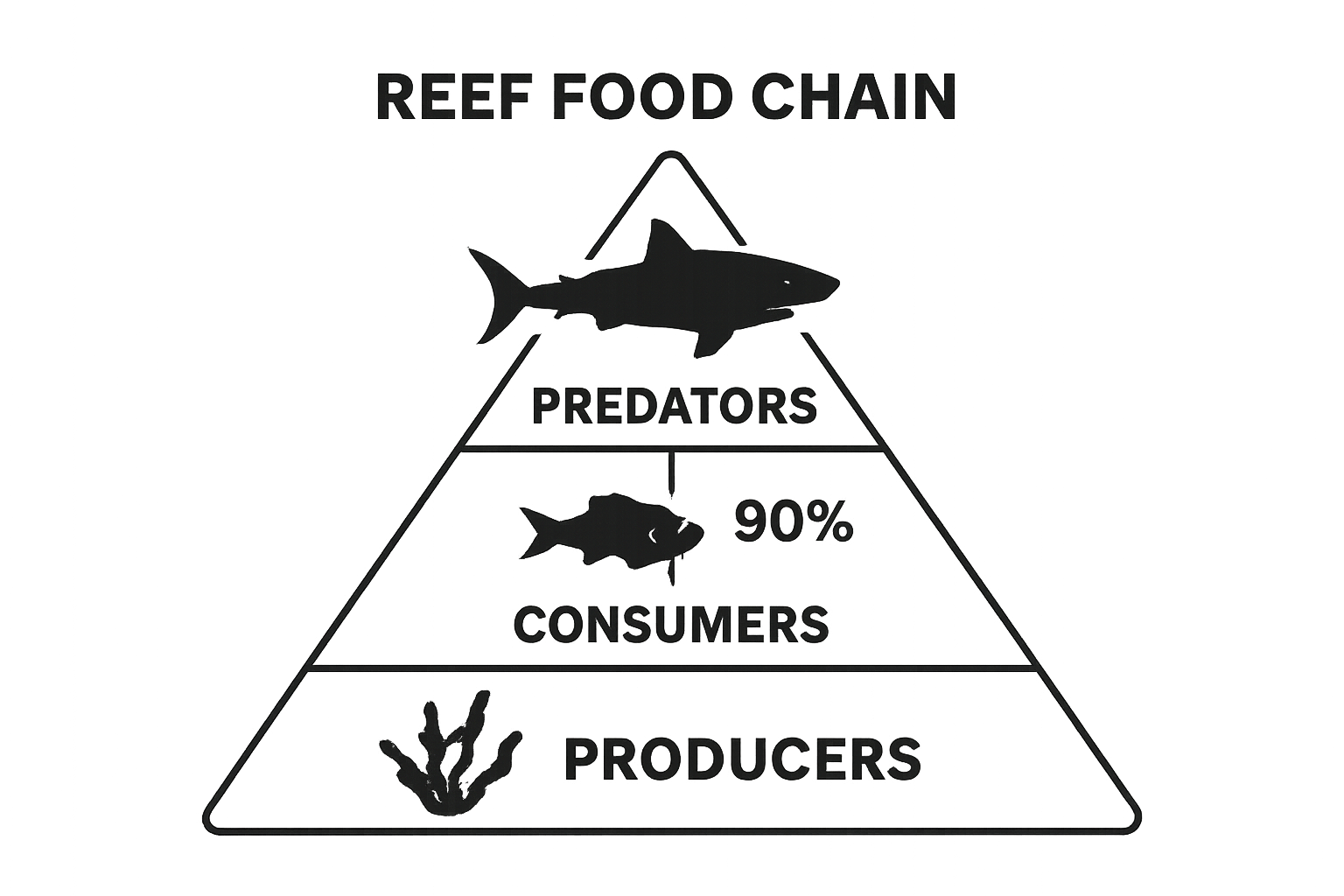
The energy transfer process follows a predictable pattern where approximately 10% of energy is transferred between consecutive trophic levels. This means that for every unit of energy produced by primary producers, only a fraction is available to organisms in higher levels, demonstrating the inherent efficiency and limitations of marine energy systems.
Trophic Level Progression
As energy moves through different trophic levels, organisms become increasingly specialized. Primary consumers like zooplankton and small herbivorous fish consume primary producers, converting plant-based energy into animal biomass. Secondary consumers such as smaller predatory fish then consume these primary consumers, further concentrating and transferring energy through the ecosystem.
Uncover the intricate patterns of marine energy dynamics that demonstrate how energy transforms and moves through complex marine systems. Understanding these mechanisms provides critical insights into ecosystem functionality and resilience.
Key characteristics of energy flow in reef food chains include:
- Hierarchical energy transfer
- Exponential energy reduction between levels
- Specialized consuming organisms
- Continuous nutrient recycling
- Ecosystem energy efficiency
The progression from primary producers to apex predators represents a remarkable demonstration of biological efficiency, where each organism plays a critical role in maintaining the delicate balance of marine ecosystems.
Human Impact on the Reef Food Chain: Challenges and Solutions
Human activities have profound and increasingly complex consequences for reef food chains, creating significant disruptions that threaten marine ecosystem stability. These interventions range from direct ecological manipulation to broader environmental changes that fundamentally alter marine biological interactions.
Direct Ecological Disruptions
Overfishing represents one of the most immediate human impacts on reef food chains. By selectively removing specific species, humans create cascading effects that destabilize entire trophic levels. Removing top predators like sharks and large groupers disrupts natural population controls, while eliminating intermediate consumers can trigger unexpected ecological imbalances. These interventions can cause dramatic shifts in species composition and ecosystem functionality.
This table highlights the major human-induced challenges to the reef food chain and the corresponding ecological effects identified in the article.
| Human Impact | Description | Resulting Ecological Effect |
|---|---|---|
| Overfishing | Removal of specific fish species, especially top predators | Destabilizes population control, leads to cascading food chain effects |
| Pollution | Introduction of chemicals, microplastics, and industrial runoff | Biomagnification, genetic mutations, species decline |
| Habitat Destruction | Physical damage to coral reefs and marine habitats | Reduces biodiversity, eliminates habitat for key species |
| Climate Change | Rising ocean temperatures, acidification, altered marine chemistry | Coral bleaching, loss of foundational species, disrupted energy transfer |
Pollution introduces another critical challenge, introducing contaminants that accumulate through biomagnification. Microplastics, chemical runoff, and industrial waste enter marine systems, becoming integrated into food chains and potentially causing genetic mutations, reproductive challenges, and long-term species decline.
Climate Change and Ecosystem Transformation
Climate change profoundly impacts reef food chains through temperature increases, ocean acidification, and altered marine chemistry. Rising ocean temperatures stress coral ecosystems, causing bleaching events that destroy critical habitat structures. These transformations compromise the foundational elements of marine food webs, reducing biodiversity and disrupting energy transfer mechanisms.
Explore the intricate dynamics of marine ecosystem interactions and understand how human activities create complex ecological challenges. Recognizing these interconnections is crucial for developing effective conservation strategies.
Key challenges in human-induced reef food chain disruption include:
- Systematic species population alterations
- Habitat destruction
- Biomagnification of pollutants
- Ecosystem structural changes
- Reduced biodiversity
Addressing these challenges requires comprehensive, multifaceted approaches that integrate scientific research, conservation efforts, and sustainable human practices. Protecting reef food chains demands global cooperation, advanced monitoring technologies, and a profound commitment to ecological preservation.

Give Your Reef Food Chain a Healthy Head Start
Have you noticed how the delicate balance of your marine ecosystem depends on every link in the reef food chain? When foundational species like phytoplankton and copepods are missing or low in quality, nutrient cycling breaks down and the entire ecosystem suffers. This article explained how essential primary producers and consumers are to reef stability. If your goal is greater biodiversity and vibrant coral and fish, the solution starts with live nutrition you can trust. Discover our Live Phytoplankton selection for tank-raised, nutrient-dense primary producers and see their impact.
Give your tank the science-backed foundation it deserves. Explore our Copepod Blends for balanced live nutrition, or visit PodDrop to find the perfect live cultures for your reef. Start supporting every level of your reef food chain today for a healthier, more resilient aquarium ecosystem.
Frequently Asked Questions
What is the reef food chain?
The reef food chain is a complex, interconnected system of energy transfer involving various organisms that depend on each other within a marine ecosystem. It starts with primary producers like phytoplankton and marine algae, which convert solar energy into biomass that supports higher trophic levels.
Why are primary producers important in the reef food chain?
Primary producers are crucial as they form the foundation of the reef food chain. They convert sunlight into chemical energy through photosynthesis, creating organic compounds that serve as the primary food source for all higher-level consumers in the ecosystem.
How does energy flow through different trophic levels in the reef food chain?
Energy flows through the trophic levels with approximately 10% efficiency between each level. Primary producers are consumed by primary consumers, which are then eaten by secondary consumers, and so forth, with a significant reduction in energy availability at each step.
What impact do human activities have on the reef food chain?
Human activities such as overfishing and pollution significantly disrupt the reef food chain. Overfishing removes key species, destabilizing the population balance, while pollution introduces harmful substances that can accumulate in the food chain, leading to ecological imbalances.