


Reef Tank Maintenance: reef tank maintenance tips for a thriving coral reef
- fabianbehague
- 3 days ago
- 15 min read
If you want a stable, beautiful reef tank, consistent maintenance is the one thing you can't skip. It’s not about having the most expensive gear or the rarest corals. Success comes down to the simple, repetitive tasks that keep problems from ever starting and maintain the delicate balance your tank’s inhabitants need to thrive.
Why Consistent Reef Tank Maintenance Is Non-Negotiable
The real secret to a stunning reef tank isn't some magic bullet; it's just a good old-fashioned routine. So many new hobbyists fall into the trap of reacting to disasters—a sudden algae bloom, a coral starting to recede, or a fish getting sick—instead of preventing them in the first place. This guide is all about building a proactive maintenance mindset, which is the core of successful reef keeping.
Small, consistent actions are your best defense against the usual headaches. Think of your reef as a finely tuned engine. Maintenance is the regular oil change that keeps it humming along. If you neglect it, you’re just waiting for a breakdown.
The Power of Stability
Corals and other marine life absolutely hate rapid changes. I can't stress this enough: a stable environment is far more important than chasing "perfect" water parameters that are constantly swinging up and down. Your goal is to create a predictable little world inside that glass box.
A solid maintenance routine makes this happen by:
Preventing Parameter Swings: Regular water changes and daily top-offs are key. They stop salinity, alkalinity, and other crucial elements from drifting into dangerous territory.
Removing Organic Waste: Getting fish waste and uneaten food out of the tank before they break down is huge. This stops them from turning into nitrate and phosphate, which are basically superfoods for nuisance algae.
Replenishing Essential Elements: Your corals are constantly using up calcium, alkalinity, and trace elements to build their skeletons. Your maintenance routine is how you put those vital building blocks back into the system.
A steady 10% water change every single week is infinitely better for your tank than a massive, sporadic 50% change that just shocks your corals. When it comes to reef tanks, consistency always wins.
From Reactive to Proactive
Once you commit to a maintenance schedule, you stop being a firefighter and become a true caretaker. Instead of scrambling to fix a tank that’s turned green and fuzzy, you’ll be doing simple tasks that prevent the algae from ever getting a foothold.
Take a simple daily observation, for instance. It takes five minutes. In that time, you can spot a powerhead that's stopped spinning or a coral that looks a little "off." Catching these things within hours, rather than days, can be the difference between a minor tweak and a full-blown tank catastrophe. Why wait for a problem to scream at you when a quick daily check-in can keep your ecosystem humming along in perfect harmony? This shift in thinking is what separates the struggling hobbyist from the successful one.
Decoding Water Chemistry for a Thriving Reef
Let's talk about the invisible force that governs everything in your tank: water chemistry. It can sound intimidating, but mastering your water parameters is the absolute bedrock of successful reef tank maintenance. Think of it less like a science experiment and more like learning the vital signs of your underwater world.
This is where many new reefers stumble. It’s a tough statistic, but historical data from the reefing community shows a staggering 75% of new tanks fail within the first year, almost always due to unstable chemistry. To put it another way, reef setups have a 40% higher failure rate than freshwater tanks simply because of the precision required. But that's not meant to scare you—it's to show that with a little consistency, you can easily buck that trend.
The Big Three: Alkalinity, Calcium, and Magnesium
These three are the essential building blocks for your corals' skeletons. They're locked in a delicate dance; if one is out of sync, it throws the others off. Keeping them balanced is one of the most important jobs you have as a reefer.
Alkalinity (dKH): If you only track one thing closely, make it this one. Alkalinity is the measure of carbonates and bicarbonates available for corals to build their skeletons, and they burn through it fast. A sharp drop can literally stop coral growth in its tracks and even cause tissue to peel back.
Calcium (Ca): This is the other key ingredient for skeletal growth. Corals pull calcium right out of the water. If your levels are too low, growth will grind to a halt, no matter how perfect your alkalinity is.
Magnesium (Mg): Think of magnesium as the referee between alkalinity and calcium. It prevents them from binding together and precipitating out of the water, which would make them useless to your corals. Low magnesium makes it nearly impossible to keep the other two where they need to be.
Nutrients: Nitrate and Phosphate
Nitrate and phosphate often get a bad rap, but they're not pure evil. In tiny amounts, they're essential nutrients for corals. The problem starts when they build up, becoming the primary fuel for every nuisance algae imaginable.
The goal isn't zero nutrients; it's balance. If you’re battling slimy cyano or that stubborn green hair algae, elevated nutrients are almost always the culprit. This is where consistent reef tank maintenance and testing save the day, letting you catch a spike before it turns into an algae farm. If you’re stuck in an algae war, our guide on reef aquarium phosphate levels can help you get things under control.
Here’s a piece of advice every seasoned reefer lives by: Stability is far more important than chasing a "perfect" number. A tank that holds a steady alkalinity of 8.5 dKH is infinitely healthier than one swinging between 7.5 and 10.0 dKH. Corals absolutely hate rapid change.
Your Water Testing Playbook
Think of your testing schedule as an early warning system. It empowers you to make tiny, gradual adjustments instead of big, stressful ones. How often you test really depends on your tank's age and how packed it is with corals.
For a new system (less than six months old), you’ll want to test more often as the biology settles in and your corals start consuming elements. Once your tank is mature and stable, you can relax the schedule a bit.
Essential Reef Tank Water Parameter Targets
Here's a quick-reference table to keep you on track. These are the ideal ranges for a typical mixed reef aquarium.
Parameter | Ideal Range | Testing Frequency |
|---|---|---|
Salinity | 1.025 - 1.026 sg | Daily/Weekly |
Alkalinity | 8.0 - 11.0 dKH | 2-3 times per week |
Calcium | 400 - 450 ppm | Weekly |
Magnesium | 1300 - 1400 ppm | Weekly to Bi-Weekly |
Nitrate | 2 - 10 ppm | Weekly |
Phosphate | 0.03 - 0.10 ppm | Weekly |
Temperature | 77 - 79°F | Daily |
Sticking to a schedule like this turns chemistry from a guessing game into a predictable routine. Once you understand what these numbers mean and how they influence each other, you're no longer just a tank owner—you're in direct control of your reef's health and beauty.
Your Actionable Reef Maintenance Calendar
This is where the rubber meets the road. We're taking all that theory about water chemistry and stability and turning it into a real, repeatable routine. A solid schedule is the absolute engine of a successful reef tank.
Don't think of this as a rigid set of rules, though. It's more like a flexible framework you can tweak to fit your own tank's personality.
A brand-new nano reef has totally different needs than a five-year-old, SPS-dominant system overflowing with coral colonies. The real key is finding a rhythm that works for you and your aquarium, turning these tasks into second nature instead of a dreaded chore.
Daily Tasks: Your 5-Minute Reef Check-In
Consistency is built on small, daily habits that honestly take less time than making your morning coffee. These quick visual scans are your best early-warning system, letting you spot small hiccups before they spiral into full-blown disasters.
Visual Health Inspection: Get your eyes on your fish and corals. Are the fish swimming and eating like they normally do? Are your corals fully open, showing off their best colors? Any red flags—like pinched fins on fish or retracted polyps on corals—mean you need to take a closer look.
Top-Off Evaporated Water: This one is completely non-negotiable. When water evaporates, the salt gets left behind, causing your salinity to creep up. Topping off every day with fresh RO/DI water keeps your salinity rock-solid, which is beyond critical for coral health. An auto top-off (ATO) system is easily one of the best quality-of-life upgrades you can buy for your tank.
Quick Equipment Check: Just a quick glance at your gear. Pumps, heater, skimmer—is everything humming along? Is the protein skimmer pulling out that nasty, dark gunk? A powerhead that's stopped spinning can create a dead spot and kick off an algae bloom in less than a day.
Weekly Tasks: The Core Maintenance Routine
Set aside 30 to 60 minutes once a week for the heavy lifting. This is your dedicated time to manage water quality and keep the tank looking sharp. Most reefers I know find a weekend morning is the perfect slot to get this done.
First thing's first: test your key water parameters before you do anything else. This gives you an honest snapshot of your tank’s weekly consumption and tells you if any dosing adjustments are needed. At a minimum, you should be testing for alkalinity, calcium, magnesium, nitrate, and phosphate.
With your numbers recorded, it’s cleaning time. Grab a magnetic scraper or a blade for the glass. If you've got an acrylic tank, please make sure you're using a scraper made specifically for it to avoid permanent scratches. While you're at it, give your powerheads a quick scrub with an old toothbrush to knock off any coralline algae and keep them pushing water efficiently.
This is also the perfect window for your water change—typically 10-15% of your tank’s total volume. For a 50-gallon tank, that's a simple 5 to 7-gallon change. Use a gravel vacuum to siphon water out while gently cleaning a section of your sandbed. This pulls out nasty detritus and helps replenish those vital trace elements.
Pro Tip: Right before you start siphoning, grab a turkey baster and gently blow water over your live rock. This dislodges all the trapped gunk, which then gets suspended in the water column and promptly removed during the water change. It seriously maximizes the cleaning power of your efforts.
Once the water change is done and the tank has cleared up, it's time to dose. If you manually add supplements for alkalinity, calcium, or other elements, now is the time. This is also a great weekly ritual for adding live nutrition like copepods or phytoplankton to boost your microfauna populations and give your corals and fish a natural, healthy meal.
Monthly Tasks: Deeper Cleaning and System Checks
Once a month, block out a bit more time—maybe one to two hours—to tackle the deeper maintenance that keeps your life support system running at peak performance.
This is your chance to give your equipment some real TLC.
Disassemble and clean your protein skimmer, paying close attention to the neck and collection cup. That’s where the crud builds up and kills its efficiency.
Clean your return pump and powerheads by giving them a good soak in a vinegar solution. This dissolves stubborn coralline algae and calcium deposits, restoring their flow back to factory-fresh levels.
Your filtration media needs attention, too.
Filter Socks or Floss: These should really be changed every few days, but the monthly check is a good backup to ensure nothing was missed.
Carbon and GFO: Plan on replacing these every 3-4 weeks. Once they're exhausted, they can actually start leaching phosphates back into your water.
Sump and Refugium: Gently siphon out any detritus that has settled in the bottom of your sump. If you run a refugium, now is a great time to prune back about one-third of your macroalgae to physically export those absorbed nutrients.
This calendar gives you a solid foundation to build from. I highly recommend keeping a logbook or using an app to record your test results and any observations. Over time, this data will paint a clear picture of your reef's unique rhythm, allowing you to fine-tune your routine for a stunning, thriving aquarium.
Keeping Your Reef Tank Equipment in Peak Condition
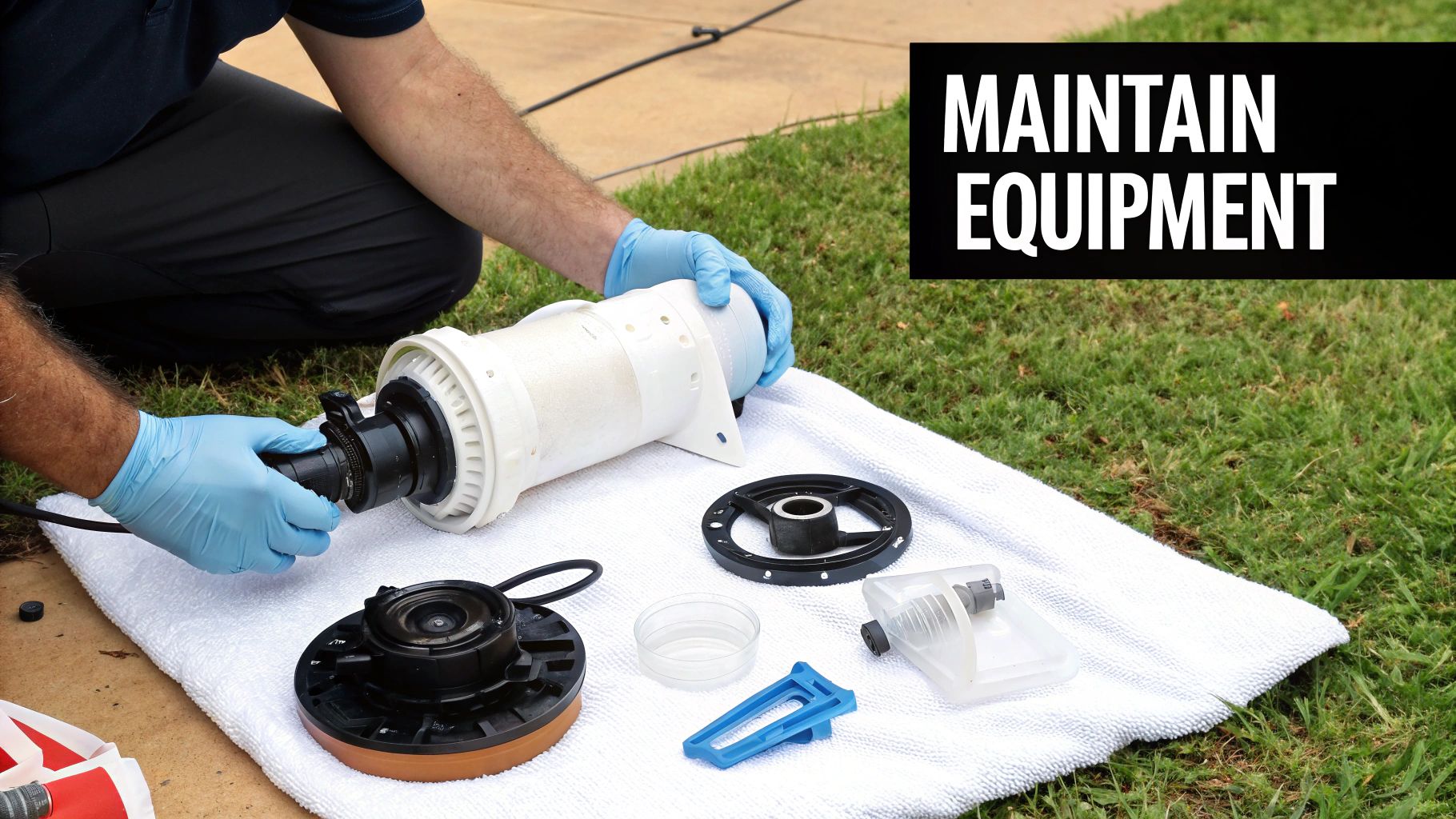
Your equipment is the life-support system for your reef. It’s easy to overlook, but letting its care slide is a direct path to problems down the road. When a pump loses flow or a skimmer stops pulling gunk, it doesn't just lower efficiency—it slowly chips away at the stability you work so hard to maintain.
Think of this as preventative care. Clean hardware isn't just for show; it's all about performance. A dirty pump can lose up to 50% of its flow rate, which is a recipe for dead spots where detritus settles and algae begins its takeover. This is our practical, no-nonsense guide to keeping your tank’s vital hardware running like new.
Mastering Protein Skimmer Maintenance
Your protein skimmer is your first line of defense against the nasty stuff—all that organic waste. To keep it working like a champion, you’ve got to give it consistent attention. Empty and clean the collection cup every few days. Seriously, don't let that gunk sit there for a week.
Every month or two, it’s time for a deep clean. This means taking the whole thing apart and giving every piece a thorough scrub. Pay extra attention to the skimmer's neck; any buildup of grime there will kill its ability to produce foam. The venturi, that little part that pulls air into the pump, is another classic clog spot for salt creep. If it gets blocked, it chokes the air supply and cripples performance.
Filtration systems are the backbone of proper reef tank maintenance, and their importance is reflected in the market. They're the fastest-growing segment, projected to expand at a rate of over 4.7% through 2032. For a typical 100-gallon tank, a well-tuned skimmer can pull out 1-2 liters of concentrated waste every single week, stopping it from fueling algae and bacteria.
Reviving Your Pumps and Powerheads
Water flow is life in a reef tank, and your pumps are the heart of the system. Over time, they get caked in coralline algae, biofilm, and calcium deposits. This gunk chokes their output and puts a ton of unnecessary strain on the motor.
A simple vinegar bath is your best friend here.
First, unplug and pull the pump or powerhead out of your tank.
Take it apart as much as you can, making sure to remove the impeller.
Soak all the parts in a 50/50 solution of white vinegar and water for a few hours.
Grab an old toothbrush and scrub away any stubborn buildup.
Finally, rinse everything really well with fresh water before putting it back together and back in the tank.
A common headache is a rattling powerhead. Before you assume it's broken, check the impeller. More often than not, a tiny snail shell or a piece of debris gets lodged inside, causing all that noise. A quick clean usually fixes it instantly.
Plan on doing this deep clean every two to three months. It doesn't just bring back lost flow; it also extends the life of the pump’s motor by letting it run cooler and more efficiently.
Calibrating Heaters and Probes
Your controllers and heaters are the brains of the operation, but they're only as good as the information they're getting. Probes for pH, temperature, and ORP can drift over time, giving you bad readings. This can lead to sketchy dosing decisions or, even worse, dangerous temperature swings.
Make it a monthly habit to calibrate your probes using the manufacturer's instructions. It’s a quick job that ensures your automated systems are actually helping, not hurting, your reef. While you're at it, give your heater a once-over. A busted heater is one of the fastest ways to wipe out an entire tank.
Check the set point: Does the temperature on your controller match a reliable, calibrated thermometer you trust?
Inspect for damage: Look for any cracks, condensation inside the glass, or signs of corrosion on the cord.
This same logic applies to all the gear in your sump. For instance, the lighting in a refugium needs regular checks to ensure it’s putting out the right spectrum for your macroalgae to grow. If you're looking to get the most out of that part of your filtration, our refugium in sump guide for a thriving reef tank has a lot more detail. At the end of the day, consistent equipment care is the ultimate proactive step in your reef tank maintenance schedule.
Solving Common Problems in Reef Keeping
Let's be real—even with a perfect reef tank maintenance schedule, things will go wrong. Problems are going to pop up. But instead of seeing this as a failure, you should think of it as your tank trying to tell you something.
Learning to read the signs, whether it's a new patch of algae or a coral that just looks off, is a fundamental skill in this hobby. The real trick is to hunt down the root cause instead of just treating the symptom you see on the surface.
Most issues in a reef tank trace back to just a few usual suspects: too many nutrients, unstable water chemistry, or not enough flow. Once you learn to connect the dots between the problem and its source, you can find a lasting fix instead of fighting the same battle week after week. This is your field guide for figuring out what’s wrong and how to fix it.
Diagnosing and Defeating Nuisance Algae
At some point, almost every reefer declares war on nuisance algae. It’s an eyesore that can quickly smother beautiful corals and just ruin the whole vibe of your tank. The good news is that each type of algae tells a specific story about what's going on in your water.
Green Hair Algae (GHA): This is the classic billboard for high nitrates and phosphates. You'll often see it spring up in low-flow areas where detritus gathers and rots. The fix requires a multi-front attack: beef up your cleanup crew, get more aggressive with siphoning detritus during water changes, and maybe run a media reactor with GFO (Granular Ferric Oxide) to pull phosphates directly out of the water.
Cyanobacteria (Red Slime Algae): Those slimy, dark red sheets that peel off rocks and sand aren't actually algae—they're bacteria. Cyano loves low-flow dead spots and feeds on excess dissolved organics. The old-school method still works wonders: a three-day blackout, siphoning out as much of the slime as you can, and cranking up your powerheads to eliminate those dead spots. For a deeper dive, check out our complete guide on how to get rid of cyanobacteria in a reef tank for good.
A common mistake is to only treat the algae you can see. The real victory comes from identifying and correcting the imbalance that allowed it to grow in the first place. You're not just weeding the garden; you're improving the soil.
Understanding Coral Health Issues
When a coral looks unhappy, it’s a flashing red light that something in its environment is out of whack. You have to act fast, because a coral's health can spiral downward quickly once stress sets in. The two biggest headaches you'll likely face are bleaching and tissue recession.
Coral BleachingBleaching is what happens when a coral gets so stressed that it kicks out its symbiotic zooxanthellae, turning it pale or bone-white. This is a serious stress response, and it's usually triggered by one of two things:
Temperature Swings: A heater that's on the fritz or a summer heatwave can easily push your tank's temperature outside the happy range of 77-79°F.
Lighting Shock: Dropping a new coral straight into a high-light spot without letting it acclimate is a surefire way to cause bleaching.
If you spot a bleaching coral, your first move is to check the thermometer. If the temp is stable, try dialing back your light intensity by 20-30% or moving the coral to a shadier, lower spot in the tank to give it a chance to recover.
Slow Tissue Necrosis (STN) and Rapid Tissue Necrosis (RTN)This is the sight every reefer dreads: the coral’s living tissue just peeling away from its skeleton. It can happen slowly over weeks (STN) or terrifyingly fast in a few hours (RTN).
The number one cause is almost always a sharp swing in a major water parameter, and alkalinity is the most common culprit. A sudden drop or spike in dKH is a classic trigger for tissue loss, especially in SPS corals. If you see STN starting, grab your alkalinity test kit immediately. Consistent reef tank maintenance and testing are your best defenses against this devastating problem.
Your Reef Tank Maintenance Questions Answered
Even with the best guides, the real questions start popping up once your hands are wet. These are the nitty-gritty, practical details that often make the difference between a thriving reef and a tank full of headaches. This is where we tackle those common points of confusion and help you sidestep some costly mistakes.
Think of this as the troubleshooting section of your maintenance manual—the place for direct, no-nonsense answers to the "what-ifs" and "how-tos" every reefer eventually asks.
How Much Water Should I Actually Change and How Often?
The classic 10-20% weekly water change is a fantastic baseline, and for good reason—it just works. If you've got a lightly stocked tank with a few corals, 10% a week is usually plenty to replenish key elements and keep nitrates from creeping up. On the other hand, a system packed to the gills with SPS corals might demand a more substantial 20% change just to keep up with how fast the corals are consuming elements.
But here’s the real secret: consistency always beats volume.
A steady 10% water change performed like clockwork every single week is infinitely better than a massive, sporadic 50% change whenever you get around to it. Those huge, infrequent changes can seriously shock your corals and throw the tank's delicate biological balance into a tailspin.
Can I Just Use Dechlorinated Tap Water for My Tank?
Let's make this simple: absolutely not. This is a hard "no," and it’s one of the most critical rules for success in this hobby. Using tap water is arguably the number one mistake that sends new reefers down a path of failure and frustration.
Your tap water is a cocktail of things you don't want in a reef tank—phosphates, nitrates, silicates, and often heavy metals. A simple dechlorinator only gets rid of the chlorine, leaving behind a buffet of nutrients for every type of nuisance algae you can imagine. You must use Reverse Osmosis Deionized (RO/DI) water, which is purified down to 0 Total Dissolved Solids (TDS).
An RO/DI unit isn’t an optional accessory; it's a foundational piece of equipment. Investing in one from day one will save you countless hours and dollars fighting algae battles you were destined to lose.
What Is the Best Way to Clean the Sandbed?
The key to a clean, healthy sandbed is gentle and consistent upkeep, not aggressive deep cleaning. When you do your weekly water change, just use a gravel vacuum to lightly skim the very top layer of sand. The trick is to focus on just one section of the tank each week.
Whatever you do, never dig deep into the sandbed. You risk disturbing the beneficial bacteria living there and, worse, potentially releasing toxic gas pockets that have built up over time. By cleaning a different small section each week, you’ll have maintained the entire sandbed over the course of a month without ever shocking the system.
Your "clean-up crew" is your day-to-day partner in this job.
Nassarius Snails: These guys are fantastic for stirring the top layer of sand as they hunt for leftover food.
Sand-Sifting Gobies: A Diamond Goby is a workhorse, constantly sifting sand through its gills, keeping it clean and oxygenated.
When you pair this light, weekly vacuuming with a reliable clean-up crew, you stop detritus from building up in the first place. That’s how you get that bright, healthy sandbed you're aiming for.
Fuel your reef with the best live nutrition. PodDrop Live Aquarium Nutrition provides lab-cultured copepods and phytoplankton to boost biodiversity and make your corals pop. See the difference life makes at https://www.getpoddrop.com.
Comments