

Your Guide: cleanup crew for saltwater tank to boost reef health
A good cleanup crew for a saltwater tank is way more than just a random assortment of snails and crabs—it's a living, breathing maintenance team. Think of them as your first line of defense against the daily grime of reefkeeping, tackling nuisance algae, leftover food, and all the gunk that builds up, keeping your aquarium balanced and beautiful.
Why a Cleanup Crew Is Your Reef Tank's Unsung Hero
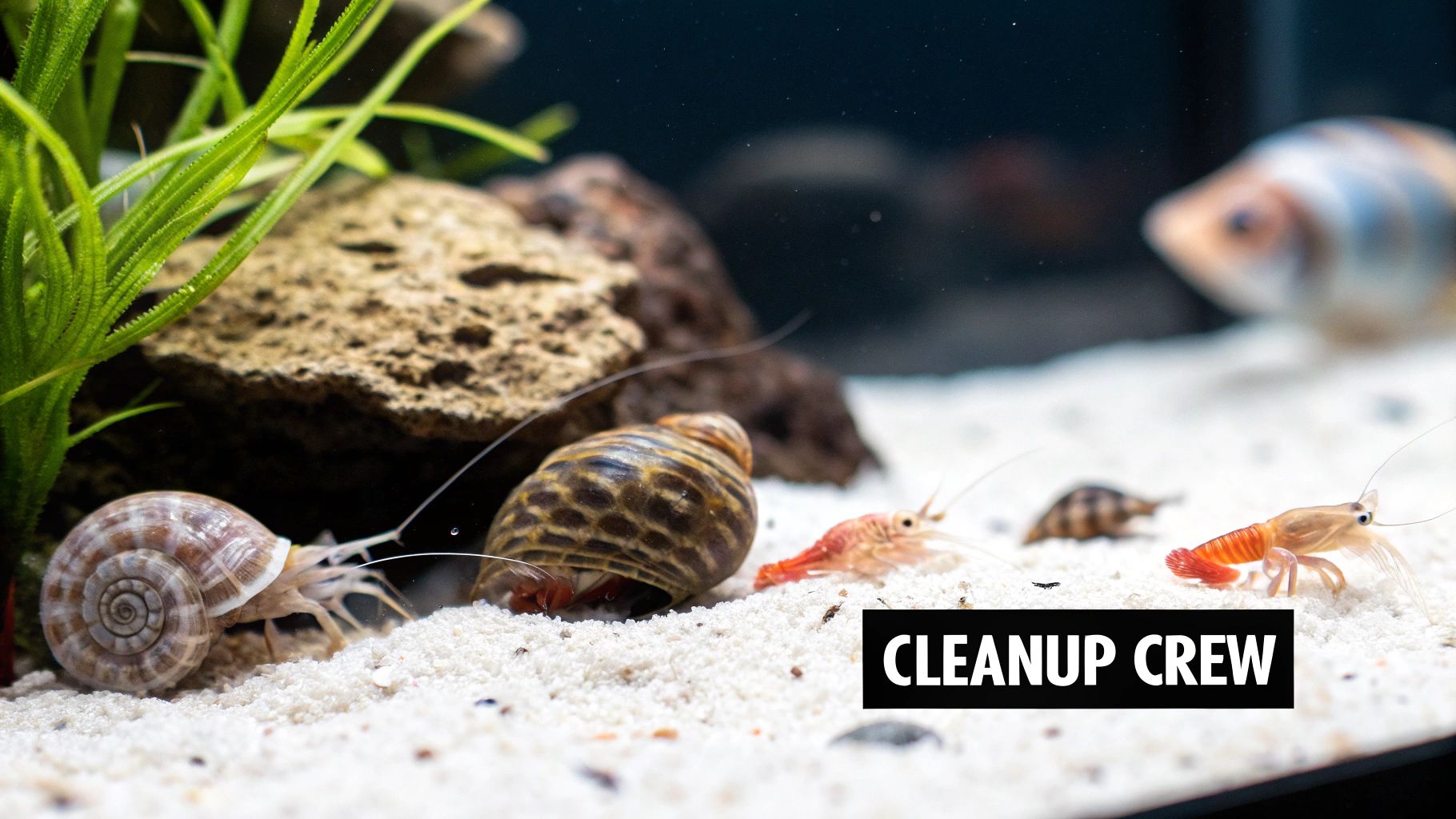
Your reef tank is its own little world, a self-contained ecosystem in your living room. And just like on a natural coral reef, waste is a constant—fish food, fish poop, and other organics are always breaking down. Without a dedicated team to manage this mess, things can get out of hand, fast.
This is where your invertebrate janitors really shine. They are the unsung heroes working around the clock, handling the critical tasks that make or break the stability and beauty of your display. A well-chosen crew means you'll be doing a lot less manual labor. Less scraping glass, less siphoning sand, and more time enjoying a healthier environment for your fish and corals.
The Core Jobs of a Cleanup Crew
An effective crew does a lot more than just tidy up; they actively improve your water quality and the function of the entire ecosystem. Here's a quick rundown of their main duties:
- Algae Management: They are constantly grazing on all sorts of algae, from the annoying film on the glass to that stubborn hair algae that pops up on your live rock.
- Detritus Breakdown: These critters are experts at finding and eating uneaten food and fish waste, breaking it down into less harmful stuff before it has a chance to pollute your water.
- Sand Bed Aeration: Snails like the Nassarius are fantastic for burrowing through the sand. This simple action prevents the sand bed from compacting and stops dangerous anaerobic "dead zones" from forming.
The difference is night and day. A tank without a proper cleanup crew often becomes a constant battle against algae, demanding endless intervention from you. On the other hand, a tank with a balanced crew is more resilient, far more stable, and just plain looks better.
A thriving cleanup crew is a clear indicator of a healthy, balanced reef aquarium. Their activity not only maintains aesthetics but also supports the intricate food web, turning waste into a resource.
This natural, ecosystem-based approach to tank maintenance is getting more and more popular for a reason. Hobbyists are increasingly looking to create self-sustaining systems, driving demand for products that mimic these natural cycles. You can explore more data on the growing market for aquarium cleaning solutions to see just how big this trend has become.
Building Your Algae and Detritus Dream Team
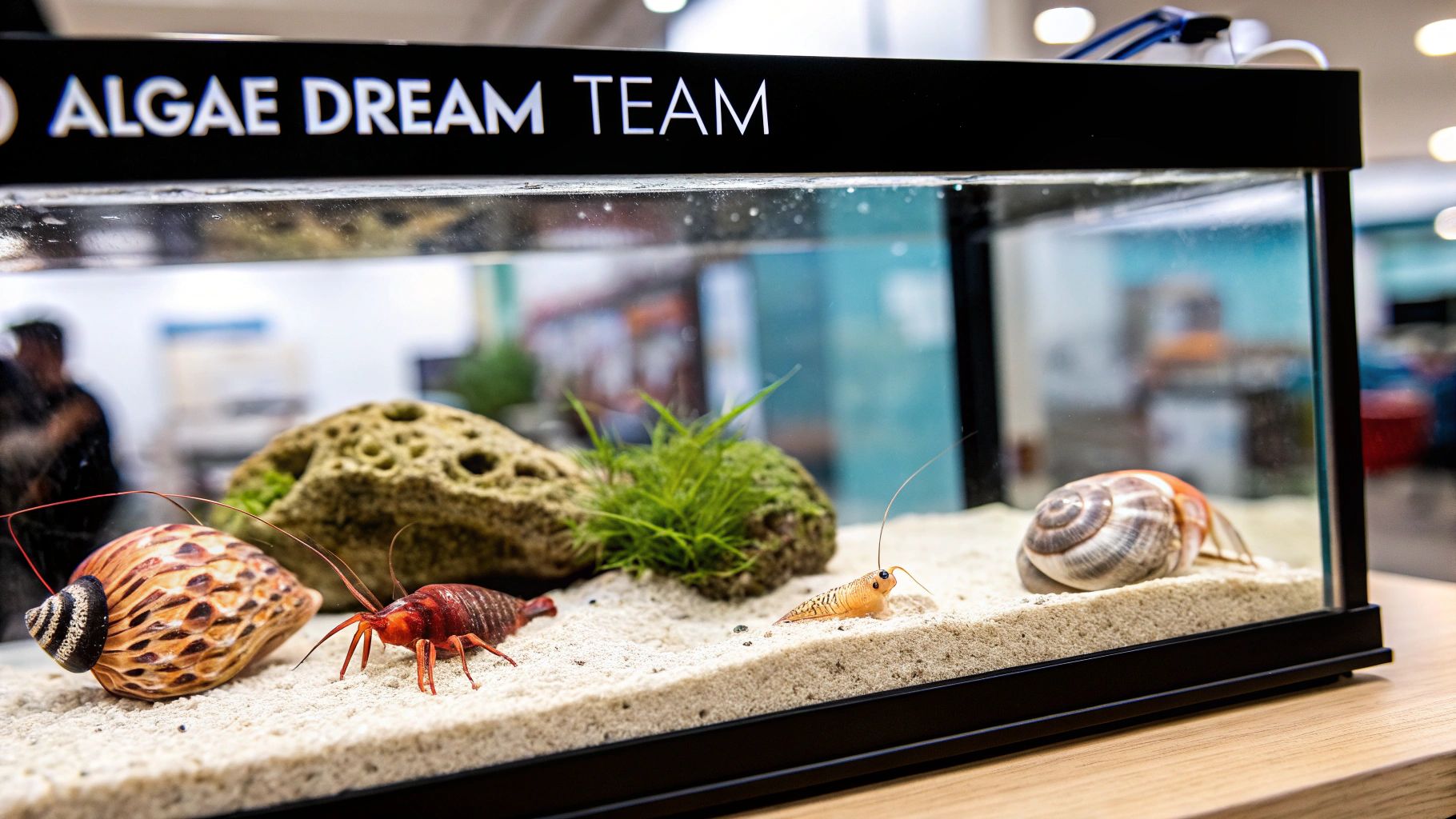
Putting together the right cleanup crew for a saltwater tank isn't about grabbing a pre-packaged "reef kit" off the shelf. Think of it more like casting the perfect team for a job. Every tank has its own personality and its own problems, so the most effective crews are hand-picked, with each member chosen for a specific skill. The one-size-fits-all approach almost always leaves you with gaps in your cleaning coverage or, even worse, starving invertebrates.
A better way to think about it is by zones: the glass, the rockwork, and the sand bed. Each area needs a specialist. By picking the right critters for each zone, you create a powerhouse team that works together, leaving no corner of your reef untouched. This is the real secret to a crew that doesn't just get by, but actually makes your tank sparkle.
The Glass Grazers and Rock Workers
Your aquarium glass and live rock are prime real estate for ugly algae films and diatoms. This is where your heavy-hitting herbivores get to work, constantly mowing down new growth before you even notice it's there.
-
Trochus Snails: These guys are the undisputed champions of glass cleaning. Their pyramid-shaped shells are perfect for getting into tight corners, and they have an insatiable appetite. Best of all? If they tumble off the rockwork, they can usually flip themselves back over—a huge advantage over other snails.
-
Cerith Snails: With their long, corkscrew shells, Ceriths are the detail-oriented members of the team. They're fantastic at digging algae out of tiny crevices in your rockwork. They also like to burrow just under the surface of the sand, which helps keep the top layer stirred up.
-
Astrea Snails: Another fantastic glass cleaner, Astrea snails are film algae machines. Their one weakness is that they're terrible at righting themselves. If you see one upside down on the sand, it's pretty much stuck until you give it a helping hand.
Masters of the Sand Bed
Keeping your sand bed clean is absolutely critical for a healthy reef. It prevents detritus from building up and turning into a nitrate and phosphate factory. The best sand-sifters are the ones that work tirelessly, keeping everything turned over and pristine.
Nassarius snails are the superstars here. You’ll barely see them, as they spend most of their time buried in the sand. But the second you drop food in the tank, they shoot out like little periscopes. This constant burrowing is exactly what you want—it keeps the sand bed aerated and consumes leftover food and waste before it can rot. They are a must-have for any tank with sand.
Now, let's put this into a quick reference guide. Choosing your crew is all about matching the right invert to the right job.
Your Saltwater Cleanup Crew Roster
This table breaks down some of the most popular crew members and what they're best at tackling.
| Crew Member | Primary Role | Best For Targeting | Reef Safety Note |
|---|---|---|---|
| Trochus Snail | Glass & Rock Grazer | Film Algae, Diatoms | Very Reef Safe: Rarely bothers corals. Self-rights if it falls. |
| Cerith Snail | Detail Cleaner | Algae in Crevices, Surface Detritus | Very Reef Safe: Great for both rocks and the sand surface. |
| Nassarius Snail | Sand Sifter | Leftover Food, Buried Detritus | Very Reef Safe: Stays in the sand, excellent at preventing waste buildup. |
| Emerald Crab | Specialist | Bubble Algae | Mostly Reef Safe: Can get opportunistic if hungry; keep well-fed. |
| Peppermint Shrimp | Pest Control | Aiptasia Anemones | Mostly Reef Safe: Can sometimes pick at fleshy LPS corals if underfed. |
| Scarlet Reef Hermit | Scavenger | Leftover Food, Film Algae | Mostly Reef Safe: Less aggressive than other hermits, but needs spare shells. |
This isn't an exhaustive list, but it's a solid foundation for building a crew that truly works for your tank.
Specialized Problem Solvers
Sometimes, you need to call in a specialist for a particularly annoying pest. While your general crew keeps things tidy, these critters are hired guns for specific problems.
-
Peppermint Shrimp: Famous for one thing: eating the pest anemone Aiptasia. If you've got an outbreak, a small group of these shrimp can often wipe it out without you having to resort to chemical treatments.
-
Emerald Crabs: The go-to solution for bubble algae. This nasty green algae can quickly cover your rockwork, and Emerald Crabs are one of the few things that reliably eat it. They're generally safe, but a hungry crab might get bold, so make sure they have enough to eat.
-
Hermit Crabs: Hermits are fantastic little scavengers, but they come with a catch. As they grow, they need bigger shells to move into. If you don't provide a variety of empty shells, they might decide to evict one of your snails to take its home. Scarlet Reef Hermits are known to be more peaceful, while Blue Leg Hermits are great workers but can be a bit more feisty.
While this army of invertebrates is the foundation of your cleanup efforts, don't forget that some fish can be amazing helpers, too. To see who might be a good fit to support your crew, check out our guide to saltwater aquarium algae-eating fish.
How to Calculate Your Crew Size Correctly
One of the quickest ways to mess up a new cleanup crew for a saltwater tank is to simply get the numbers wrong. It's a classic rookie mistake. Overstocking is a huge pitfall; you end up with too many mouths to feed, which leads to starvation, death, and more waste than you started with. But understocking is just as bad, leaving your crew totally overwhelmed and your algae problems raging on.
First things first, throw out that simplistic "one snail per gallon" rule you might have heard. A reef tank is a living, breathing ecosystem, and its needs are far more dynamic than any simple formula can capture.
What really matters? The maturity of your tank, its bioload (how many fish are you feeding?), and the specific type of nuisance algae you're dealing with. A brand-new tank with a light dusting of diatoms has a completely different carrying capacity than a year-old reef battling green hair algae.
Starting with a Solid Baseline
A much smarter way to go about it is to start conservatively. Think of it as hiring a small, efficient team first and then bringing on specialists as needed. This approach avoids the classic boom-and-bust cycle where a massive crew demolishes all the algae in a week and then promptly begins to starve.
For a new tank, a skeleton crew is the perfect starting point. This gives them time to settle in and get to work without immediately running out of food.
- Snails: A good starting point is about one small snail (like a Cerith or Nassarius) for every two to three gallons of tank volume.
- Hermit Crabs: Go even lighter here. Add one small hermit crab for every five to ten gallons.
This initial team is just there to handle the light film algae and diatoms that are common in new systems. You're building a foundation, not launching an all-out assault.
Remember, the goal of a cleanup crew isn't to be a magic bullet for a massive algae outbreak. They are your maintenance team, designed to prevent problems from ever getting out of hand. Think of them as dedicated gardeners, not a squad of exterminators.
Adjusting for Your Tank's Unique Needs
Let your tank run with this initial crew for a month or two. Now, you get to play detective. Observe your tank closely. Is that film algae still creeping back onto the glass a day after you scrape it? Are you starting to see little patches of hair algae popping up on the rockwork? These are your cues. These are the signals that it might be time to slowly expand the team.
Let's use a real-world example. Say you have a 40-gallon tank. Your starting crew might have been 15 snails and 4 hermit crabs. If you're now seeing consistent algae growth that they can't keep up with, you could add another 5-10 snails. But be strategic—pick species that target your specific problem. Adding a few Trochus snails for that glass film or a single Emerald Crab for bubble algae are targeted, intelligent additions, not just throwing more bodies at the problem.
This gradual, observational approach allows your tank's biological filter to adjust to the new additions and, more importantly, ensures your crew always has a sustainable food source.
The Role of Microfauna
Don't forget about the invisible workforce. Beyond the snails and crabs you can see, a truly healthy reef tank is teeming with a bustling population of microfauna like copepods and amphipods. These tiny crustaceans are the microscopic janitors of your reef, getting into every nook and cranny to consume detritus and phytoplankton in places your larger crew members can’t even dream of reaching.
A thriving "pod" population is one of the best signs of a mature and stable ecosystem. As a bonus, they're an incredible, natural food source for picky fish like mandarins and many corals. You can kickstart this vital workforce by seeding your tank directly. If you want to dive deeper into this crucial layer of your cleanup crew, our guide on how to add copepods to a tank breaks down the entire process. This hidden workforce is the perfect complement to your larger, more visible crew members.
Acclimating and Caring for Your New Janitors
Your new janitors have arrived, and their first few hours in your care are without a doubt the most critical. Here’s a hard truth: invertebrates are far more sensitive to changes in water chemistry—especially salinity—than fish are. Just floating the bag and dumping them in is a recipe for disaster.
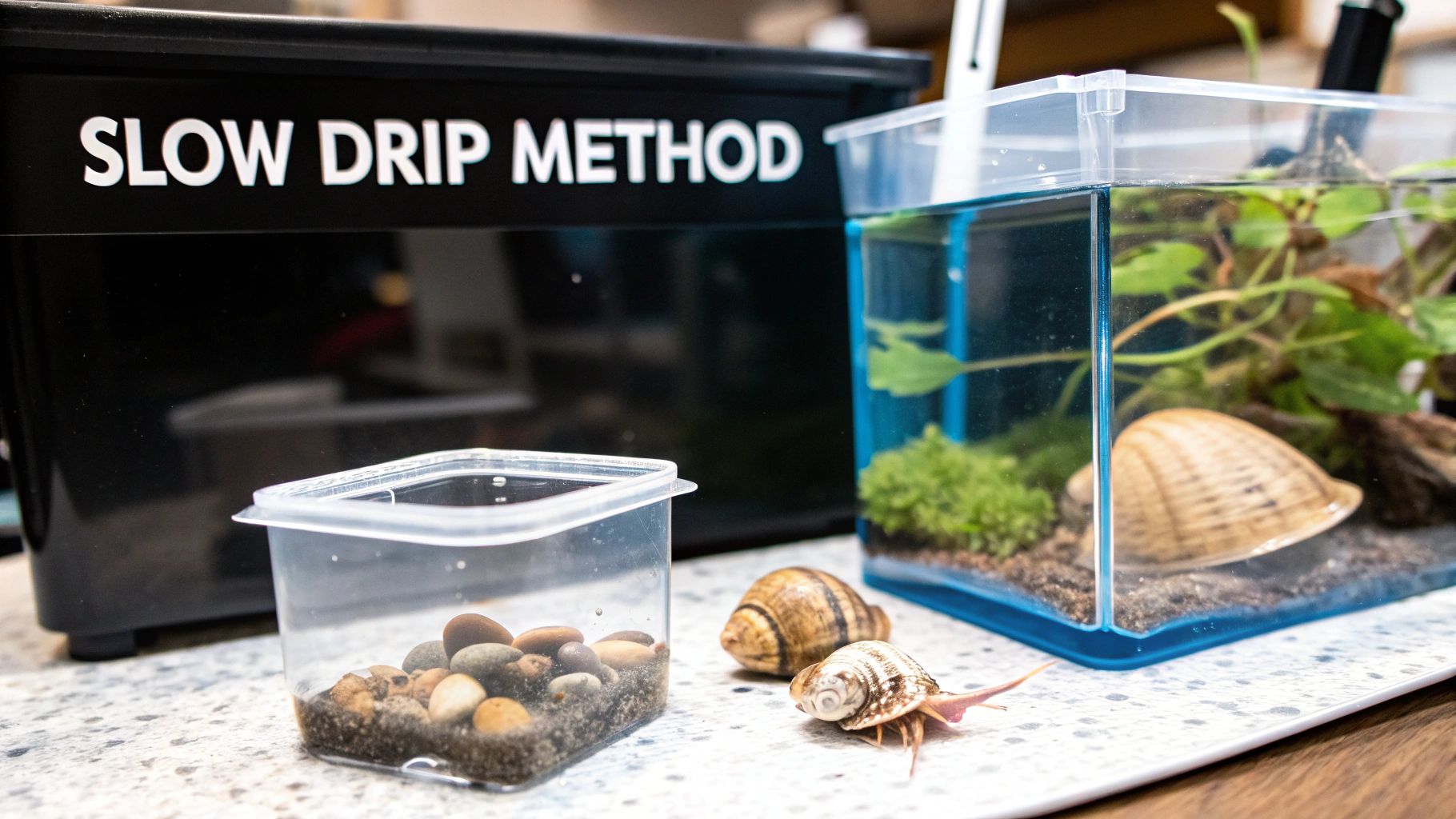
The gold standard for introducing any cleanup crew for a saltwater tank is drip acclimation. This slow, gentle process gradually equalizes the water from their shipping bag with your tank's water, preventing deadly osmotic shock.
It's not complicated. Just place your new arrivals in a small container and use airline tubing with a valve to start a slow drip from your main tank. You're aiming for just 2-4 drips per second. Let this run for at least an hour, or until the water volume in their container has doubled. This patience pays off with much, much higher survival rates.
The Overlooked Step of Quarantine
I know it’s tempting to get your new crew straight into the display tank to start cleaning. But trust me on this one: quarantining is a wise practice that can save you a world of headaches down the road.
A separate, small quarantine tank lets you observe them for a few weeks. This is your absolute best defense against introducing pests like nuisance algae, pyramidellid snails that prey on clams, or even fish diseases that can hitch a ride.
A simple 5-gallon setup is all you need. It doesn't have to be fancy—just a heater, a small powerhead, and a piece of PVC for hiding. Think of it as a safety net that ensures only the animals you want are making it into your pristine reef environment.
Long-Term Care and Feeding
Once they’re successfully introduced, your crew will get right to work. But what happens when they're too good at their jobs? In many clean, mature tanks, the natural food supply of algae and detritus runs low, leading to a starving cleanup crew. A lethargic crew is almost always a hungry one.
Pay close attention to your invertebrates' behavior. Active Nassarius snails burrowing in the sand and Trochus snails busy on the glass are good signs. If they become inactive or start congregating near the water line, it may be a sign they need supplemental food.
Don't let them starve. Giving them some extra food is simple and essential for their long-term health.
- Offer Nori: A small piece of dried seaweed (nori) clipped to the glass or a rock is a favorite for many snails and hermit crabs.
- Use Sinking Pellets: Specialized pellets for invertebrates or even algae wafers are another great option that ensures everyone gets a bite.
- Maintain Microfauna: A healthy population of copepods provides a continuous, natural food source for your entire tank, especially the smallest members of your crew.
Feeding them intentionally once or twice a week ensures your crew remains a productive part of your ecosystem, not just another source of waste. If you're interested in providing a sustainable food web, learning how to culture copepods at home is a game-changer.
Solving Common Cleanup Crew Problems
Even the most carefully planned cleanup crew can hit a snag. But don't think of it as a failure. Instead, see it as a chance to get a better read on your reef's delicate balance. A little proactive troubleshooting is all it takes to keep your invertebrate team healthy and effective.
What's Up With My Hermit Crabs?
One of the most common complaints I hear involves hermit crabs and their snail tank mates. If you're finding a graveyard of empty snail shells while your hermits look fat and happy, you’ve got a classic hermit crab housing crisis on your hands. As they grow, they need bigger shells. If there are none to be found, they'll happily evict a snail to take its home.
Thankfully, the fix is simple: add a variety of empty, larger shells to the tank. Just scatter them across the sand bed. This gives your hermits plenty of real estate options and takes the pressure off your poor snails.
My Crew Is Lazy (or Disappearing)!
So what happens when your once-busy crew seems to be slacking off, or worse, members start to vanish? This usually points to one of two things: they’ve either done too good a job and run out of food, or something in the tank is eating them. More often than not, an inactive crew is just a hungry crew.
If your tank is pristine, it’s probably time to supplement their diet. Tossing in some nori or a few sinking pellets once or twice a week usually does the trick. But if snails are straight-up disappearing, you might have a hidden predator. Certain fish, like many wrasses and hawkfish, see small inverts as a buffet. It could even be a hitchhiker crab that snuck in on your live rock.
The Sudden Snail Die-Off
A sudden, mass snail die-off is a huge red flag. This almost always points directly to a serious water quality issue. Snails, particularly sensitive species like Astrea, are the classic "canaries in a coal mine" for a reef tank.
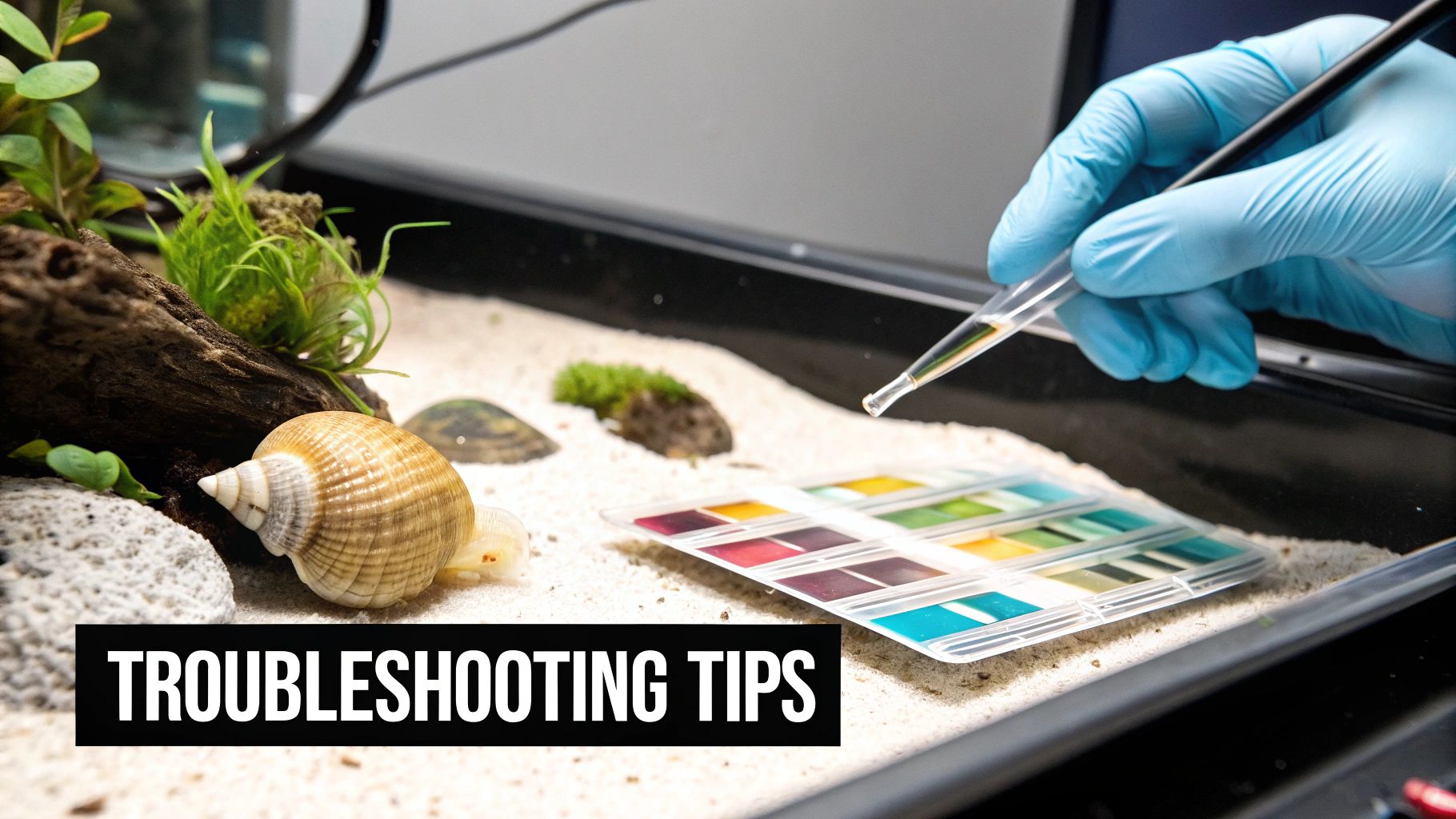
If you find yourself in this situation, grab your test kits immediately. You need to check:
- Salinity: Did a water change or auto-top-off malfunction cause a sudden swing?
- Temperature: Is your heater working properly? Stability is everything.
- Ammonia/Nitrite: A spike here means your biological filter is in trouble.
- High Nitrates: While less immediately lethal, nitrates consistently above 20 ppm will stress and weaken invertebrates over time.
A stable environment is completely non-negotiable for a healthy cleanup crew. Invertebrates just can't handle rapid swings in salinity or temperature, making slow acclimation and consistent tank maintenance absolutely critical for their survival.
This need for stability and health isn't just about our tanks. With an estimated 6–7 million reef hobbyists around the world, our demand for these critters is significant. This has thankfully pushed the industry toward aquaculture and more sustainable collection practices to protect wild reefs. You can read more about these efforts in the global aquarium trade and see how being a responsible hobbyist makes a real difference.
By catching problems early and keeping your system stable, you’re not just solving a problem—you’re ensuring your cleanup crew for a saltwater tank will thrive for years to come.
Got Cleanup Crew Questions? We’ve Got Answers.
Even with the best plan, you're going to have questions. It’s just part of the hobby. After years in the reefing community, I've seen the same handful of questions pop up time and time again, from first-timers and seasoned pros alike.
Let's dive into some of the most common ones. Getting these cleared up will help you manage your crew with confidence.
How Often Should I Add More Crew Members?
There's no magic formula here. The honest answer? Your tank will tell you when. The goal is a stable, effective team, not just constantly throwing more critters in. You'll naturally lose some snails over time—many common species live for one to three years—and that's perfectly normal.
The best way to know it's time for a top-off is to just look at your tank. Are you starting to see a slow, creeping return of that pesky film algae on the glass? Is a little more detritus building up in the corners of your sand bed? Those are the classic signs that your crew has thinned out a bit.
When you see this, it’s probably time to add a few more snails or hermits. But don't go overboard. Add them in small, targeted groups, not a massive new army. This prevents a sudden spike in your system's bioload.
A great habit to get into is doing a quick "headcount" every couple of months. For most established tanks, a small top-off once or twice a year is pretty standard. This keeps the cleaning power consistent without draining the available food supply.
Can My Cleanup Crew Fix a Huge Algae Outbreak?
Let me be blunt: no. Your cleanup crew for a saltwater tank is the janitorial staff, not the emergency response team. One of the most common—and expensive—mistakes I see is someone trying to solve a massive hair algae bloom by dumping 50 new snails into their tank.
A major algae outbreak isn't a cleaning problem; it's a symptom of a deeper issue, almost always boiling down to excess nutrients like nitrates and phosphates.
Throwing a huge crew at the problem won't fix the root cause. In fact, it usually backfires spectacularly. The new additions devour what they can, then quickly starve and die, releasing all those nutrients right back into the water and fueling an even worse algae bloom.
If you're facing an algae apocalypse, your first steps should always be:
* Knock out a few large water changes.
* Cut back on how much you're feeding your fish.
* Tune up your protein skimmer and clean your filter media.
Once you get the nutrient problem under control, your existing crew can get to work polishing off the leftovers. They’re there to handle the daily grind, not to make up for bad water chemistry.
What Fish Will Eat My Cleanup Crew?
This is a big one. It's heartbreaking to spend money on a great crew only to see them become expensive snacks. Unfortunately, many of the most popular and charismatic fish in the hobby are hardwired invertebrate hunters. You absolutely must research fish compatibility before you buy.
Here are some of the usual suspects notorious for preying on inverts:
* Most Wrasses: Fun to watch, but species like the Six Line, Melanurus, and various Halichoeres wrasses are relentless hunters of pods, worms, and small crustaceans.
* Puffers and Triggers: These guys come equipped with powerful beaks practically designed for crushing snail and hermit shells.
* Hawkfish: They love perching on rocks and ambushing unsuspecting shrimp and crabs from above.
* Dottybacks: Many are beautiful but can be surprisingly aggressive toward smaller shrimp and hermits.
If you've got your heart set on keeping these types of fish, just go into it accepting that your cleanup crew might be a recurring expense. You can mitigate losses by choosing larger, tougher crew members like Turbo snails and bigger hermit crabs, but even they aren't totally safe from a hungry and determined predator.
Ready to boost your tank’s unseen workforce and provide a sustainable food source for your entire ecosystem? Give your reef the live nutrition it craves. PodDrop Live Aquarium Nutrition provides high-quality, lab-cultured copepods and phytoplankton to create a truly thriving environment. Explore the options at the PodDrop store and bring new life to your reef.