

Your Guide to Saltwater Tank Snails for a Thriving Reef
Saltwater tank snails are the unsung heroes of any thriving reef aquarium. They are a core part of the cleanup crew that keeps the whole system in balance. You can think of them as the hidden workforce, tirelessly cleaning the glass, rocks, and sand to keep your little slice of the ocean healthy and looking its best.
Honestly, it's better to see them less as pets and more as the essential, hard-working engineers of your underwater world.
The Indispensable Workforce in Your Reef Tank
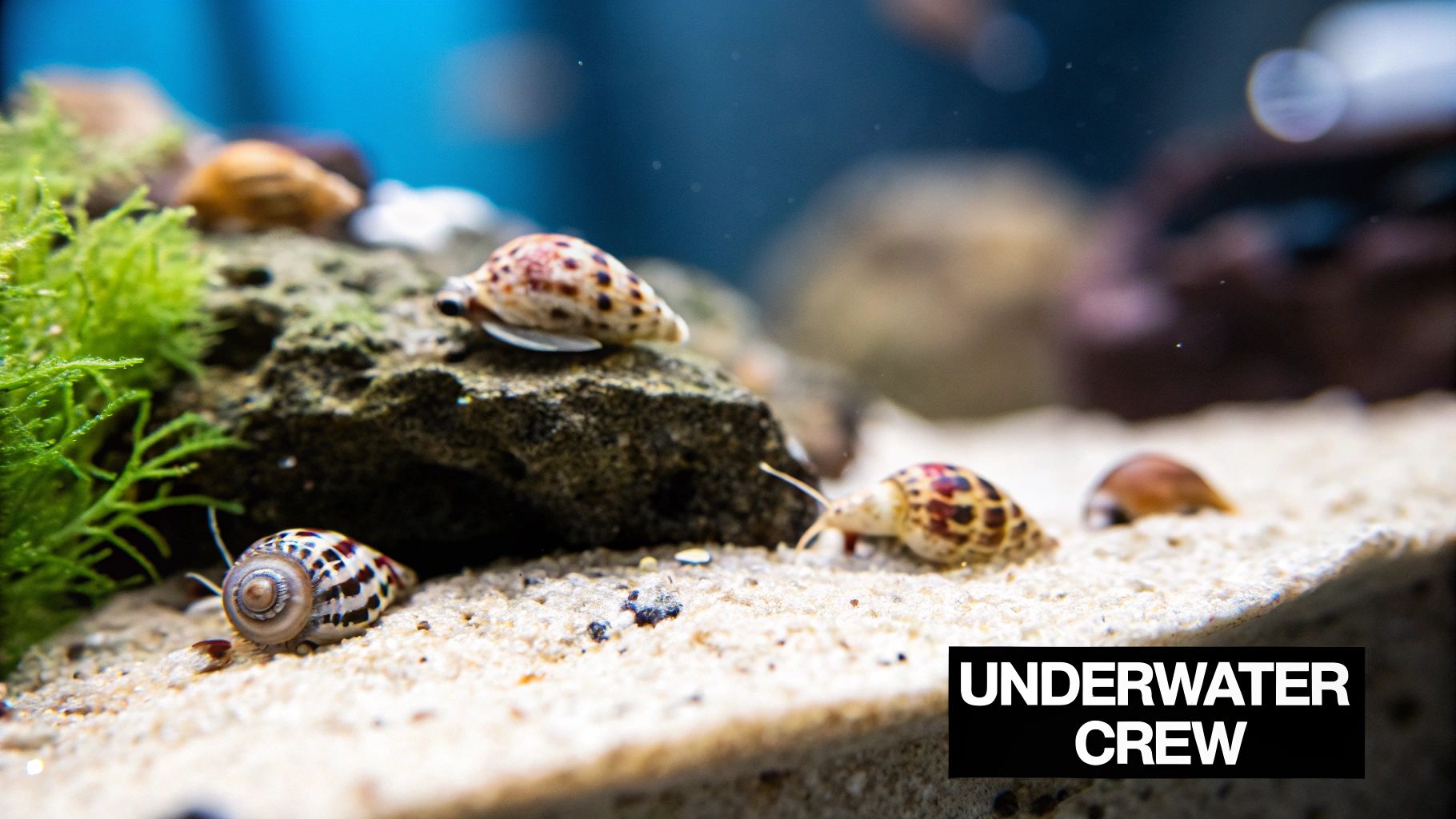
When you imagine a stunning reef tank, what comes to mind? Probably vibrant corals and flashy, colorful fish. But behind all that beauty, a tireless crew is working around the clock to keep the environment pristine. Saltwater snails are the absolute backbone of this maintenance team, handling the crucial jobs that filtration systems alone just can't touch.
Without them, tanks would quickly get bogged down with ugly algae and all sorts of decaying gunk.
But these little invertebrates are so much more than just "algae eaters." They are specialists, each with a very specific job to do in the miniature city that is your aquarium.
The Roles of Your Snail Cleanup Crew
Picture your tank as a bustling metropolis. The snails are the sanitation workers, the gardeners, and the recycling experts all rolled into one efficient package. Their constant, quiet activity is what makes a stable and healthy ecosystem possible.
Here's what they're doing for you 24/7:
- Controlling Algae Growth: Many snail species are fantastic grazers, mowing down the thin film of algae that coats your glass and rockwork before it can smother your delicate corals.
- Cleaning Detritus: They're pros at consuming leftover fish food, fish waste, and other organic debris. If left alone, this stuff would break down and foul up your water quality in a hurry.
- Aerating the Sandbed: Sand-sifting snails are constantly burrowing through the substrate, which prevents it from compacting and stops toxic anaerobic zones from forming.
It's this quiet, continuous work that makes a beautiful reef tank possible. Their popularity is no surprise; snails and slugs are some of the top-selling invertebrates in the entire aquarium trade. In fact, the industry sees about 2.6 times more invertebrates sold than fish, which really shows how much value hobbyists place on them.
By managing waste and algae, a well-chosen snail population takes a huge maintenance load off your shoulders and helps create a more natural, self-sustaining environment. They aren't just an add-on; they are a flat-out necessity for long-term success.
Ultimately, looking at your snails as a vital piece of your tank's ecosystem is the first step toward building a truly thriving reef. Their contributions go way beyond just keeping things tidy—they directly impact your water quality, coral health, and the overall stability of your aquarium.
For a deeper dive into putting together the perfect team, check out our guide to choosing a cleanup crew for saltwater tanks to boost reef health.
Choosing the Right Snails for the Job
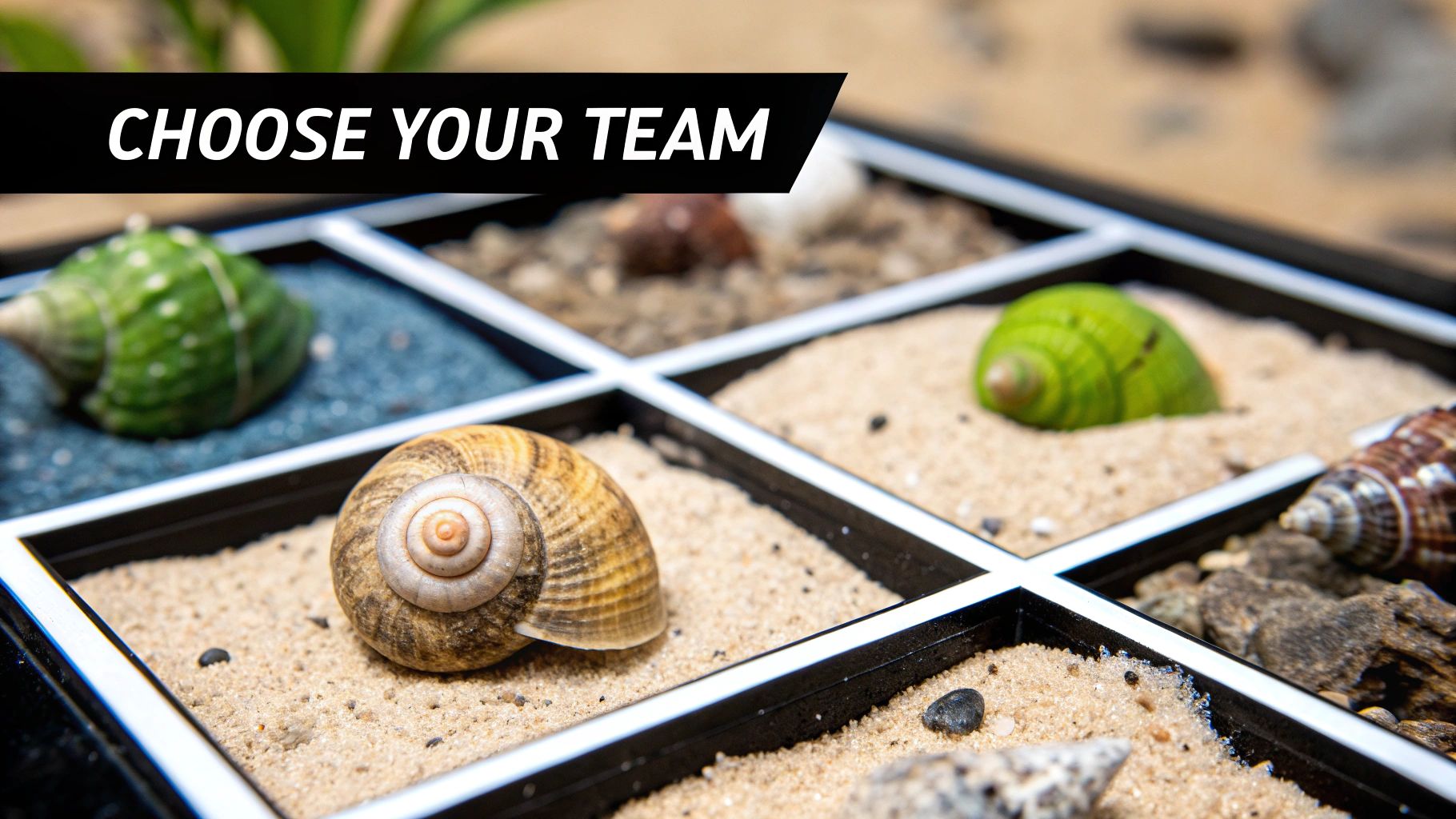
Putting together a solid cleanup crew is a lot like fielding a sports team. You wouldn’t just send out nine pitchers to play a baseball game, right? The same logic applies to your saltwater tank snails. Each species has evolved over millennia to do one or two things really well.
To build a crew that actually keeps your tank clean, you need specialists who can tag-team every surface and tackle every type of grime. Just tossing in a dozen of the same snail might give you spotless glass, but you'll still have algae-caked rocks and a dirty sandbed. The secret to a truly pristine reef is understanding these roles and recruiting the right talent.
The Glass Cleaners and Rock Scalers
Think of these snails as your frontline defense against the inevitable film of algae that blankets your glass and live rock. They are the grazers, constantly patrolling and scraping surfaces clean with their radula—a sort of microscopic, tooth-covered tongue. These are the window washers and mountain climbers of your reef.
-
Trochus Snails: These guys are the undisputed all-stars of algae control. With their classic pyramid-shaped shells, they are absolute workhorses on both glass and rock. Their secret weapon? They can flip themselves back over if they fall. It sounds simple, but it’s a huge advantage that dramatically boosts their survival rate.
-
Astrea Snails: Often called "Turbo Snails" (though true Turbos get much bigger), Astrea snails are the rock-scaling experts. Their star-shaped shells are perfectly designed for maneuvering across the complex surfaces of live rock, getting into all the nooks and crannies. Their one Achilles' heel is that they're terrible at righting themselves if they fall upside down on the sand.
These snails are non-negotiable for keeping your viewing panes crystal clear and stopping that first layer of green or brown film from taking over your rockscape. They're the foundation of any good cleanup crew.
The Substrate Specialists
Your sandbed isn’t just decorative; it’s a vital biological filter. Unfortunately, it can also become a dumping ground for fish waste, leftover food, and all sorts of gunk. If left unchecked, this detritus bomb can cause nutrient spikes and ugly algae outbreaks. That’s where the sand-sifters punch in.
Nassarius snails are the undisputed champions of sandbed maintenance. They spend most of their day buried, keeping the sand aerated and preventing toxic anaerobic pockets from forming. But the moment they "smell" food in the water, they erupt from the sand like a scene from a sci-fi movie.
They use a long siphon that sticks out of the sand like a periscope, constantly sniffing for their next meal. It's fascinating to watch them emerge the second you feed your fish. This behavior makes them incredibly effective at gobbling up uneaten food before it has a chance to decay and foul your water.
The Versatile Janitors
Some snails are more like general contractors—they can handle a bit of everything. These versatile janitors are perfect for filling in the gaps and cleaning the awkward spots your specialists might miss.
Cerith Snails are a prime example. Their long, corkscrew-shaped shells let them wiggle into tight crevices on the rockwork that other snails can't reach. They're happy on the glass, on the rocks, and will even dig around in the top layer of sand. They are a true jack-of-all-trades and are particularly good at dealing with diatoms and cyanobacteria.
For smaller tanks or really tight spaces around coral bases, Dwarf Cerith Snails are tiny powerhouses. They get into the fine details that larger snails have to ignore.
If you want to dive deeper into how different invertebrates contribute to a healthy tank, our guide to reef tank invertebrates for a thriving aquarium is a great place to start.
Saltwater Snail Species Comparison
Feeling a bit overwhelmed by the options? Don't be. Breaking it down by their primary job makes picking your saltwater tank snails much easier. This quick-reference table will help you assemble the perfect clean-up crew for your tank’s unique needs.
| Snail Species | Primary Role | Main Diet | Reef Safe | Ideal Tank Size |
|---|---|---|---|---|
| Trochus Snail | Glass & Rock Cleaner | Film Algae, Diatoms | Yes | 10+ Gallons |
| Astrea Snail | Rockwork Specialist | Film Algae, Diatoms | Yes | 10+ Gallons |
| Nassarius Snail | Sandbed Sifter | Detritus, Uneaten Food | Yes | 5+ Gallons |
| Cerith Snail | Versatile Janitor | Film Algae, Diatoms, Cyano | Yes | 5+ Gallons |
| Margarita Snail | Cooler Water Algae Eater | Film & Hair Algae | Yes | 15+ Gallons (Sub-78°F) |
| Bumble Bee Snail | Carnivorous Scavenger | Detritus, Pest Vermetid Snails | Yes | 5+ Gallons |
The table really highlights the core function of each snail. By combining a few specialists from each category—say, a glass-cleaning Trochus, a sand-sifting Nassarius, and a versatile Cerith—you create a well-rounded team that works together to keep your reef beautiful. This balanced approach ensures no part of your aquarium gets neglected, leading to a much more stable and visually stunning ecosystem.
How Many Snails Does Your Reef Tank Need?
Deciding on the right number of snails is one of the oldest questions in the reefing hobby, and the answer is almost never a simple number. Let's get one thing straight: forget the outdated "one snail per gallon" rule. A truly effective cleanup crew isn't about hitting a specific headcount; it's about building a balanced, diverse team tailored to the unique battleground of your specific tank.
The trick is to view your tank's surfaces—the glass, all that intricate rockwork, and the sandbed—as completely separate zones, each demanding its own specialist. A tank with a vast, deep sandbed but minimal rock needs a totally different crew than one packed to the gills with live rock. The real goal is to staff each zone just right, without overdoing it and causing your hardworking snails to starve.
A Better Way to Build Your Snail Crew
Instead of clinging to a rigid rule, a much smarter approach is to stock your tank based on its size and, more importantly, the amount of surface area available for grazing. This strategy makes sure your snails have plenty of food to thrive without completely stripping the tank bare. It also saves you from the dreaded boom-and-bust cycle, where snails starve, die off, and trigger a nasty nutrient spike.
Here’s a practical, zone-based starting point for a moderately stocked reef tank:
- Glass & Rock Grazers (Trochus, Astrea, Cerith): Start with roughly one snail for every 2-3 gallons of tank volume. These are your film algae specialists, constantly working over your main structures.
- Sandbed Specialists (Nassarius): Plan for one snail for every 3-4 gallons. Since these guys are mostly after detritus and leftovers, their numbers should be tied more to your bioload than to algae.
So, for a 30-gallon tank, you might start with 10-12 grazers (like a mix of Trochus and Astrea) and about 7-8 sand-sifting Nassarius snails. This isn't a strict formula, just a safe, conservative baseline you can tweak as your tank evolves.
The absolute best strategy is to start small with a foundational crew and only add more if you see a need. It's always, always easier to add a few more snails than to deal with the fallout from a mass starvation event caused by overstocking.
Reading the Signs: Too Many or Too Few?
Your aquarium will give you clear signals about whether your snail population is dialed in. Learning to read these signs is what allows you to fine-tune your cleanup crew for that perfect balance. Think of it as an ongoing conversation with your tank, not a one-time setup.
A classic indicator is the "snail line." In a well-balanced system, you might see a faint line of algae growth high up on the glass near the water's surface, just above where the snails usually cruise. If your glass is perpetually spotless and you see snails camping out up there, they're probably getting desperate for food.
Signs of an Under-stocked Tank:
* A visible film of algae reappears on the glass within a day or two of cleaning.
* Patches of diatoms or other nuisance algae are clearly expanding on your rocks and sand.
* Detritus and uneaten food are piling up and becoming an eyesore on the sandbed.
Signs of an Over-stocked Tank:
* Snails are constantly huddled together at the waterline—a classic sign they're searching for their next meal.
* You start finding an unusual number of empty shells, a grim sign of starvation.
* All surfaces are completely barren, with no visible algae film at all, ever.
Remember, how much you feed your fish is directly connected to the health of your snail population. Heavy feeding means more waste, which fuels more algae and can cause certain snail species to reproduce like crazy. Keeping a stable, efficient cleanup crew is just as much about managing what goes into your tank as it is about the snails themselves.
A Guide to Safe Snail Acclimation
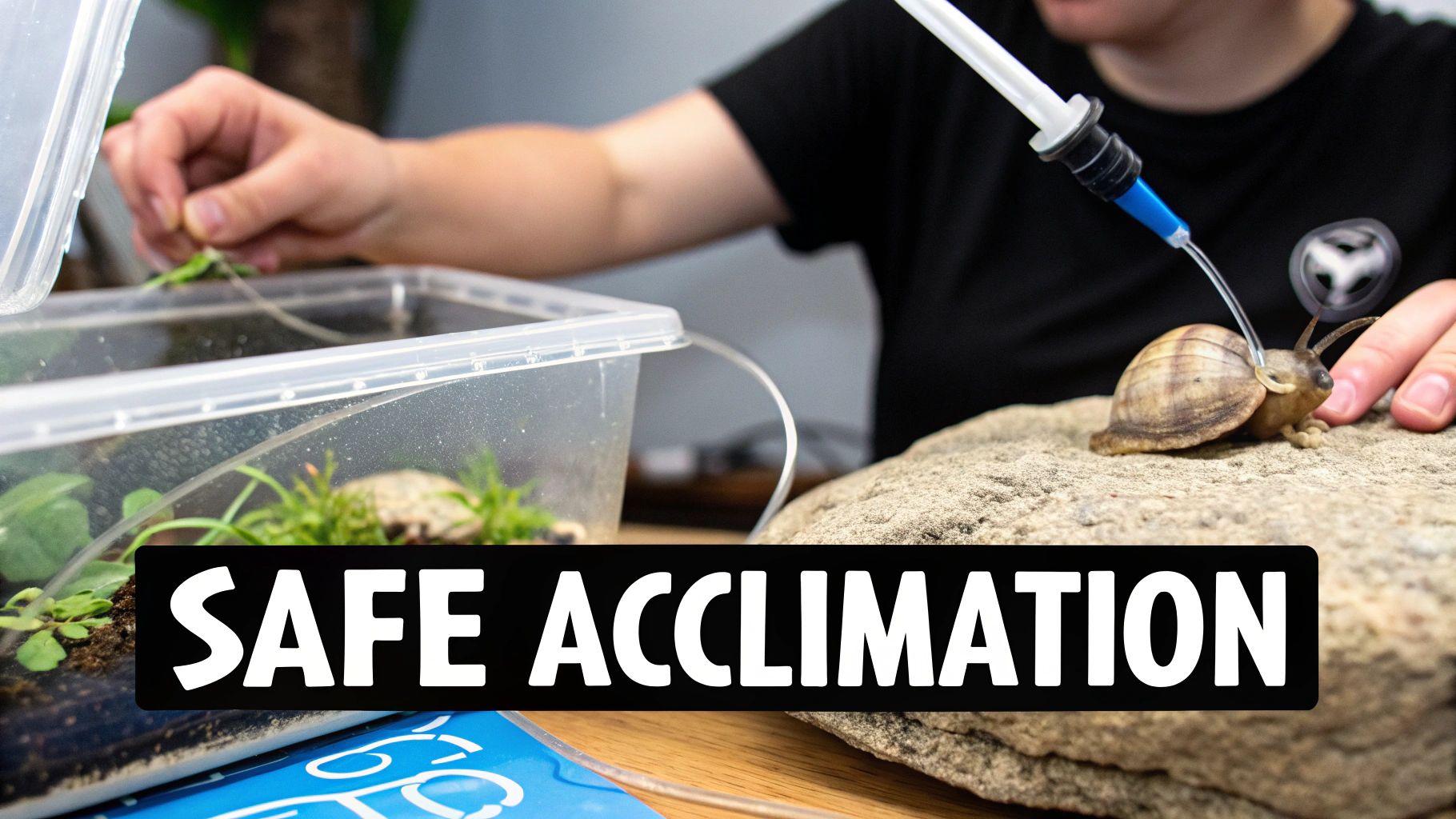
Bringing new saltwater tank snails home is one of the most critical moments in their lives. These little invertebrates are surprisingly sensitive to sudden changes in their world. One of the biggest mistakes new reefers make is rushing the introduction process, which almost always leads to stress, shock, and a pile of empty shells.
Think of it like taking a deep-sea diver and yanking them to the surface in seconds—the rapid pressure change is a massive shock to their system. Snails feel a similar jolt when they're dropped from one tank's water into another. Taking the time to acclimate them properly isn't just a suggestion; it's a must-do for their survival.
Your First Line of Defense Is Quarantine
Before you even start thinking about acclimation, your first step should be quarantine. A simple, separate tank—it doesn't have to be fancy—acts as a critical buffer zone. This isn't just about protecting the new snails; it's about protecting every single living thing in your established display tank.
Quarantining gives you the chance to observe your new arrivals for any signs of illness. More importantly, it lets you screen for nasty hitchhikers. Many a reefer has learned the hard way that a batch of snails can be a trojan horse for pests like pyramidellid snails, which are notorious for preying on expensive clams and other inverts. A few weeks in quarantine gives you the time to spot and remove these threats before they can take hold in your main system.
The Drip Acclimation Method
Once your snails have passed their quarantine period, it’s time for the main event: drip acclimation. This is the gold standard for gently introducing invertebrates into a new aquarium. The method works by slowly and carefully replacing the water they arrived in with your tank water, giving them plenty of time to adjust to differences in temperature, salinity, pH, and other parameters.
Here’s how to do it, step by step:
- Preparation: Place the snails and the water from their bag into a small, clean container. Make sure you position this container somewhere below the water level of your aquarium.
- Start the Drip: Use a piece of airline tubing to start a siphon from your display tank, letting it flow into the container with the snails.
- Control the Flow: Tie a loose knot in the tubing or use a small valve to slow the flow down to a steady drip, aiming for about 2-4 drips per second.
- Wait Patiently: Let the water volume in the container double. This should take at least an hour—and honestly, the slower, the better.
- Final Steps: Once the volume has doubled, pour out about half the water from the container and then let it fill up and double a second time.
This gradual process is your best tool against osmotic shock, a stressful and often fatal condition caused by a sudden change in water chemistry. A little patience at this stage dramatically increases the odds that your new cleanup crew will survive and thrive.
After the drip process is complete, gently pick the snails out of the container and place them directly into your tank. Never just dump the acclimation water in. And always, always place them right-side up on a rock or the sandbed. An upside-down snail is a helpless snail, and it can quickly become a snack for a curious fish or crab before it even has a chance to right itself. This one small action gives your new crew the safe start they need.
Even in the most pristine, well-kept reef tank, things can go sideways. When it comes to your saltwater tank snails, a sudden change in behavior or a mysterious die-off can be a real cause for concern. Figuring out what’s going wrong is the first step to keeping your cleanup crew happy and your aquarium humming along.
Most snail problems really just boil down to one of three things: bad water quality, starvation, or a rough acclimation. A mass die-off, for example, is a huge red flag that usually points to an ammonia or nitrite spike, or a major swing in salinity or temperature. If you find several snails have kicked the bucket, your first move—always—is to grab your test kits.
Diagnosing Snail Die-Offs and Distress
It’s easy to panic when you see a snail lying perfectly still on the sandbed. Before you assume the worst, just remember that a lot of these critters are nocturnal and can stay motionless for a surprisingly long time. The trick is learning to spot the difference between a snail that's just chilling out and one that's in genuine trouble.
A healthy, resting snail will usually have its operculum—that little hard "trapdoor" sealing the shell opening—pulled in tight. If you give it a gentle nudge, you should feel some resistance. A dead snail, on the other hand, will be limp, with its operculum hanging open. If you take it out of the water, you'll know for sure from the unmistakable, foul smell.
One snail dying unexpectedly could just be old age. But a widespread die-off is a five-alarm fire for your entire system. This kind of event can trigger a nasty ammonia spike, so it's critical to remove the deceased snails immediately and start playing detective to find the root cause.
Identifying and Managing Pest Snails
Let's be honest, not every snail that pops up in your tank is a welcome guest. Some hitchhikers can quickly turn into full-blown pests, overrunning your system or, even worse, preying on your prized corals and clams. Spotting these intruders early is the key to keeping them under control.
Keep an eye out for these common troublemakers:
- Sundial Snails: These guys have a distinctive flat, spiral shell and are notorious for munching on Zoanthid polyps.
- Pyramidellid Snails: Tiny, white, and shaped like a little cone, these are nasty parasites that feed on Tridacnid clams.
- Vermetid Snails: These look more like a worm building a hard tube than a classic snail. They cast out a sticky mucus net to catch food, which can seriously irritate and even kill nearby corals.
The most direct way to deal with them is manual removal. Grab some tweezers and go on a hunt during the day, or use a flashlight after lights-out. For a serious infestation, you might need to bring in the big guns, like a Bumble Bee Snail (great for Vermetids) or certain types of wrasse that can help manage their populations naturally.
Preventing Snail Shell Erosion
Ever look at your snails and notice their shells seem thin, pitted, or chalky? That’s shell erosion, and it’s a clear signal that your water chemistry is off-kilter. Snail shells are made almost entirely of calcium carbonate, and they need the right building blocks in the water to keep them strong.
The main culprits here are almost always low calcium and low alkalinity. When those levels drop, the water can become slightly acidic enough to literally start dissolving their shells. The best defense is a good offense: regularly test and maintain stable calcium (400-450 ppm) and alkalinity (8-12 dKH). This doesn’t just protect your snails; it’s absolutely essential for the health of any corals in your reef, too. For more on this, our practical guide to algae control also dives into why stable water parameters are so important.
How Snails Fuel Your Tank's Hidden Ecosystem
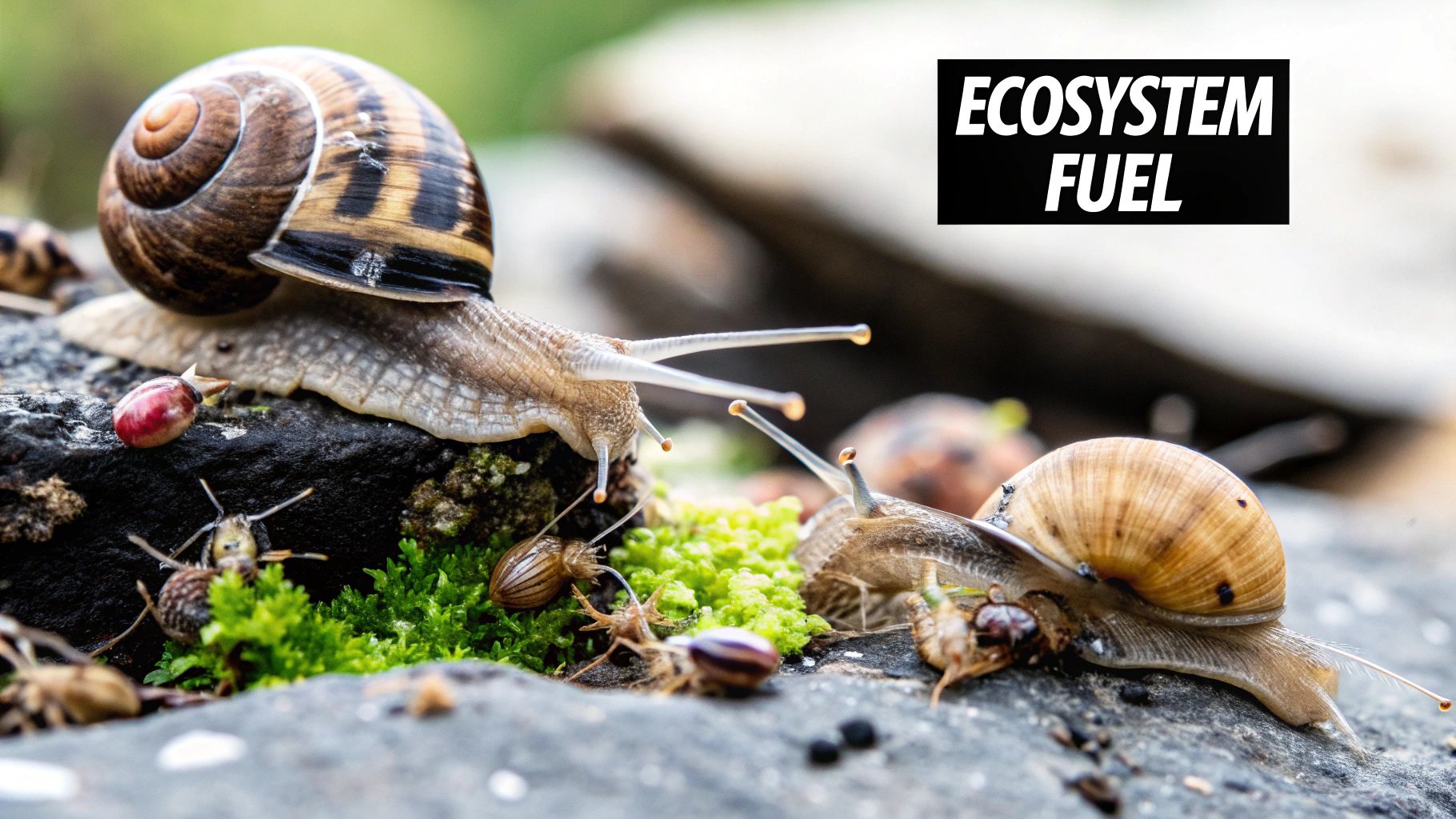
It’s easy to think of your saltwater tank snails as simple janitors, just scraping algae off the glass and rocks. But that's only seeing part of the picture. They are actually fundamental engineers of a hidden, microscopic food web that powers the entire reef.
Think of them less as cleaners and more as the first, crucial link in a powerful recycling chain. They take all that unwanted grime and turn it into high-quality, live nutrition for everything else in your tank.
When a Trochus snail mows down a patch of algae or a Nassarius snail finds some leftover fish food, they aren’t just getting rid of waste. They're processing these simple organic materials and converting them into nutrient-rich waste of their own, which becomes the primary food source for your tank's beneficial microfauna.
From Snail Waste to Living Food
This is where the real magic happens. The waste produced by your snail crew directly fuels an explosive growth of copepods, amphipods, and other tiny critters. These little crustaceans are a nutritional powerhouse for your corals and fish, absolutely packed with the essential fatty acids they need for vibrant color and robust health.
By constantly providing a food source, your snails cultivate a self-sustaining microfauna population deep within your rocks and sandbed. It creates a natural, 24/7 feeding station for your tank's most delicate inhabitants.
This process is what transforms your aquarium from a simple collection of animals into a complete, interconnected ecosystem. Snails turn nuisance algae and detritus into copepods, which in turn become a five-star meal for mandarins, wrasses, and even your corals.
Supporting the Microfauna Engine
It's a straightforward connection: the healthier and more active your snail population is, the more robust your microfauna will be. This natural cycle drastically reduces your reliance on supplemental feeding and creates a far more stable, resilient environment that closely mimics a natural reef. Getting this connection right is a cornerstone of advanced reef keeping.
To really kick this cycle into high gear, many hobbyists add live phytoplankton and fresh copepod cultures to their systems. Products like PodDrop Live Aquarium Nutrition can supercharge this natural food web, making sure your microfauna has everything it needs to flourish. The snails start the process, and dosing live cultures takes it to a whole new level.
This deeper understanding elevates your whole approach to reefing. You're no longer just cleaning up messes; you're actively cultivating a living, breathing ecosystem. By supporting your snail crew, you are fostering a healthier, more balanced, and more beautiful reef for years to come.
Of course. Here is the rewritten section, designed to sound like an experienced human expert while following all your specific instructions and matching the provided style examples.
Your Saltwater Snail Questions Answered
Even the most seasoned reefers run into questions now and then about their cleanup crew. Let's tackle some of the most common ones I hear from hobbyists. Think of this as a quick-reference guide for those moments when you're staring at your tank, wondering what your snails are thinking.
Why Are My Saltwater Snails Not Moving?
First off, don't panic. Inactivity isn't always a red flag. A lot of these guys are nocturnal, doing their best work when the lights are out. Seeing them parked in one spot during the day is often just them resting up for the night shift.
However, if a snail hasn't budged for more than 24 hours—especially if it’s flipped upside down or just dangling from the glass—it's time to investigate. The usual suspects are poor water quality (get those test kits out and check ammonia, nitrite, and salinity), starvation, or shock from being added to the tank too quickly.
Here’s a simple check: gently poke the snail’s operculum, which is the little "trapdoor" it uses to seal its shell. If that door is shut tight, it’s probably alive and just being lazy. If it's hanging loose or wide open, the snail has likely passed on and needs to be removed immediately to avoid fouling your water.
Can I Have Too Many Snails in My Reef Tank?
Absolutely, and it's a mistake I see all the time. Overstocking your cleanup crew can backfire in a big way. When you have more snails than your tank's algae can support, they'll mow down every last bit of food and then start starving.
A mass die-off from starvation is a genuine threat to your tank's stability. It can trigger a nasty ammonia spike that puts your fish and corals at risk. A sudden explosion in your snail population is almost always a symptom of another problem—usually, you're overfeeding your fish.
The goal is a balanced crew that keeps the algae in check but doesn't eat itself out of house and home.
Are All Saltwater Snails Reef Safe?
For the most part, yes. The vast majority of snails sold as "cleanup crew" members are completely reef safe. This means they have no interest in messing with your corals, clams, or other invertebrates. Your standard choices like Trochus, Astrea, Cerith, and Nassarius snails are fantastic, peaceful grazers.
But—and this is a big but—not all snails are created equal. Some species, like Whelks, are predators that will actively hunt down your other snails or even your clams. It is absolutely crucial to know what you're buying. Always purchase your saltwater tank snails from a reputable source you trust to avoid accidentally introducing a tiny terror into your peaceful reef.
A well-fed, balanced cleanup crew is one of the pillars of a healthy reef. To really give your tank's natural food web a boost from the bottom up, think about adding live microfauna. PodDrop provides lab-cultured copepods and phytoplankton that fuel your entire ecosystem. You can learn more about building a thriving micro-ecosystem at https://www.getpoddrop.com.