


A Modern Guide to Your Thriving Reef Tank Refugium
- fabianbehague
- Dec 16
- 17 min read
So, what exactly is a reef tank refugium?Imagine a dedicated, protected space connected to your main aquarium, specifically designed to cultivate beneficial macroalgae and all sorts of helpful microfauna. It's basically a natural filtration engine that exports nitrates and phosphates, helps keep your pH stable, and grows live food—all safely separated from your display tank.
Why a Refugium Is Your Reef Tank's Biological Engine
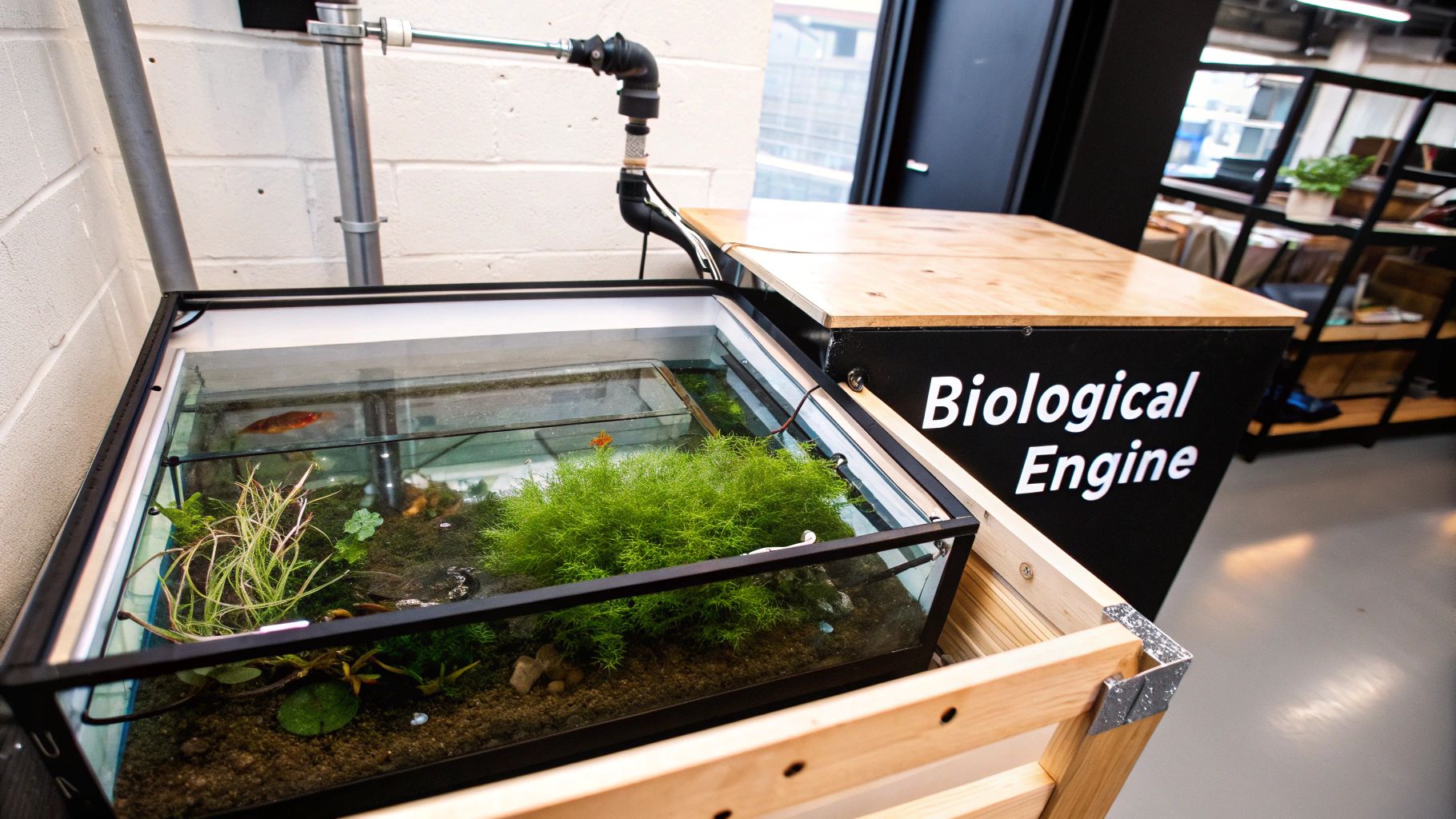
For a lot of seasoned reef keepers, a refugium isn't just some optional add-on; it's the very heart of their tank's stability. Think of it as a powerhouse working tirelessly behind the scenes, creating a more resilient and vibrant ecosystem and tackling some of the most persistent headaches in the hobby.
This special space provides a safe haven—a "refuge"—for tiny critters and plants that would otherwise get eaten in the main display. By putting these natural processes to work, a well-run refugium can seriously cut down your reliance on chemical media and the endless cycle of water changes.
The Power of Natural Nutrient Export
The number one job for most refugiums is nutrient export. Fast-growing macroalgae, like the popular Chaetomorpha (or "chaeto"), acts like a sponge. It soaks up nitrates and phosphates directly from the water to fuel its own growth. And yes, those are the exact same compounds that fuel nuisance algae in your display.
Every time you harvest and remove a chunk of this macroalgae, you are physically pulling those locked-up nutrients out of your system for good. This organic approach is far more stable than using chemical methods, which can sometimes strip the water too fast and shock your system. A properly sized refugium can simply outcompete ugly algae, leaving you with a cleaner display tank and less scraping.
A thriving refugium isn't just another piece of filtration gear. It's a living, breathing ecosystem that actively balances your aquarium's chemistry, making your job as a reefer easier and a whole lot more rewarding.
A Self-Sustaining Live Food Factory
Beyond just controlling nutrients, a refugium is the ultimate breeding ground for microfauna. It's the perfect, predator-free environment for copepods and amphipods to establish booming populations. As they reproduce, a steady stream of highly nutritious, live food naturally flows into your display tank.
This constant supply of pods is absolutely essential for tricky species like Mandarin Dragonets and certain wrasses, but honestly, it benefits your entire reef.
Corals: They get to snack on tiny pods all day, a natural source of amino acids and fatty acids. The result? Better polyp extension and deeper coloration.
Fish: Your fish get a continuous supply of natural prey, which encourages their instinctual hunting behaviors and boosts their overall health and vitality.
Biodiversity: It just makes your whole system more biodiverse, creating a more robust and natural food web from the ground up.
Stabilizing Your Tank's Chemistry
Here’s one of the most underrated perks of a refugium: its ability to buffer pH. When you run your refugium light on a reverse daylight cycle—meaning the 'fuge light is on when the display lights are off—the macroalgae performs photosynthesis at night.
This process consumes CO2, which would otherwise build up and cause that classic nightly pH dip we see in most reef tanks. By counteracting this drop, a refugium helps maintain a much more stable pH around the clock. This reduces stress on your corals and is known to promote better, more consistent growth.
While the modern hobby has fully embraced this kind of tech, its roots run deep. You can learn more about the fascinating history of saltwater aquariums and filtration on Reef Builders.
Designing a Refugium That Fits Your System
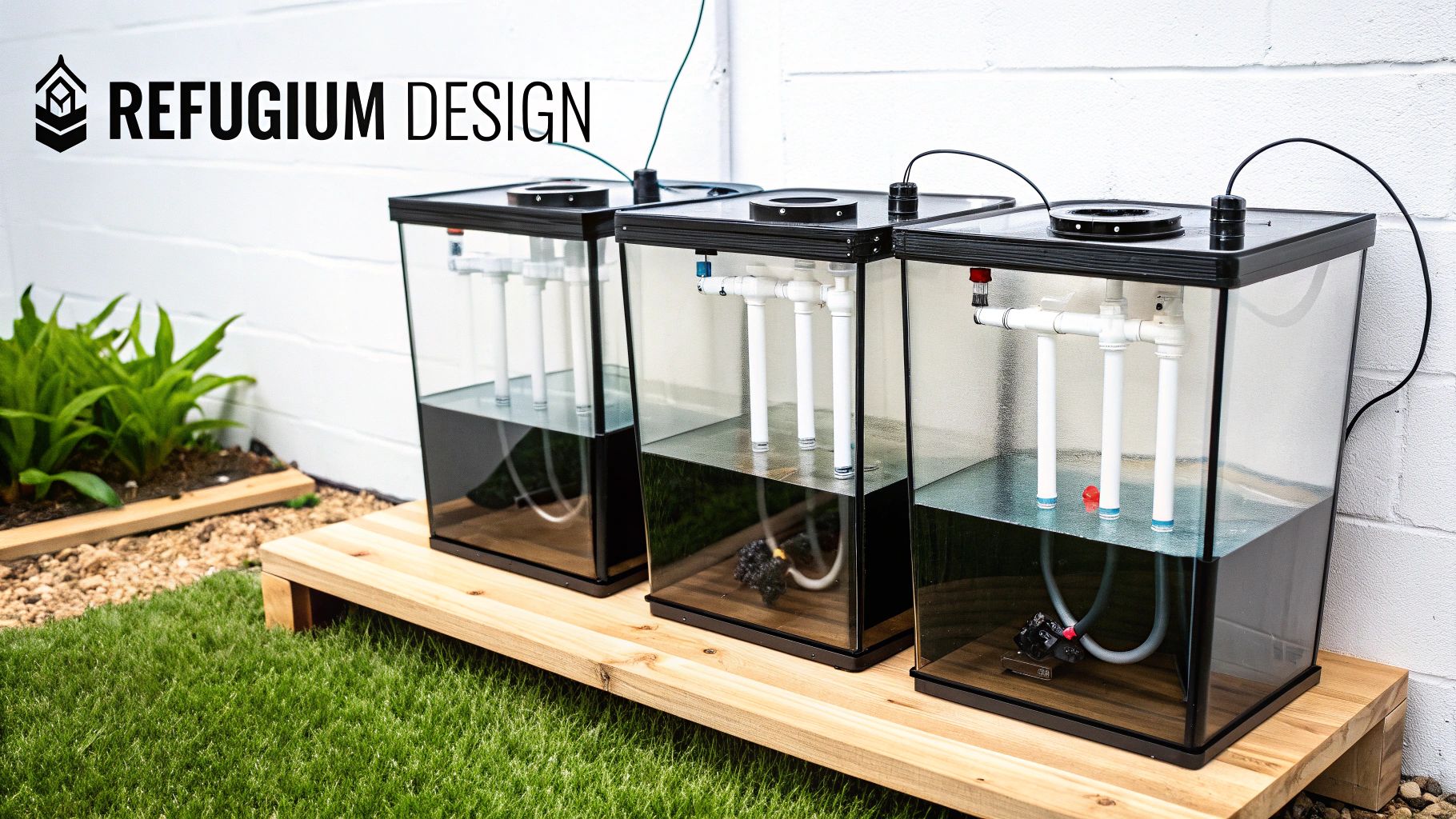
Choosing the right refugium isn't just a minor detail—it's one of the foundational decisions that will shape your tank's stability and your maintenance routine for years to come. What works for a massive SPS-dominant system might be overkill for a nano tank, and what fits neatly under one stand won't work for another. It all comes down to your current setup, the space you have, your budget, and what you’re trying to achieve.
There's no single "best" refugium, only what's best for your reef. We'll walk through the most common styles you'll find: in-sump, hang-on-back (HOB), and remote setups. Each has its own set of trade-offs, making one of them the perfect match for your situation.
In-Sump Refugiums: The Integrated Powerhouse
For most reefers, the in-sump refugium is the gold standard. If you already have a sump, dedicating one of its chambers to a 'fuge is easily the cleanest and most efficient way to go. It keeps all your filtration gear tucked away and integrated into a single, seamless system. Water simply flows from your display tank's overflow, through the refugium chamber, and eventually back up via the return pump.
The biggest draws here are simplicity and the potential for a decent size. Most modern sumps come with a dedicated section already baffled off, which helps control the flow and, crucially, keeps your macroalgae from getting sucked into your return pump. If you're mapping out a new build, our guide to setting up a saltwater sump made simple is a great resource for seeing how all these pieces fit together.
The only real catch is that you have to plan ahead. Make sure the chamber is big enough to actually make a difference, and think about how you'll light it without spilling light into other chambers (like your skimmer section) or adding unwanted heat.
Hang-on-Back (HOB) Refugiums: The Nano Tank Solution
But what if you don't have a sump? That's where a Hang-on-Back (HOB) refugium becomes your best friend. These are compact, self-contained units that hang right on the rim of your display tank, complete with their own little pump and light.
HOBs are the go-to choice for nano reefers or anyone with an "All-In-One" (AIO) tank that lacks the cabinet space for a sump. They give you all the core benefits of a refugium in an easy, plug-and-play package—no complex plumbing required.
Of course, the major limitation is their size. A HOB unit is naturally going to be much smaller than a dedicated sump chamber, meaning it can't process as many nutrients or sustain as massive of a copepod population. Still, for tanks under 40 gallons, a well-run HOB refugium can have a surprisingly big impact on your water quality and biodiversity.
Remote Refugiums: For Maximum Volume and Customization
A remote refugium is exactly what it sounds like: a completely separate tank that’s plumbed into your main system. You could put it next to your display, in the basement directly below it, or even in another room. This approach gives you ultimate freedom in terms of size and design.
This is the path often taken by reefers with very large systems or highly specific goals, like breeding certain types of pods or growing huge amounts of macroalgae for nutrient export. The only limits are your available space and your comfort level with plumbing. A remote 'fuge can dramatically increase your system's total water volume, which adds a huge amount of stability.
The trade-off? Complexity and cost. You'll need an extra pump to feed water to the refugium and a bulletproof overflow to get it back to the sump. Every additional piece of equipment and plumbing connection is another potential point of failure you have to monitor.
Deciding between these options is a crucial first step. To make it easier, here’s a quick breakdown of how they stack up against each other.
Comparing Refugium Placement Options
Placement Type | Pros | Cons | Best For |
|---|---|---|---|
In-Sump | Integrated, clean look. Simple plumbing. Good potential for size. | Limited to the space available in your sump. | Aquarists with an existing sump who want an efficient, all-in-one filtration solution. |
Hang-on-Back (HOB) | Easy to install. No sump required. Great for small tanks. | Limited in size and capacity. Can look cluttered on the display. | Nano and AIO tank owners, or those wanting to add a 'fuge without major plumbing. |
Remote (Standalone) | Virtually unlimited size. Increases total system volume. Highly customizable. | Complex and costly plumbing. More potential points of failure. | Owners of large systems or those with specific breeding goals who need maximum capacity. |
Ultimately, the best choice aligns with your system's scale and your personal goals. An in-sump is fantastic for most, a HOB is a lifesaver for small tanks, and a remote setup is the power-user's choice for massive systems.
Key Takeaway: The ideal flow for a refugium is slow and gentle. You want enough movement to slowly tumble your macroalgae, ensuring all sides get light, but not so much that it tears the algae apart or creates a whirlpool. Aim for a turnover rate of roughly 3-5 times the volume of the refugium chamber per hour. For a 10-gallon refugium, this means a flow of 30-50 GPH.
Getting Your Refugium’s Lighting and Substrate Right
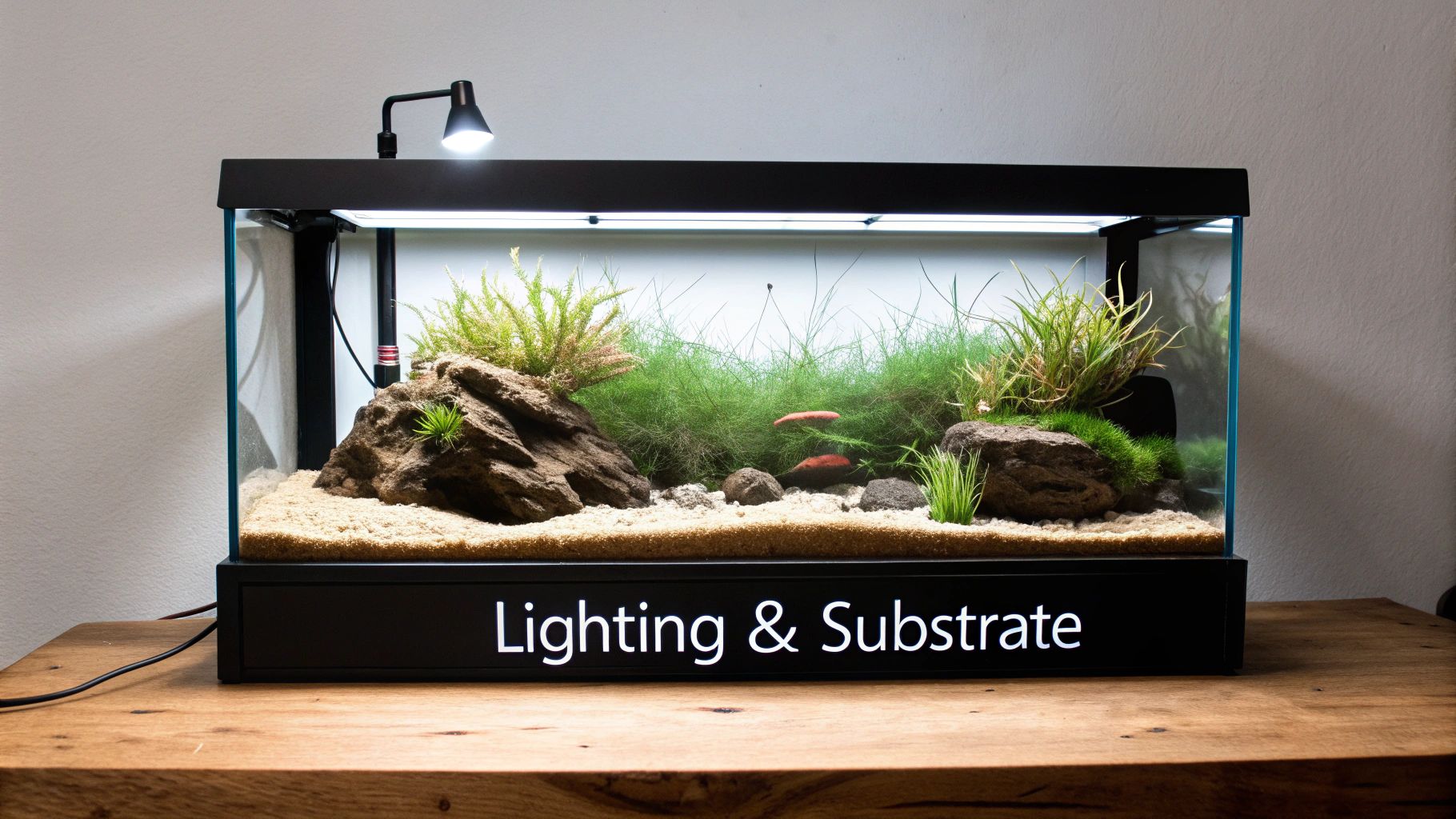
A refugium that actually works doesn't just happen by accident—it’s engineered. The two most critical pieces of that puzzle are the light that fuels its engine and the substrate that forms its foundation. Nailing these choices from the get-go will be the difference between a powerhouse biological filter and a constant source of headaches.
Don't just grab a spare light and toss in some leftover sand. Every decision here directly impacts how well your 'fuge exports nutrients, cultivates microfauna, and ultimately stabilizes your entire tank. Let’s break down exactly what you need to build a productive foundation that meets your goals.
Selecting the Right Light for Macroalgae
The light over your reef tank refugium is all about one thing: growing macroalgae like it's a crop. Fast. You’re not trying to make corals pop with fancy colors; you're farming a plant that devours nutrients. This makes the light's spectrum incredibly important.
Back in the day, reefers got by with simple clip-on lights and warm-toned bulbs, and they did the job. But modern LED technology gives us way more control. Today's specialized refugium lights are dialed in with a spectrum heavy on red and blue wavelengths, which are the primary drivers for plant photosynthesis.
This targeted spectrum is hyper-efficient. It pushes fast, dense growth in algae like Chaetomorpha while being less than ideal for many nuisance algae, giving your chosen macro a serious competitive advantage.
Pro Tip: Don't just blast your new macroalgae with full-power light from day one. Start at a lower intensity and slowly ramp it up over a week or two. This lets the algae acclimate without getting "scorched" by the sudden, intense light.
The Reverse Daylight Cycle Explained
One of the most powerful and simple strategies you can implement is the reverse daylight cycle. It's a brilliant concept: your refugium light kicks on just as your main display lights are shutting down for the night, and vice versa. The benefits here are huge.
At night, without photosynthesis happening in the display tank, CO2 levels rise and cause a natural dip in your aquarium's pH. By running the refugium light overnight, the macroalgae keeps the photosynthesis party going. It soaks up that excess CO2, acting as a brake on the pH swing.
Benefit 1: This creates a much more stable pH around the clock, which means less stress on your corals and better growth.
Benefit 2: You maximize your refugium’s nutrient export, ensuring that photosynthesis—and the nutrient uptake that comes with it—is happening 24 hours a day between the two systems.
This single scheduling trick transforms your refugium from a part-time filter into a full-time chemical stabilizer for your reef.
The Great Substrate Debate
What you put on the floor of your refugium is just as critical as the light hanging above it. Your substrate choice will determine what kinds of tiny critters can thrive and whether your 'fuge will also help with denitrification. There are pretty much three schools of thought on this.
1. Bare BottomThis is the keep-it-simple approach. A bare-bottom refugium is a breeze to clean because detritus has nowhere to settle and hide. Maintenance is easy, and you prevent nasty nutrient sinks from forming. The tradeoff is that you get very little surface area for beneficial bacteria and it’s a poor habitat for burrowing pods and worms.
2. Deep Sand Bed (DSB)A true deep sand bed, usually 4-6 inches deep, is all about creating different oxygen zones. The top layer stays oxygen-rich (aerobic) for nitrifying bacteria. Deeper down, it becomes oxygen-poor (anaerobic), which is the perfect home for bacteria that perform denitrification—turning nitrates into harmless nitrogen gas. A DSB is also a five-star hotel for copepods and other microfauna. The main risk? If neglected, it can become a trap for nutrients.
3. Miracle Mud or Mineralized SubstratesSpecialty substrates like Miracle Mud are engineered to slowly release trace elements while providing an amazing habitat for microfauna to flourish. They function a bit like a DSB but are often finer and packed with beneficial minerals. These are fantastic for cultivating a robust food web that constantly seeds your display tank with live food. While the trace element release isn't a magic bullet, the biodiversity benefits are undeniable. To supercharge that pod population, consider learning how to culture phytoplankton for your reef tank, giving them the perfect fuel source.
Cultivating a Thriving Ecosystem of Algae and Pods
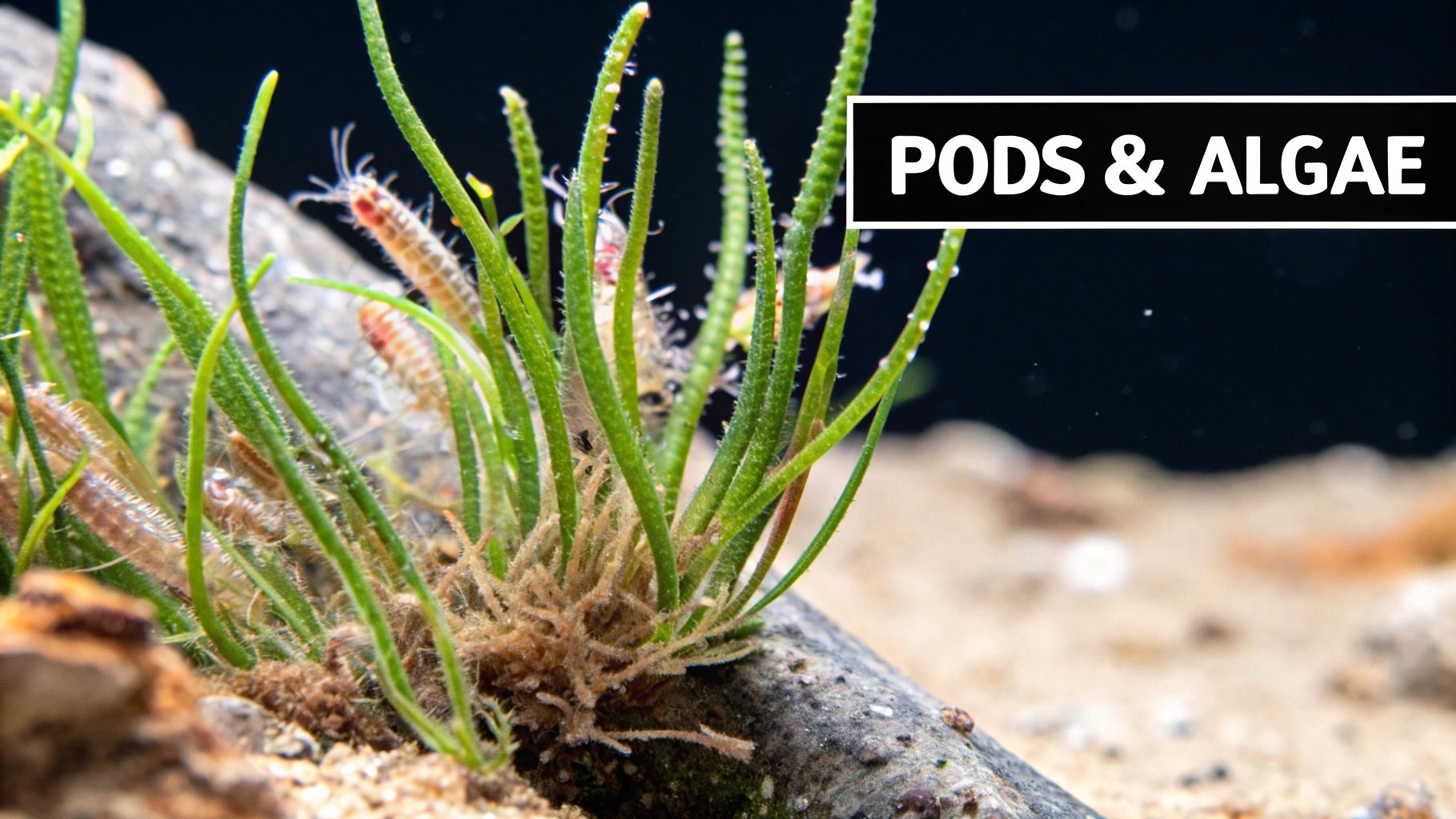
Okay, this is where the magic really happens. We've got the hardware sorted, but now it's time to focus on the living, breathing heart of your refugium: the macroalgae and the microfauna. This space is about to become a bustling hub of biological activity, directly fueling the health and vibrancy of your display tank.
The idea isn't just to grow something. It's about cultivating specific organisms that perform critical jobs for your reef. Think of it as hiring the best "employees" to work for you 24/7.
Choosing Your Primary Macroalgae
For the vast majority of reefers, there's one undisputed champion of the refugium: Chaetomorpha, or "chaeto" as we all call it. This stuff looks like a clump of green fishing line, and it's fantastic. It's hardy, grows incredibly fast (which means it's sucking up nitrates and phosphates), and it's very unlikely to go "sexual."
Going sexual is a disaster. It’s when macroalgae releases its gametes, dies off, and dumps all those nutrients it stored right back into your water column. It's a huge step backward.
Some hobbyists might try other types, like certain species of Caulerpa. Sure, Caulerpa can grow even faster, making it a nutrient-exporting machine. But it comes with that huge risk of going sexual, which can nuke your parameters overnight. For that reason alone, sticking with chaeto is the safest and most recommended path for almost every setup.
Back in the early 2000s, methods like chaeto reactors were already allowing reefers to export 80-90% of their system's nitrates and phosphates naturally. This simple approach mimics natural reef processes, creating safe havens that can boost pod populations 5-10 times their normal levels.
Popular Macroalgae Choices for Your Refugium
Selecting the right macroalgae is a crucial decision for any reefer. While Chaetomorpha is the go-to for most, understanding the alternatives can help you tailor your refugium to your specific goals. Here’s a quick comparison of the most common options.
Macroalgae Type | Growth Rate | Nutrient Export | Potential Risks | Ideal Conditions |
|---|---|---|---|---|
Chaetomorpha | Moderate to Fast | Excellent | Low; rarely goes sexual. Can get dense and block flow. | High flow; intense, full-spectrum light. |
Caulerpa | Very Fast | Very High | High; prone to going sexual, which releases stored nutrients. | Moderate flow; moderate to high light. |
Ulva (Sea Lettuce) | Fast | Good | Moderate; can go sexual. Can break apart easily and spread. | Moderate flow; moderate to high light. |
Red Mangroves | Very Slow | Low to Moderate | Low; roots can damage equipment. Not very efficient for export. | Low flow; requires light above the water surface. |
Ultimately, Chaetomorpha remains the top recommendation due to its effectiveness and low-risk profile. It provides the best balance of nutrient export and a safe, stable habitat for microfauna to thrive.
Seeding Your Refugium with Microfauna
With your macroalgae handling nutrient export, it's time to introduce the real game-changer for biodiversity: your microfauna population. We're talking about copepods and amphipods. These tiny crustaceans are a live, continuous, and incredibly nutritious food source for your fish and corals.
When should you add them? The sooner, the better. As soon as your tank is cycled and stable, you can add a starter culture right into the refugium. This gives them a predator-free zone to get established and build a self-sustaining colony.
Sourcing: Always buy your pods from a reputable supplier. You want healthy, vibrant cultures, not a bottle of pests or dead critters. Look for blends of multiple species.
Acclimation: Don't just dump the bottle in. Float the bottle or bag in your sump for 15-20 minutes to equalize the temperature, then gently release them into the chaeto. It's best to do this with the lights off to reduce stress.
Species Diversity: Using a mix of pod species is a huge advantage. Tisbe pods, for example, tend to stay in the substrate and rockwork, while Tigriopus are more likely to swim in the water column. This variety ensures you're feeding all the inhabitants of your tank.
Supercharging Your Pod Population
Adding pods is just step one. The real goal is to create an environment where their population explodes. The single best way to achieve this is to feed the pods themselves with live phytoplankton.
Phytoplankton is the microscopic algae at the very bottom of the marine food web. By dosing your refugium with live phyto, you're giving your copepods a direct, nutrient-dense meal that will send their reproduction rates through the roof. This simple step turns your 'fuge from a pod hotel into a supercharged breeding factory.
A weekly dose of high-quality, live phytoplankton is often all it takes. You'll see the results in your display tank: corals with better polyp extension and fish that are more active and vibrant. If you really want to dive deep, you can even learn how to culture copepods at home.
Your Long-Term Refugium Maintenance Playbook
A successful reef tank refugium isn't a "set it and forget it" piece of gear—it's a living, breathing part of your ecosystem. The great news is that it’s incredibly low-maintenance compared to other filtration methods, but it still needs a little attention to keep it firing on all cylinders.
Think of it less like a chore and more like tending a small, underwater garden. A garden that pays you back with a cleaner, healthier reef tank. This playbook will walk you through the simple routines that keep your refugium thriving and help you tackle the few common headaches that might pop up.
The Art of Harvesting Macroalgae
Your macroalgae, especially a ball of chaeto, is the engine of your refugium. As it grows, it soaks up nitrates and phosphates like a sponge. The only way to get those locked-up nutrients out of your system for good is to physically pull some of that algae out.
Consistency is the name of the game here. Don't wait until your chaeto is a dense, overgrown brick that’s blocking flow. A regular trimming schedule, maybe every one or two weeks, is way more effective than a massive hack-job once a month. This approach keeps nutrient removal steady and avoids shocking your system.
How Much to Take: A solid rule of thumb is to harvest about 30-50% of the chaeto ball each time. This leaves plenty behind to keep growing and exporting nutrients without stalling out.
The Right Technique: It's as simple as it sounds. Just pull the chaeto mass out and use your hands or a pair of aquascaping scissors to trim off what you need. Before you put the remaining chaeto back, give it a good swish in a bucket of tank water to knock loose any trapped detritus.
Pro Tip: Don't just chuck that harvested chaeto! It's usually crawling with copepods and amphipods. Before you toss it, give it a vigorous shake in your sump to dislodge some of that valuable live food back into your system. Free fish food!
Troubleshooting Common Refugium Issues
Even the most dialed-in refugium can hit a speed bump. The good news is that most problems are easy to diagnose and even easier to fix. If you notice your refugium isn't performing like it used to, it's just your tank's way of telling you something has shifted.
My Chaeto Stopped Growing
This is probably the most common call for help we see. If your chaeto growth grinds to a halt, it's almost always one of three things:
Bottomed-Out Nutrients: Your refugium might have done its job too well, using up all the available nitrates and phosphates. If your test kits are reading zero for both, the algae has simply run out of food.
Micronutrient Deficiency: Macroalgae needs more than just N and P to thrive. Iron is a huge one, and it's often the first micronutrient to get depleted. A small, reef-safe dose of iron can often kickstart growth again.
Bad Flow or Light: Is the chaeto ball just sitting there? If it isn't tumbling, the parts underneath are shaded, not getting light, and likely dying. Make sure you have enough gentle, rolling flow to slowly rotate it, giving all sides a turn in the sun.
Hair Algae Is Taking Over
It's beyond frustrating to see nuisance algae growing in the one place you put in to prevent it. This is a classic sign that the hair algae is outcompeting your chaeto. This can happen if your light spectrum is off or, more commonly, if your chaeto has stalled for one of the reasons above, leaving the door wide open for opportunistic algae.
The fix is a two-step process. First, manually pull out as much of the hair algae as you can. Then, figure out why your chaeto isn't happy—check your nutrients, flow, and consider dosing iron.
My Pod Population Crashed
Seeing a thriving pod population suddenly disappear can be alarming. The first suspect is usually a predator. A small fish, a rogue shrimp, or even a baby bristleworm can sneak in and decimate a pod population.
It can also mean the pods have simply eaten all their available food. To get the population booming again, first do a thorough check for any predators. Once you're sure it's predator-free, start dosing live phytoplankton. Phyto is the direct food source for copepods, and adding it will supercharge their reproductive rates and get your colony thriving again in no time.
Got Questions About Refugiums? Let's Clear Things Up.
Once you start down the refugium path, a few common questions always seem to pop up. It's totally normal. Whether you're still sketching out your sump design or trying to figure out why your Chaeto has stopped growing, getting solid answers from people who've been there makes all the difference.
Let's tackle some of the most frequent questions I hear from fellow reefers.
How Big Does My Refugium Really Need to Be?
The old advice you'll hear everywhere is to aim for 10-20% of your display tank's volume. So for a 100-gallon tank, you're looking at a 10 to 20-gallon refugium. That's a good starting point and gives you enough real estate for your macroalgae to actually make a dent in your nutrients.
But here's the honest truth: when it comes to refugiums, bigger is almost always better.
If you have the room in your sump and it fits the budget, go bigger. A larger refugium isn't just a bigger nutrient sponge; it's a more stable, thriving habitat for your copepods and other micro-critters to breed without getting eaten.
Think of it this way: more total water volume in your system means more stability. By maxing out your refugium size, you’re not just getting better filtration. You're adding a serious buffer against swings in your water chemistry, and that’s a massive win for any reef tank.
Should I Just Leave the Light On 24/7?
It seems like it would make sense, right? More light, more growth. But running your refugium light around the clock is one of the most common mistakes new hobbyists make. The absolute best practice is running it on a reverse daylight cycle—meaning the refugium light kicks on right when your display tank lights turn off.
Why? It’s all about pH stability.
Your tank's pH naturally dips at night. Photosynthesis in the display tank stops, which means CO2 starts to build up in the water, making it more acidic. By firing up the 'fuge light at night, your macroalgae picks up the slack, sucks up that excess CO2, and keeps your pH from swinging wildly. Running the light 24/7 offers zero real benefits, can stress out the algae, and just runs up your power bill.
Help! My Chaeto Stopped Growing. What's Wrong?
First off, don't panic. This happens to everyone. Seeing your once-thriving ball of Chaetomorpha suddenly stall out is super common, and it's usually an easy fix. It almost always boils down to one of these three things:
You Starved It: Your refugium might have done its job too well. If it stripped all the nitrates and phosphates out of the water, the algae has nothing left to eat. If your test kits are reading zero, that's likely your culprit.
It's Missing Micronutrients: Just like corals, macroalgae needs trace elements to really thrive. Iron is a big one. A tiny, reef-safe dose of an iron supplement can often be the magic kickstart a stalled culture needs.
Bad Flow: That ball of Chaeto needs to gently tumble. This ensures all sides get exposed to light. If it just sits in one spot, the parts underneath get shaded, start to die off, and bring the whole growth process to a grinding halt.
Can I Keep Fish or Other Critters in There?
It's tempting to turn your refugium into another little display, but you need to resist the urge to add any fish. Seriously. They will view your booming copepod and amphipod population as their own private, all-you-can-eat buffet, completely defeating one of the main reasons you built a refugium in the first place. Remember, the word is "refuge"—a safe place for microfauna to breed without being hunted.
That said, a small, dedicated cleanup crew is actually a great idea. The right critters can help manage detritus without wiping out the pod population you're working so hard to grow.
Good Choices: Think small and unobtrusive. Cerith snails, Nassarius snails, and micro-brittle stars are perfect for the job.
Avoid: Anything that eats pods for a living. This includes Emerald crabs, peppermint shrimp, and absolutely any kind of fish or wrasse.
These helpful janitors will keep the substrate clean and break down waste, making your little ecosystem even more productive and healthy.
At PodDrop Live Aquarium Nutrition, we believe a thriving refugium is the cornerstone of a vibrant reef. Supercharge your microfauna population and give your corals and fish the live nutrition they crave.
Explore our premium, lab-grown copepod and phytoplankton cultures at https://www.getpoddrop.com.
Comments