


The Best Food For Corals A Reef Keeper's Guide
- fabianbehague
- Oct 31
- 17 min read
The secret to those jaw-dropping, vibrant reef tanks? It’s almost always about what the corals are eating. We pour so much effort into our lighting rigs, but that’s only half the story. Corals have a fascinating two-part strategy for feeding, and once you get it, everything clicks.
Understanding What Your Corals Truly Eat

Think of each coral as a self-sufficient farmer and a skilled hunter, all rolled into one tiny animal.
The "farmer" part comes from microscopic algae called zooxanthellae that live right inside the coral's tissue. These tiny powerhouses are incredible—they use photosynthesis to turn your aquarium light into a steady stream of sugary energy, feeding the coral from the inside out. This symbiotic relationship is the engine that drives a coral's daily life, providing up to 90% of its energy and giving many corals their signature brown, green, and golden hues.
The Hunter Within
But that internal energy factory is just for keeping the lights on. To truly grow, build, and color up, a coral has to hunt. Those beautiful, flowing tentacles aren't just for looks; they are armed with stinging cells called nematocysts, perfectly designed to snatch tiny organisms drifting by in the water.
This is where the real building blocks for a thriving coral come from. Active feeding provides essential nutrients that light and algae simply can't create:
Amino Acids: The raw material for building new tissue and producing those brilliant, eye-popping pigments.
Fatty Acids (lipids): Crucial for storing energy, fueling reproduction, and maintaining healthy cells.
Vitamins and Minerals: The spark plugs for countless metabolic functions that keep the coral's internal machinery running smoothly and help it fight off disease.
Without these captured meals, a coral might hang on, but it will never truly flourish. Growth stalls, colors look washed out, and the coral will struggle to bounce back from any stress.
Why Light Alone Is Not Enough
This brings us to a common trap for reefers: relying solely on powerful lighting. Blasting your tank with light ensures the zooxanthellae are maxed out on production, but it doesn't give the coral the physical materials it needs to build itself up. It’s like giving a construction crew an unlimited supply of electricity but no bricks or mortar. To see how this all fits together in the bigger picture, check out the incredible dynamics of the coral reef food web.
To give you a clearer picture, here's a quick breakdown of how corals get their food.
Coral Feeding Methods at a Glance
Feeding Method | Description | Primary Food Source |
|---|---|---|
Photosynthesis | Microscopic algae (zooxanthellae) inside the coral's tissue convert light into energy (sugars). | Light from your aquarium fixture. |
Active Capture | The coral uses its polyps and tentacles to physically catch and consume prey from the water column. | Zooplankton like copepods, phytoplankton, and bacterioplankton. |
This table highlights the dual nature of coral nutrition. While photosynthesis is the primary energy source, active feeding provides the essential building blocks for growth, color, and resilience that light alone cannot supply.
A mistake many new hobbyists make is thinking that if their corals aren't dying, they must be fine. But there's a huge difference between surviving and thriving. It's like living on bread and water—you'll get by, but you won't be at your peak.
The key to unlocking spectacular health, explosive growth, and the kind of color that makes people stop and stare is a complete feeding strategy—one that fuels both the internal "farm" and the external "hunter."
The Building Blocks of Coral Health and Color
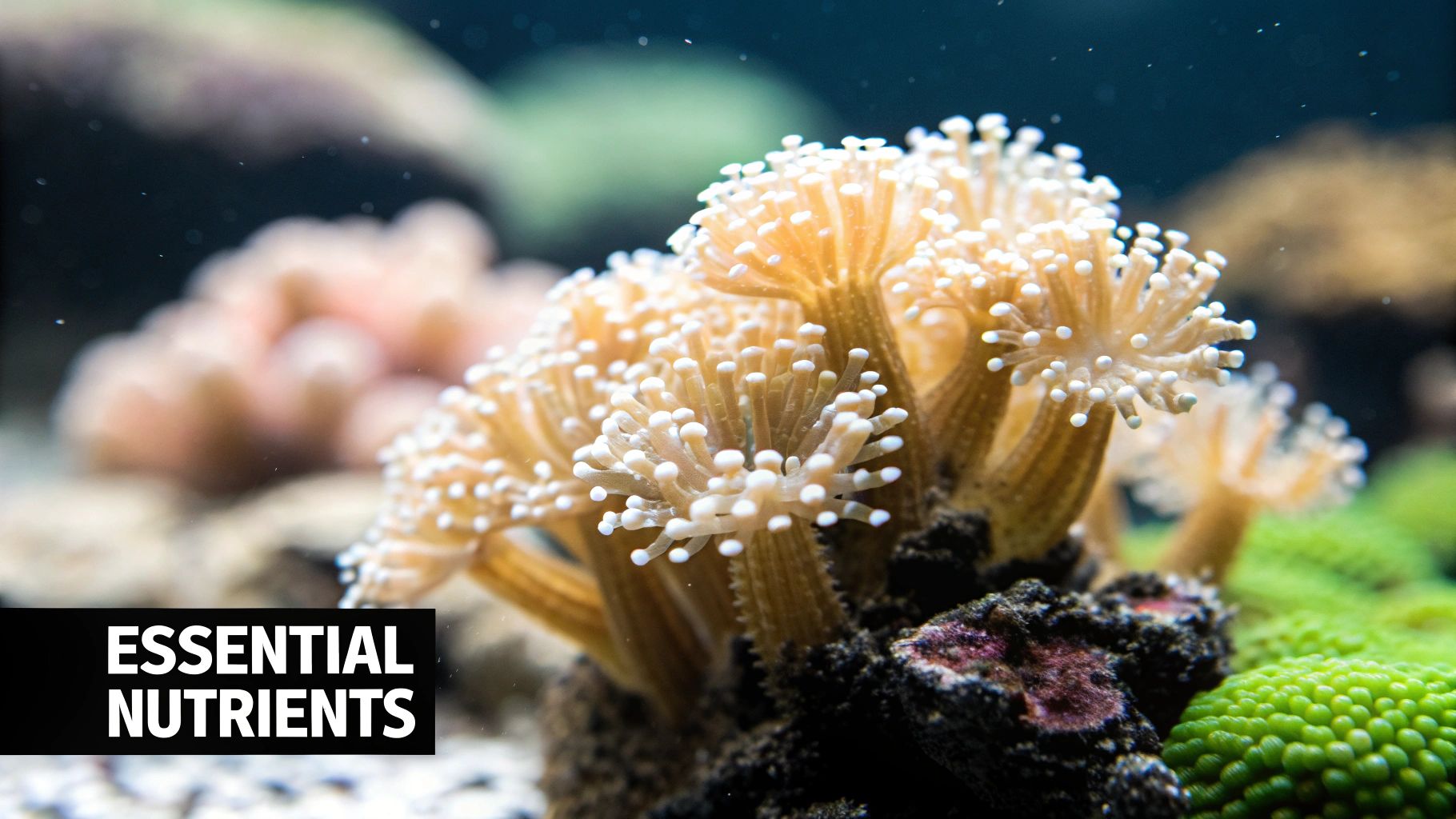
To really get what makes the best coral food, we have to stop thinking like hobbyists and start thinking like corals. Sure, light gives them a ton of energy, but it’s the specific nutrients they capture from the water that let them build their bodies, pop with color, and fight off stress. These are the literal building blocks that separate a coral that’s just getting by from one that’s truly thriving.
Think of a coral's skeleton as the foundation of a house. The tissue that covers it is the framing, walls, and roof. To build all that, corals need a constant supply of amino acids. These are the "bricks" they use for everything, from repairing a sting from a neighbor to growing brand-new polyps.
For reef keepers, this is where color comes from. Amino acids are directly responsible for producing the vibrant pigments that make our tanks glow. When a coral has a rich source of them, it can crank up pigment production, giving you those deep reds, electric greens, and intense purples. Without a steady supply, colors just look washed out.
Fueling Growth with Essential Fats
If amino acids are the bricks, then fatty acids—especially Highly Unsaturated Fatty Acids (HUFAs)—are the high-octane fuel that powers the construction crew. These lipids are absolute energy powerhouses, providing the dense calories corals need for demanding jobs like spawning and explosive tissue growth.
HUFAs are like a coral's energy savings account. When the tank is stable and food is plentiful, this stored energy allows a coral to expand its tissue, extend its polyps with confidence, and get ready to reproduce. A diet poor in quality fats often leads to weak polyp extension and slow, stunted growth because the coral simply lacks the fuel for the job.
This isn't just about our glass boxes, either. This same complex dietary need is what powers entire marine ecosystems. Healthy reefs support a massive food web, and globally, around 850 million people depend on them for food and income. In fact, healthy reefs directly support an estimated 30 million small-scale fishing jobs. The connection between reef health and human survival is critical, and you can learn more about it on livingplanet.panda.org.
The Spark Plugs: Vitamins and Trace Elements
Finally, vitamins and trace elements are the microscopic spark plugs that ignite a coral's metabolic engine. They’re only needed in tiny amounts, but without them, nothing else works right. They are absolutely indispensable for long-term health.
These micronutrients kickstart countless biological reactions, from absorbing nutrients to repairing cells. A shortage in key vitamins can weaken a coral's immune system, leaving it vulnerable to stress, disease, and bleaching. By providing a varied food source, you ensure your corals get the full spectrum of these vital components.
The real goal of feeding isn't just to shovel in calories. It's about delivering a complete nutritional package. A balanced diet of amino acids, fatty acids, and vitamins is the formula that unlocks a coral's full genetic potential for jaw-dropping color and growth.
Let's connect these ideas back to what you actually see in your tank:
Amino Acids: Directly tied to color intensity and the speed of tissue growth. If your frags are coloring up fast and encrusting their plugs, they’re getting plenty of amino acids.
Fatty Acids (HUFAs): The engine behind polyp extension and energy reserves. Corals with big, fluffy polyps that greedily reach out for food are well-supplied with these essential fats.
Vitamins & Minerals: The foundation of long-term health and resilience. A coral that bounces back quickly from a minor tank mishap has a strong immune system fueled by these micronutrients.
Understanding these individual pieces makes it crystal clear why a diverse, complete diet is so important. No single food can provide everything. The best food for your corals will always be one that delivers a full profile of these building blocks, giving your reef everything it needs to build, fuel, and protect itself.
A Practical Comparison of Coral Food Types
Walking down the aisle of a local fish store can feel pretty overwhelming. You’re hit with a wall of powders, mysterious liquids, frozen packs, and bags of live critters, all promising to make your corals pop. So, which one do you actually need?
Choosing the right food comes down to understanding what these options are and who in your tank is going to eat them. Let's break down the main categories so you can match the right meal to your corals' needs.
Live Phytoplankton: The Microscopic Powerhouses
Live phytoplankton are microscopic marine algae—the absolute foundation of the ocean's food chain. Think of dosing phytoplankton as adding a nutrient-packed green smoothie to your tank. It's not a direct meal for every coral, but its ripple effect is massive.
This stuff is a buffet for filter-feeding invertebrates like clams, feather dusters, and sponges. More importantly, it's the primary food for copepods. By feeding the phytoplankton, you’re really just fattening up your tank's microfauna population for your corals and fish.
Best For: Soft corals (especially Gorgonians), clams, sponges, and fueling a healthy copepod population.
Pros: Boosts the entire food web from the bottom up, provides essential fatty acids, and is easily eaten by the smallest organisms.
Cons: Can spike your nitrates and phosphates if you get a little too heavy-handed with dosing. It also has a limited shelf life.
Live Zooplankton: The Natural Choice
Zooplankton are small, swimming animals, and they are hands-down the most natural food source for the majority of corals. This category covers everything from tiny copepods to larger brine and Mysis shrimp, but live copepods are the real MVP here.
Their jerky, swimming motion triggers a powerful, instinctual feeding response from corals that processed foods just can't imitate. When you add live copepods, you're also seeding your tank with a self-sustaining population that reproduces on its own, offering a constant source of nutrition.
For a deeper look at how these live foods really stack up, you can explore our comparison of phytoplankton vs copepods and see which one is the true champion for your reef's needs.
Live zooplankton does more than just feed your corals; it helps recreate a miniature, living ecosystem. The pods will graze on nuisance algae and detritus, acting as a 24/7 clean-up crew while also serving as a continuous, nutritious food source for your fish and corals.
This natural interaction is the secret sauce for a stable and vibrant reef tank.
Frozen and Freeze-Dried Foods: The Convenient Standby
Frozen foods, like Mysis shrimp, brine shrimp, and the various "reef cuisine" blends, are a super popular and convenient option. They offer larger, meatier particles that are perfect for target-feeding LPS corals, which can easily snag them with their hungry tentacles.
Freeze-dried foods give you similar benefits with a much longer shelf life, but they can sometimes be less effective at getting a coral's attention and triggering that all-important feeding response.
Best For: Target-feeding LPS corals (like Acans, Hammers, and Torches) and anemones.
Pros: Very convenient to store and use, offers a dense caloric punch for big eaters.
Cons: Can be incredibly messy, adding a serious load of nitrates and phosphates to your tank if you're not careful. The freezing process also zaps some of the nutritional value.
Liquid and Powdered Supplements: The SPS Special
Finally, you have the huge range of liquid and powdered supplements. These products usually contain concentrated blends of amino acids, vitamins, and incredibly fine particles designed for small-polyp stony (SPS) corals and other critters that eat tiny food.
They are perfect for broadcast feeding—where you just dose the food directly into the water column for the whole tank to share. This method is great for making sure corals with tiny polyps, like Acropora and Montipora, get the fuel they need to build their skeletons and show off those stunning colors.
Comparison of Common Coral Food Types
With all these options, it helps to see them side-by-side. Here’s a quick rundown of what each food type brings to the table, and where it might fall short.
Food Type | Best For | Pros | Cons |
|---|---|---|---|
Live Phytoplankton | Soft corals, filter feeders, copepod populations | Boosts entire food web, high in HUFAs | Can raise nutrients, short shelf life |
Live Zooplankton | All corals (especially SPS/LPS), finicky fish | Triggers natural feeding, creates a clean-up crew | Higher initial cost, requires a healthy tank to thrive |
Frozen Blends | Target-feeding LPS corals, anemones | Convenient, easy to store | Messy, high nutrient impact, less nutritious |
Liquid/Powder | Broadcast-feeding SPS corals | Easy to dose, targets small-polyp corals | Easy to overdose, can cloud water |
In the end, the best feeding strategy isn’t about picking just one. A truly thriving reef tank gets a varied diet. By combining the ecosystem-building power of live phytoplankton and copepods with occasional target feedings, you make sure every single inhabitant gets exactly what it needs to flourish.
Why Live Zooplankton Is a Game Changer for Reef Tanks
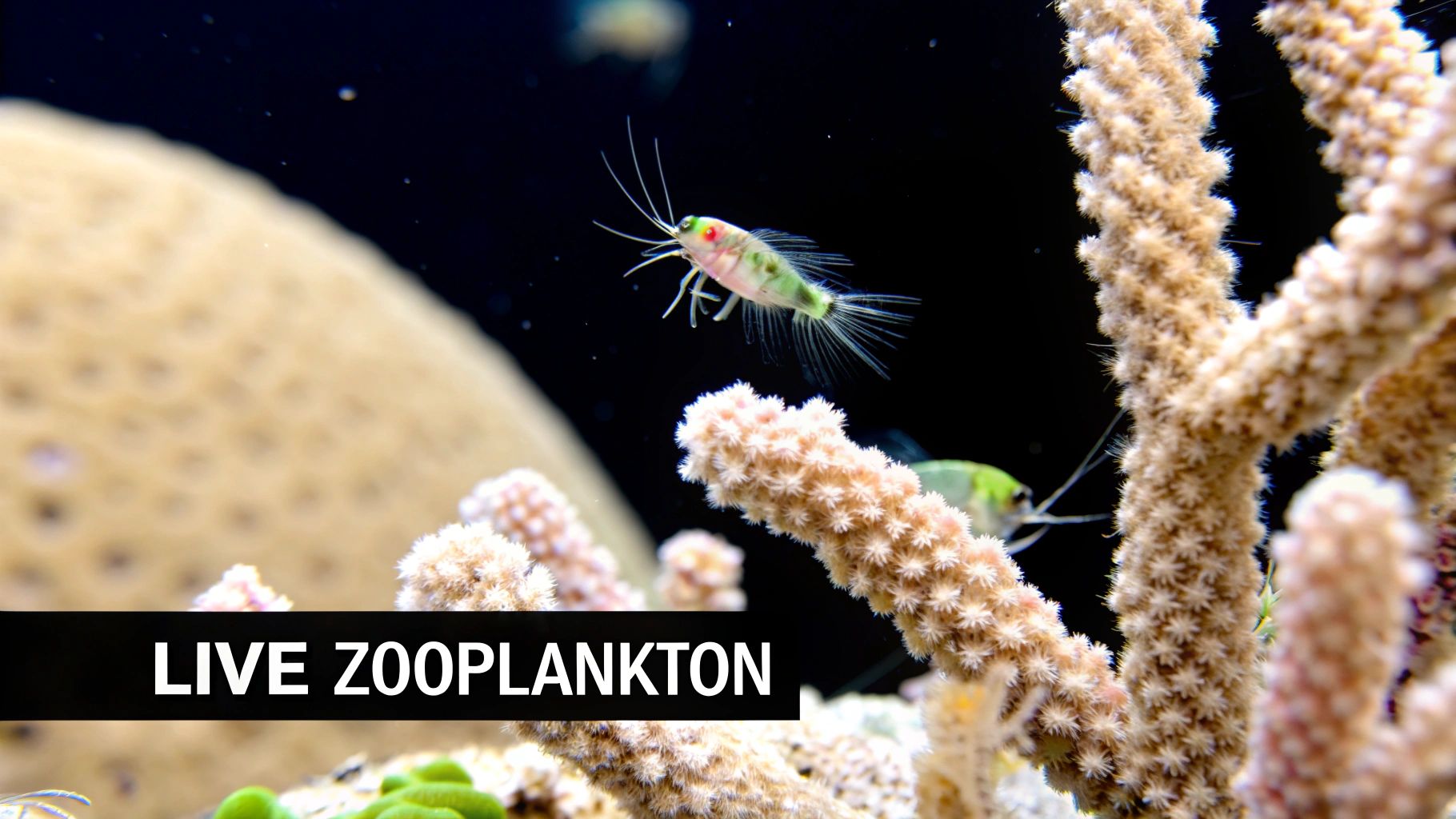
While frozen and powdered foods definitely have their place in the hobby, nothing quite hits the mark like offering your corals a living meal. Adding live zooplankton, especially copepods, is what many seasoned reefers consider the absolute gold standard in coral nutrition. Why? It’s simple: you’re giving them exactly what they’re hardwired to eat in the wild.
This isn't just about dumping nutrients into the water column. It's about meticulously recreating a slice of the ocean in your living room. Live zooplankton does so much more than feed your corals—it builds a complete, self-sustaining micro-ecosystem that every single inhabitant in your tank stands to benefit from.
Triggering the Natural Feeding Response
Have you ever watched a coral’s polyps snap shut on a piece of food? That’s pure instinct, and nothing triggers it quite like live prey. The jerky, frantic swimming of a copepod sends a powerful signal that processed foods just can’t replicate. It screams "FOOD!" in a way corals have understood for millions of years.
This energetic movement prompts even the most finicky corals to extend their polyps and actively hunt, making sure they snag the nutrition they need. This isn't just feeding; it's enrichment. You're encouraging natural behaviors that are absolutely essential for a coral’s long-term health and vibrancy.
By introducing live food, you're not just dropping in a meal; you're flipping a switch in your corals' DNA. You are activating ancient hunting instincts that have allowed them to thrive on natural reefs for millions of years, leading to better food capture and nutrient absorption.
This active feeding helps corals build up the energy reserves they need for growth, brilliant coloration, and bouncing back from stress.
Creating a Living Food Web
Maybe the biggest win of using live zooplankton is its ability to set up shop and establish a breeding population right inside your tank. A single serving of frozen food that goes uneaten just breaks down and pollutes your water. But live copepods? They reproduce, creating a non-stop, self-replenishing source of nutrition for your corals and fish.
This self-sustaining food source provides a constant drizzle of highly nutritious nauplii (that’s baby copepods) that are the perfect bite-sized meal for even the smallest polyp stony (SPS) corals. It also creates a natural buffet for notoriously picky fish like Mandarins and Pipefish, which often struggle to survive on prepared foods alone. The importance of live plankton in building this resilient food web is huge, as it truly becomes the foundation of a stable reef.
The 24/7 Clean-Up Crew
Beyond being a five-star meal, a healthy copepod population acts as a diligent, round-the-clock janitorial service for your reef. These tiny crustaceans are voracious eaters of detritus, uneaten fish food, and nuisance algae.
Detritus Control: Copepods are constantly grazing on the decaying gunk that settles on your rockwork and sandbed, breaking it down before it can fuel nitrate and phosphate spikes.
Algae Management: They happily munch on diatoms and film algae, helping keep your glass and rocks cleaner without you having to lift a finger.
This constant tidying helps maintain better water quality and lightens your overall maintenance load. The health of any reef is deeply tied to the biodiversity within it. On a global scale, an estimated 25% of all marine life depends on coral reefs for food and shelter, which really highlights how vital these complex ecosystems are. To learn more, check out how fisheries and coral reefs are connected over at NOAA Fisheries.
In the end, adding live zooplankton is a strategic investment in the long-term health of your entire reef. It’s the closest you can get to replicating the ocean currents that constantly deliver fresh, living food to wild corals. This approach transforms feeding from a simple chore into an act of ecosystem creation, making it one of the most powerful tools in any reefer's arsenal.
Of course. Here is the rewritten section, following all your requirements for style, tone, and formatting.
Effective Coral Feeding Techniques to Maximize Growth
Knowing what to feed your corals is only half the battle. The real art and science lie in how you deliver that nutrition. It's the difference between a reef tank that just survives and one that truly thrives.
The goal is simple: get the most food into your corals with the least amount of waste left floating around. Nail this, and you’ll see explosive growth and color without fouling your water. There are two main approaches every reefer should have in their toolkit, each with its own time and place.
Broadcast Feeding for Total Tank Nutrition
Broadcast feeding is exactly what it sounds like—you add food directly to the water column and let your pumps do the work of spreading it around. Think of it as creating a nutrient-rich "reef snow" that blankets the entire tank.
This method is perfect for tanks packed with SPS corals or other filter feeders that are constantly grabbing tiny particles from the water. It’s the best way to deliver microscopic foods like phytoplankton and copepod nauplii.
The secret to doing it right? Temporarily shut off your protein skimmer and return pumps for about 30 minutes. This simple step keeps the food suspended where your corals can actually eat it, instead of having it whisked away to the sump.
Target Feeding for Precision Delivery
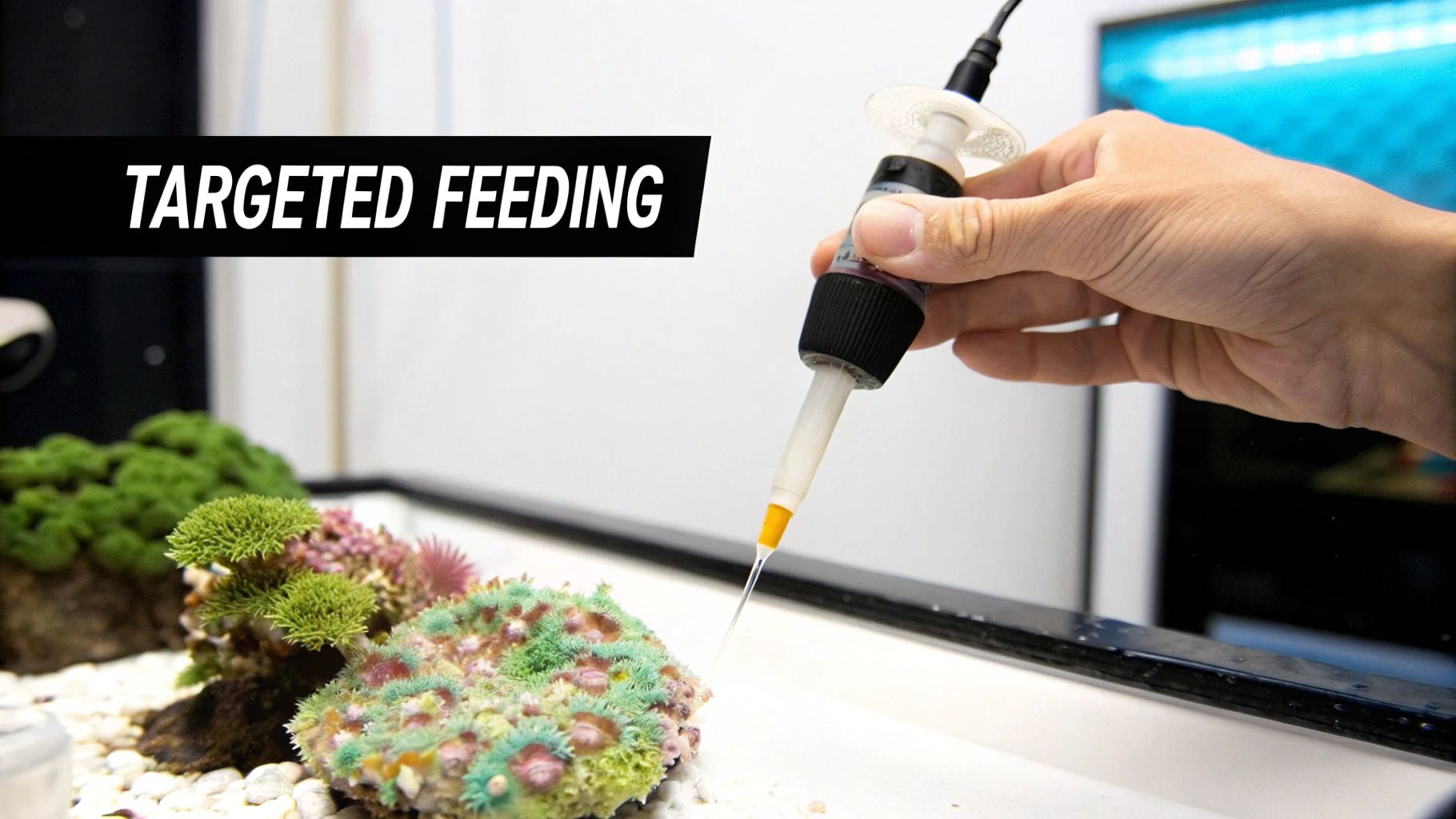
For corals with big, hungry mouths like most LPS (Large Polyp Stony) species, a more direct approach is needed. Target feeding lets you play waiter, delivering a meal right to their doorstep.
Using a pipette or a turkey baster, you can gently squirt a small cloud of food directly onto the coral's polyps. You’ll see them respond almost instantly, their tentacles reaching out to grab the food and pull it in. It’s one of the most rewarding things to watch in the hobby.
This technique ensures those slower-moving corals get a solid meal without having to fight off speedy fish and shrimp who are always ready to steal a snack.
The biggest mistake in coral feeding isn't the type of food, but the quantity. Overfeeding is the number one cause of nutrient problems and algae outbreaks in reef aquariums. Always start with less food than you think you need and observe the results.
This idea of careful resource management is a lesson taken directly from nature. The delicate ecosystems of wild reefs provide services valued at an estimated $11 trillion annually, a staggering figure that highlights their global importance. You can learn more about why coral reefs are so critical on sciencepolicyreview.org.
Pro Tips for a Successful Feeding Routine
Getting the most out of every feeding session comes down to a few simple habits. Work these into your routine, and you’ll see a massive difference in nutrient uptake and the stability of your whole system.
Feed After Lights Out: Many corals are nocturnal hunters. Their feeding tentacles come out in full force at night. Try feeding about an hour after your main lights go off—you’ll be amazed at the feeding response you get.
Observe the Feeding Response: Your corals will tell you if you're doing it right. Look for polyp extension, tentacles actively grabbing food, and mouths opening up. If you don't see this, the coral might be full, stressed, or just not a fan of what's on the menu.
Start Small and Be Consistent: It's way better to feed a small amount two or three times a week than to nuke the tank with a huge feeding once. Consistency creates the stable environment corals crave, preventing the shock of sudden nutrient spikes and promoting steady, healthy growth.
Designing Your Coral's Perfect Meal Plan
So, you’ve got a handle on what to feed and how to get it into your corals' mouths. Now it's time to put it all together and build a real nutrition plan tailored for your reef. The truth is, the "best" coral food isn't a single product—it's a smart strategy. A great plan isn't set in stone; it's a living thing you adjust as your tank and its inhabitants tell you what they need.
For example, a tank loaded with fleshy LPS corals like Chalices and Hammers is going to have a completely different appetite than one packed with delicate, stick-like SPS. The real trick is to blend different feeding techniques. This way, every coral gets its ideal meal without you turning your tank into a nutrient swamp. This is where you graduate from following generic advice to truly expert reef keeping.
Sample Weekly Feeding Schedules
Building a weekly routine is a fantastic place to start. Think of these sample plans as templates—a launching pad for your own customized schedule. Your tank has its own unique personality, and your best tool for figuring it out is simple observation.
LPS-Dominant Tank Plan:
Monday: Target feed your LPS corals with a meaty zooplankton blend, like Mysis shrimp. They love a direct meal.
Wednesday: Do a light broadcast feeding of live copepods. This nourishes the entire system, from fish to microfauna.
Friday: Target feed the LPS again, maybe switching up the food to offer some variety.
SPS-Dominant Tank Plan:
Tuesday: Broadcast feed a mix of live phytoplankton and amino acids. This is perfect, fine-particle food for small-polyp corals.
Thursday: Dose a high-quality live copepod blend like PodDrop Live Reef Nutrition. This keeps the microfauna population booming.
Saturday: Add another light broadcast feeding of phytoplankton to keep the whole food web energized.
The ultimate goal is to create a rhythm your tank can rely on. A consistent schedule promotes stability, dials down coral stress, and makes it way easier for you to spot when something's off with your reef's health or appetite.
Reading the Signs and Adapting Your Plan
Your corals are giving you constant feedback; you just have to learn their language. Paying close attention to how they look and act is the final, most important step in mastering their nutrition. This is what separates the good reef keepers from the great ones.
Keep an eye out for these key indicators to fine-tune your approach:
Polyp Extension: Are your corals' polyps fully extended and fluffy, especially when it's feeding time? Eager polyps are a sign of a healthy, hungry coral. If they stay tight and retracted, it could be a sign of stress, or maybe they're already getting plenty to eat.
Color Intensity: Those deep, vibrant colors are a direct result of proper nutrition. If you see colors starting to wash out or turn brown, it might signal you're either underfeeding or, just as likely, overfeeding and creating too many nutrients.
Growth Rate: Healthy corals grow. You should see visible new growth around the edges of encrusting corals or at the tips of branching ones. If growth has completely stalled, that's a crystal-clear sign that something in their diet or environment needs a second look.
By watching these signs, you can confidently tweak your feeding amounts and frequency. You'll stop just feeding your tank and start having a conversation with it, becoming a truly responsive and effective aquarist.
Of course. Here is the rewritten section, crafted to sound like an experienced human expert while following all your specific instructions.
Frequently Asked Questions About Feeding Corals
Even after you've got a game plan, questions are bound to pop up. Let's be real—feeding corals is as much an art as it is a science, and dialing in your technique is all part of the fun. Here are some quick answers to the questions I hear most often from fellow reef keepers.
How Often Should I Feed My Corals?
For most mixed reef tanks, starting with 2-3 feedings per week is a solid baseline. But the real key is to watch your corals and see what they need. There's no magic number.
If your tank is packed with SPS corals, you might find that smaller, more frequent broadcast feedings of microscopic goodies work best. On the other hand, LPS corals with those big, hungry mouths will be perfectly happy with a meaty, target-fed meal just once or twice a week. The golden rule? Keep a close eye on your water parameters, especially nitrates and phosphates. If you see them creeping up, just dial back the frequency or the amount. Your best guides will always be consistency and observation.
What Are The Signs Of Overfeeding Or Underfeeding?
Your tank will give you some pretty clear signals when your feeding strategy isn't quite right. Learning to read them is one of the most important skills in reefing.
Signs of Overfeeding:
Stubborn algae that just won't quit, especially that nasty cyano or hair algae.
Nitrate and phosphate readings that are consistently high every time you test.
Water that looks cloudy or murky and takes forever to clear up after feeding.
Signs of Underfeeding:
Corals that look pale, washed-out, or have started to "brown out."
Noticeable lack of growth—it seems like they haven't changed in months.
Polyps are rarely extended, even at night when they should be out hunting for a snack.
Healthy, happy corals will show off with deep, rich colors, obvious new growth, and fluffy, extended polyps that are always ready for their next meal.
Paying attention to these visual cues is far more effective than sticking to a rigid, one-size-fits-all schedule. Your corals are the ultimate authority on whether their diet is working.
Do My SPS Corals Like Acropora Really Need Food?
They absolutely do. It's true that SPS corals get the lion's share of their energy from light through their symbiotic zooxanthellae, but they need that extra nutritional boost to really hit their peak growth and color. Their polyps are tiny, so they can't exactly chow down on a big piece of mysis shrimp like an LPS can.
The best foods are the ones they can snatch right out of the water column. Think high-quality phytoplankton, amino acid supplements, and microscopic zooplankton like copepod nauplii. Broadcast feeding these tiny food particles is the way to go, as it gives every one of those little polyps a chance to grab a nutritious bite.
Ready to give your reef the vibrant, living nutrition it's been missing? PodDrop Live Reef Nutrition delivers a thriving ecosystem right to your door, packed with freshly cultured copepods and phytoplankton that kickstart natural feeding responses and build a resilient food web. It's time to take your coral care to the next level and watch your tank truly flourish. Discover the PodDrop difference today.
Comments