

Phytoplankton Reef Tank A Complete Guide
Adding phytoplankton to your reef tank is hands-down one of the most powerful things you can do to fuel a healthy marine ecosystem from the ground up. I like to think of it as liquid sunshine—a living, microscopic plant that turns light into pure energy for your corals, copepods, and other filter feeders. The result? Unbelievable color and explosive growth.
The Unseen Engine of a Thriving Reef Tank
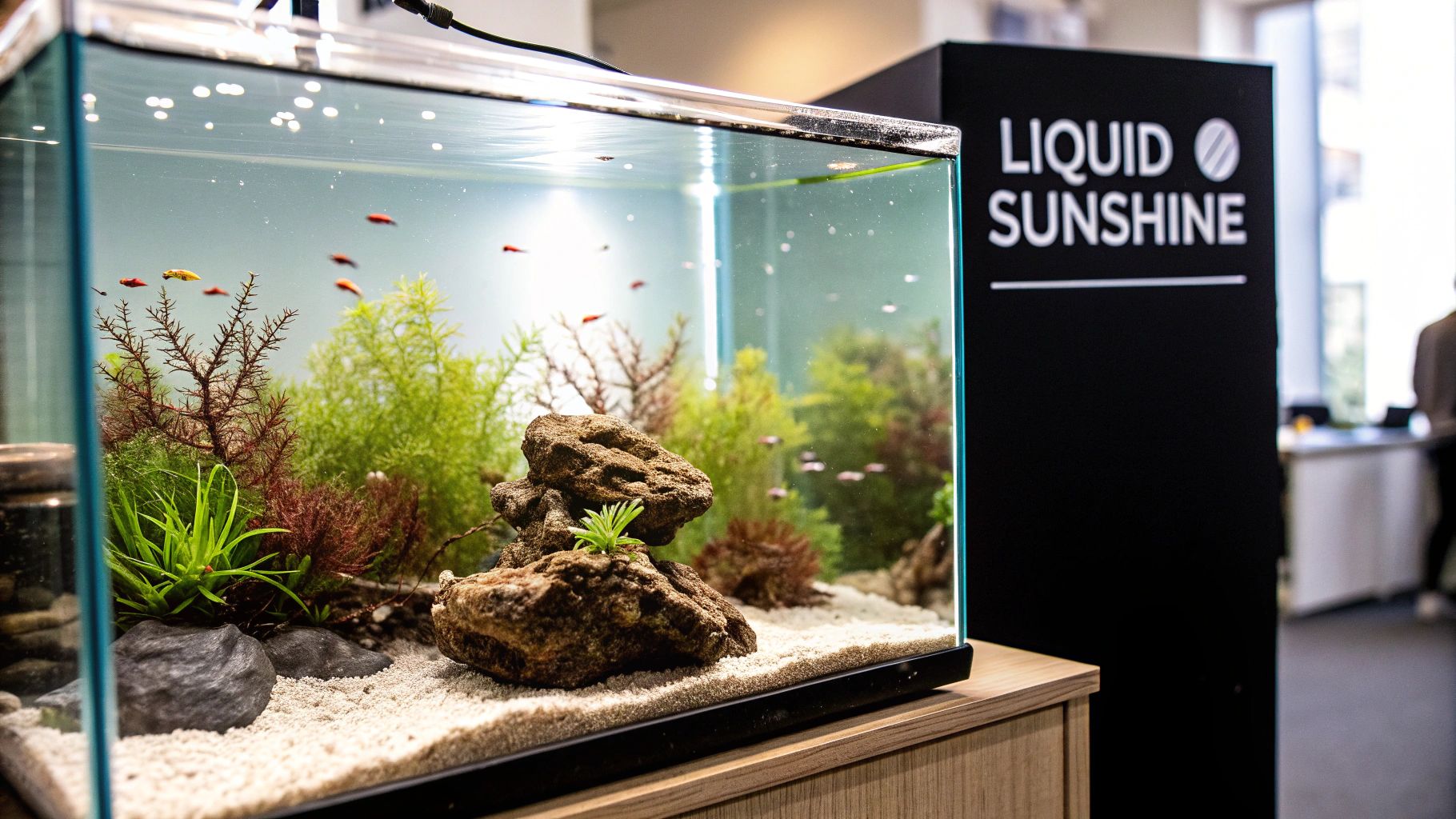
It’s easy to get caught up in what we can see—the fish, the corals, the inverts. But the real foundation of a stable reef tank is often completely invisible. Phytoplankton, a massive group of single-celled algae, forms the absolute base of the entire marine food web. Out in the ocean, these microscopic powerhouses produce a huge chunk of the planet's oxygen and keep countless creatures alive.
When you bring live phytoplankton into your closed system, you're tapping into that same fundamental process. You aren't just dumping in "food"; you're introducing a living, breathing component that actively makes the whole environment better.
More Than Just Coral Food
Sure, many corals eat phytoplankton directly, but the benefits create a ripple effect that touches every corner of your aquarium. This "green water" does way more than you might think, contributing to long-term stability in some critical ways. Dosing your reef tank with phytoplankton is a proactive move that builds a more balanced and resilient ecosystem, going far beyond just feeding. You can dive into all the details in our guide on the 10 benefits of live phytoplankton in marine aquariums.
So, what does adding this living nutrition actually do for you?
- Fuels Your Microfauna: It's the primary food source for zooplankton like copepods and rotifers. This creates a self-sustaining live food factory right in your tank for fish and corals to feast on.
- Boosts Coral Vitality: It delivers a payload of essential fatty acids (EFAs), vitamins, and amino acids that make coral colors pop, accelerate growth, and improve polyp extension.
- Improves Water Quality: Live phytoplankton is hungry. It actively consumes excess nutrients like nitrates and phosphates, helping you win the war against nuisance algae.
Think of it this way: phytoplankton transforms light and waste into usable energy. It becomes the biological engine that drives everything else in your reef. Its presence elevates a tank from a pretty glass box to a dynamic, living ecosystem.
Regularly dosing phytoplankton is a game-changer. The live cells pull nitrate (NO3) and phosphate (PO4) out of the water as they photosynthesize, which helps keep things clean and balanced. This process also bumps up dissolved oxygen and reduces carbon dioxide, stabilizing your pH and making it much harder for ugly stuff like hair algae and cyano to get a foothold. It really is a reefing superpower.
Choosing the Right Phytoplankton Strains

If you're diving into the world of phytoplankton, you'll quickly discover that not all green water is created equal. Different strains are like different tools in a toolbox, each one designed for a specific job in your reef tank. Picking the right one—or the perfect blend—is how you unlock the exact benefits you're after.
Think of it like tending a garden. You wouldn't use the same fertilizer for leafy greens as you would for vibrant flowers, right? It’s the same principle here. One phytoplankton strain might be an absolute powerhouse at scrubbing nutrients from your water, while another is the perfect bite-sized meal for copepods or a fatty-acid bomb for your corals.
Once you understand the unique profiles of the most common strains, you can move past just randomly dosing and start making strategic moves to boost your aquarium's health.
The Big Three Strains Explained
For most of us in the hobby, the choice boils down to three primary workhorse species. Each one brings a distinct size and nutritional profile to the table, making it ideal for different roles within a phytoplankton reef tank ecosystem. Let’s get to know them.
Nannochloropsis Oculata (Nanno)
This is the undisputed champion of nutrient control. With an incredibly tiny cell size of around 2-4 microns, Nanno stays suspended in the water column for ages. This gives it maximum opportunity to soak up nitrates and phosphates before they can fuel that ugly nuisance algae we all hate.
Its small size also makes it the perfect first food for the tiniest filter feeders and zooplankton larvae. If your main goal is to outcompete algae and get your water sparkling clean, Nanno is a non-negotiable part of your arsenal. For a deeper dive, check out our guide on how Nannochloropsis supports aquarium health.
Tetraselmis Suecica (Tetra)
Considerably larger than Nanno at about 10-15 microns, Tetraselmis is a nutritional heavyweight. This "green beast" is loaded with amino acids and lipids, making it an excellent meal for larger organisms and a gut-loading superfood for adult copepods and brine shrimp.
Because of its bigger size and flagella (tiny tails that help it swim), it's more attractive to filter feeders. This makes it the ideal choice if you're trying to build up a massive, self-sustaining pod population to feed hungry fish like mandarins or wrasses.
Isochrysis Galbana (Iso)
If brilliant coral coloration is what you're chasing, Isochrysis is your secret weapon. This strain is famous for its exceptionally high concentration of docosahexaenoic acid (DHA), a critical omega-3 fatty acid. This is the exact nutrient that helps corals develop those deep, jaw-dropping pigments.
While other strains offer broad benefits, Isochrysis is the specialist. Think of it as a direct color-enhancing supplement that gives your corals the specific building blocks they need to truly pop.
At a moderate size (5-6 microns), it's easily eaten by a wide range of corals and invertebrates, making it a powerful tool for boosting the visual "wow" factor of your reef.
Comparing Common Phytoplankton Strains
To make things even clearer, here’s a quick-reference table that breaks down the key players. Think of this as your cheat sheet for choosing the right strain for the job.
| Strain Name | Primary Benefit | Cell Size | Best For |
|---|---|---|---|
| Nannochloropsis | Nutrient Export & Water Clarity | 2-4 microns | Outcompeting nuisance algae, feeding small zooplankton. |
| Tetraselmis | Zooplankton & Copepod Food | 10-15 microns | Gut-loading and breeding copepods, feeding larger filter feeders. |
| Isochrysis | Coral Coloration | 5-6 microns | Enhancing coral pigments (especially reds and purples), providing DHA. |
Ultimately, many seasoned reefers find that a blend of these strains provides the most comprehensive benefits. You get the nutrient control of Nanno, the pod-fueling power of Tetra, and the color-boosting magic of Iso—a perfect trifecta for a thriving reef.
Mastering Your Phytoplankton Dosing Strategy
Alright, you've picked out the perfect phytoplankton strain for your tank. Now for the fun part: actually using it. This is where the rubber meets the road, but don't sweat it—dialing in a dosing plan is much easier than it sounds.
If there’s one golden rule, it’s this: start low and go slow. You want to give your tank's ecosystem time to adjust to the new addition. Think of it like seasoning a new dish. You can always add a little more, but you can't take it back out once it's in there.
A solid, conservative starting point for most reef tanks is 5ml of live phytoplankton per 20 gallons of total tank volume, dosed once a day. This is just enough to introduce the benefits without giving your biological filter a shock.
Reading Your Tank's Feedback
Your aquarium is constantly talking to you. The trick is learning its language. Once you start dosing, keep a close eye on a few key signals. These are your tank's way of telling you whether you've hit the sweet spot or need to back off a bit.
The two most important signs to watch for are:
- Water Clarity: It’s perfectly normal to see a slight green tint in the water right after dosing. If that haze clears up within a few hours, you're golden. It means your corals, pods, and other filter feeders are happily munching away. If the water stays green all day, you’re probably adding too much, too fast.
- Skimmer Production: Your protein skimmer will absolutely react to the added organics from phytoplankton. A small increase in dark, smelly gunk in the collection cup is a good thing. But if your skimmer starts overflowing with wet, light-colored foam, that's a crystal-clear sign to cut back on the dose.
By keeping an eye on just these two things, you can confidently bump up your daily dose. Try increasing it by 1-2ml per 20 gallons each week until you find the perfect balance for your specific system. You’ll know you’ve hit the max when you see a slight but persistent increase in skimmate or the water takes a bit longer to clear.
Manual vs. Automated Dosing
So, how do you get the phyto into the tank? It really comes down to your personal preference and lifestyle. Both manual and automated methods get the job done, but they suit different kinds of reef keepers.
Manual Dosing:
This is as simple as it gets—measure it out and pour it in. The big advantage here is control. You can shut off your skimmer and filter socks for an hour or so, letting your corals feast without interruption. The only catch? You have to remember to do it. Every. Single. Day.
Automated Dosing:
For unbeatable consistency, nothing beats a dosing pump. You can set it up to deliver tiny, precise amounts of phytoplankton around the clock. This creates a more stable, continuous food source in the water column and prevents any big swings in water chemistry. It’s the "set it and forget it" method that a lot of reefers swear by for long-term success.
Proper Storage Is Non-Negotiable
This is a big one. You're dealing with a live product, and you need to treat it that way. If you don't store it correctly, you’re basically just pouring dead cells and nutrients into your tank, which is a recipe for an algae outbreak.
Always, always, always keep your live phytoplankton in the refrigerator. The cold slows down its metabolism and keeps it nutritionally potent for weeks.
Before you dose, just give the bottle a gentle flip or two to get the cells back into suspension. Never shake it vigorously! You can actually damage the cells that way. Follow these simple rules, and you'll ensure every drop you add is packed with life and ready to fuel your reef.
Building a Self-Sustaining Food Web
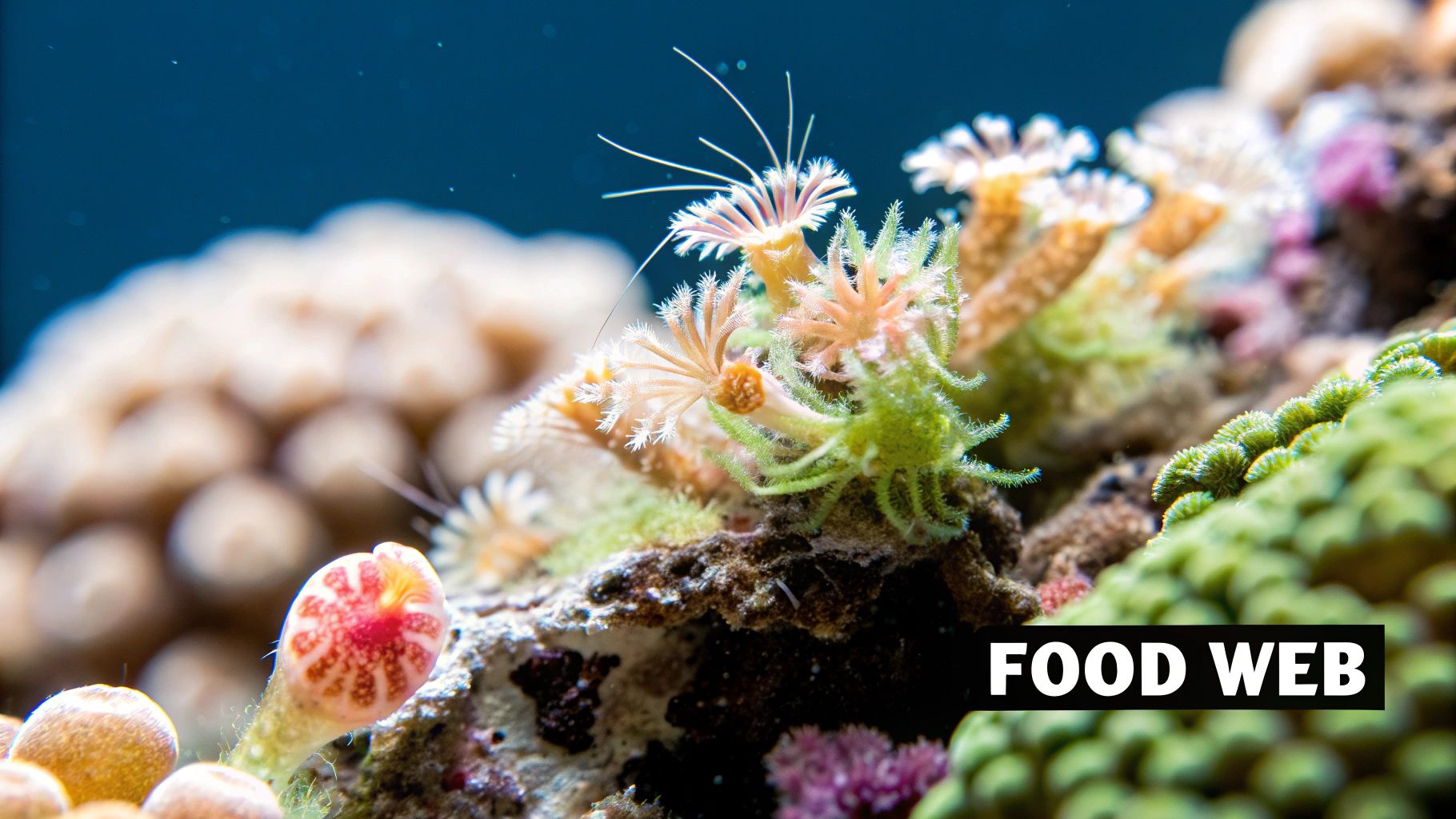
When you dose phytoplankton in your reef tank, you're doing a lot more than just spot-feeding your corals. You are kicking off an entire, self-sustaining food web right in your aquarium. It’s a shift in mindset: your tank isn't just a display case for pretty specimens, but a living, breathing miniature ecosystem.
The foundation of this ecosystem is your microfauna—copepods, amphipods, and other tiny critters. Phytoplankton is their primary fuel. Dosing live phyto directly feeds this "cleanup crew," letting them feast on the microscopic algae and pack themselves full of essential nutrients and fatty acids. This process is called gut-loading, and it turns your pods into tiny, nutritious snacks that swim all over your tank, just waiting to be eaten.
The Synergy of Phyto and Pods
This powerful partnership between phytoplankton and zooplankton is what truly makes a reef come alive. Instead of just relying on processed flakes or frozen cubes, you're cultivating a live, continuous source of nutrition. The difference is immediately obvious. Your fish and corals will show a much more natural feeding response, actively hunting and behaving more like they would in the wild.
This chain reaction benefits the whole system:
- Happy Fish: Picky eaters like mandarins, pipefish, and certain wrasses are notoriously hard to keep fed. A thriving copepod population gives them a constant supply of food to hunt, allowing them to truly flourish.
- Vibrant Corals: Don't forget that many corals actively hunt and eat copepods. This provides a protein-packed meal that perfectly complements the energy they get from photosynthesis through their zooxanthellae.
- The Hidden Crew: A whole host of organisms you might not even think about, like sponges, feather dusters, and clams, are filter feeders. They pull phytoplankton directly from the water, which helps support greater biodiversity throughout your tank.
By creating this crucial link at the very bottom of the food chain, you're building a more stable and resilient environment. If you want to dive deeper into these connections, you can explore the complete reef food chain in our detailed guide.
Establishing a robust phytoplankton-to-copepod food web is one of the most effective ways to build a truly stable and low-maintenance reef. It turns your tank into an active ecosystem rather than just a passive display.
A Growing Foundation for a Thriving Hobby
This approach—creating a natural, living food source from the ground up—is gaining serious traction as hobbyists look for more sustainable solutions. It's not just a niche idea anymore. The global live phytoplankton market, recently valued at around $145.2 million, is on the rise, reflecting its growing use in both commercial aquaculture and home aquariums. North America is leading this charge, thanks to advances in marine research and technology.
This trend makes one thing clear: reefers are embracing the power of building a natural food web from scratch. It's a move toward a more holistic, and ultimately more successful, way of caring for our little slice of the ocean.
Using Phytoplankton for Natural Algae Control
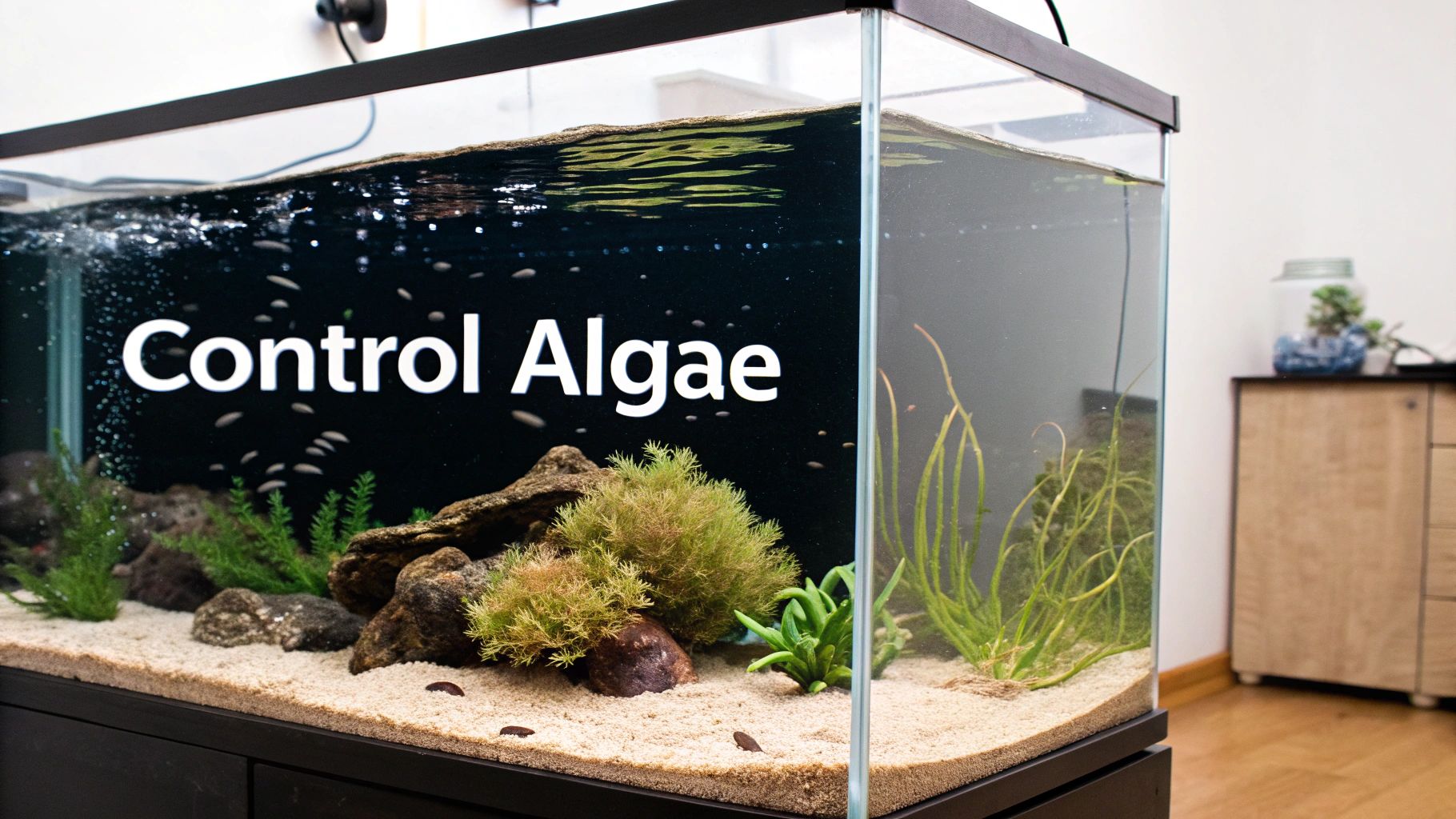
While most reefers think of phytoplankton as just another food source, its most powerful, and often overlooked, role is that of a silent janitor. Live phytoplankton is a biological powerhouse, constantly scrubbing your water clean of the very nutrients that fuel ugly algae outbreaks.
Think of your reef tank like a garden. You can spend all your time pulling weeds (the nuisance algae), or you can plant something you actually want—something that uses up all the space and resources so the weeds never get a chance to grow. Dosing a phytoplankton reef tank works on this exact same idea.
The Power of Competitive Exclusion
This natural process is called competitive exclusion. It's a pretty simple concept: when two organisms are fighting for the same limited resources, one will eventually win out. In your aquarium, the main resources up for grabs are dissolved nutrients like nitrates (NO3) and phosphates (PO4).
Both phytoplankton and your typical nuisance algae—like that slimy green hair algae or gross cyanobacteria—are hungry for these nutrients. By introducing a healthy, thriving population of live phytoplankton, you're intentionally starting a fight for food. The phytoplankton soak up the nitrates and phosphates to fuel their own growth, effectively starving the unwanted algae.
Your goal isn't to get nitrates and phosphates to zero, but to control who gets to eat them. By dosing phytoplankton, you’re picking a beneficial organism to win the nutrient war, turning potential waste into a valuable food source for your reef.
This changes everything. Dosing is no longer just a feeding strategy; it becomes a proactive way to keep your water pristine. Instead of reacting to an algae bloom with chemical removers and a scraper, you’re preventing it from ever getting a foothold in the first place.
Proactive Nutrient Export in Action
So, how does this actually play out in your tank? When you add live phytoplankton, it stays suspended in the water, photosynthesizing and soaking up nutrients. From there, one of two things happens, and both are great for your tank:
- It Gets Eaten: Your corals, copepods, and other filter-feeding critters consume the phytoplankton. This removes the captured nutrients from the water and turns them into growth.
- It Gets Skimmed Out: Any excess phytoplankton that doesn't get eaten is eventually pulled out by your protein skimmer, exporting those absorbed nitrates and phosphates from your system for good.
This two-pronged attack makes phytoplankton an incredibly efficient way to export nutrients and maintain stability and clarity. It's a sustainable approach that fits perfectly with the hobby's shift toward more natural, balanced ecosystems. In fact, the reef tank market is projected to hit $4.78 billion by 2032, driven by this exact desire for more sustainable practices. You can discover more insights about this trend and the growing reef tank market.
Ultimately, using phytoplankton for algae control means you’re working with your tank’s biology, not against it. You're cultivating a clean, balanced environment where your corals thrive and nuisance algae simply can't compete. The result is a healthier, more beautiful reef with a lot less scraping.
Answering Your Top Phytoplankton Questions
Even with the best game plan, you're bound to have questions when adding something new to your reef. Let's tackle the most common ones that pop up for hobbyists dosing phytoplankton. Think of this as your go-to guide for quick answers so you can dose with confidence.
These aren't just random tips; they build on everything we've already covered, giving you practical advice you can use right away.
Can I Overdose My Reef Tank with Phytoplankton?
Yes, you absolutely can, but don't panic—it's usually an easy fix. The real issue with overdosing isn't the phytoplankton itself, but what happens when it goes uneaten. It dies, breaks down, and can dump a bunch of nitrates and phosphates back into your water.
You'll know you've gone a bit too heavy-handed if you spot these tell-tale signs:
- Persistent Cloudiness: Your water stays green or hazy for hours on end instead of clearing up relatively quickly after dosing.
- Skimmer Overflows: Your protein skimmer goes haywire, pulling out a ton of wet, light-colored gunk and overflowing the collection cup.
- Sudden Algae Bloom: Out of nowhere, you see a fresh outbreak of nuisance algae, which is feasting on all those new nutrients.
The best way to sidestep this is to live by the "start low, go slow" rule. Kick things off with a conservative dose—something like 5ml per 20 gallons—and slowly ramp it up over a few weeks. If you see any of the warning signs, just back off the dose or even skip a day to let your tank catch up.
Should I Turn Off My Skimmer When Dosing?
This is a great habit to get into, especially if you're dosing by hand. Shutting down your protein skimmer for about 30 to 60 minutes right after you add the phyto creates a crucial window. It gives your corals, pods, and other filter feeders a chance to grab a meal before the skimmer yanks it all out of the water column.
It's a simple step, but it makes a huge difference in how much nutritional benefit your tank actually gets from each dose. More food for your inhabitants, less for the skimmer cup.
The exception to this rule? Automated dosing pumps. Since a doser is adding tiny, steady amounts all day long, it never really overwhelms the system. In that scenario, leaving your skimmer on 24/7 is totally fine and helps keep your water quality rock-solid.
What Is the Difference Between Live and Dead Phyto?
This is a big one. The difference between live and dead (often called "preserved") phytoplankton is more than just freshness—it's about its entire function in your reef tank.
Live phytoplankton is a living, breathing organism. When you pour it into your aquarium, it keeps doing its thing: consuming nitrates and phosphates from the water and actively helping you keep things clean. It also stays suspended in the water longer, giving your filter feeders a much better shot at catching it. It’s both a nutrient export tool and a far superior food source.
Dead phytoplankton, on the other hand, is just food, nothing more. It’s usually sold as a preserved liquid or even a powder, and the moment it hits the water, it starts to break down. Any cells that aren't eaten quickly begin to decompose, adding to the nutrient load in your tank—potentially fueling the very algae you were hoping to combat.
For a truly healthy and balanced phytoplankton reef tank, live culture is always the way to go. It helps build your ecosystem from the microscopic level up, while dead phyto just adds nutrients to it. By choosing live, you get the whole package of benefits, from cleaner water to a booming, self-sustaining food web.
Fuel your reef's entire food web with the highest quality live nutrition. PodDrop Live Reef Nutrition delivers freshly cultured, nutrient-rich phytoplankton and copepods directly to your door, ensuring every drop adds life and vitality to your aquarium. Start building a more vibrant and stable ecosystem today at https://www.getpoddrop.com.