


Hair algae in saltwater tank: A definitive guide to beating it
- fabianbehague
- Dec 5
- 16 min read
If you’re seeing long, green strands smothering your rockwork and corals, you’re not just imagining things. That dreaded hair algae is one of the most common headaches for reef keepers. The good news? It’s completely beatable once you understand what’s fueling its growth. Almost every time, the root cause is a simple imbalance of nutrients, light, and flow.
Understanding Why Hair Algae Is So Common
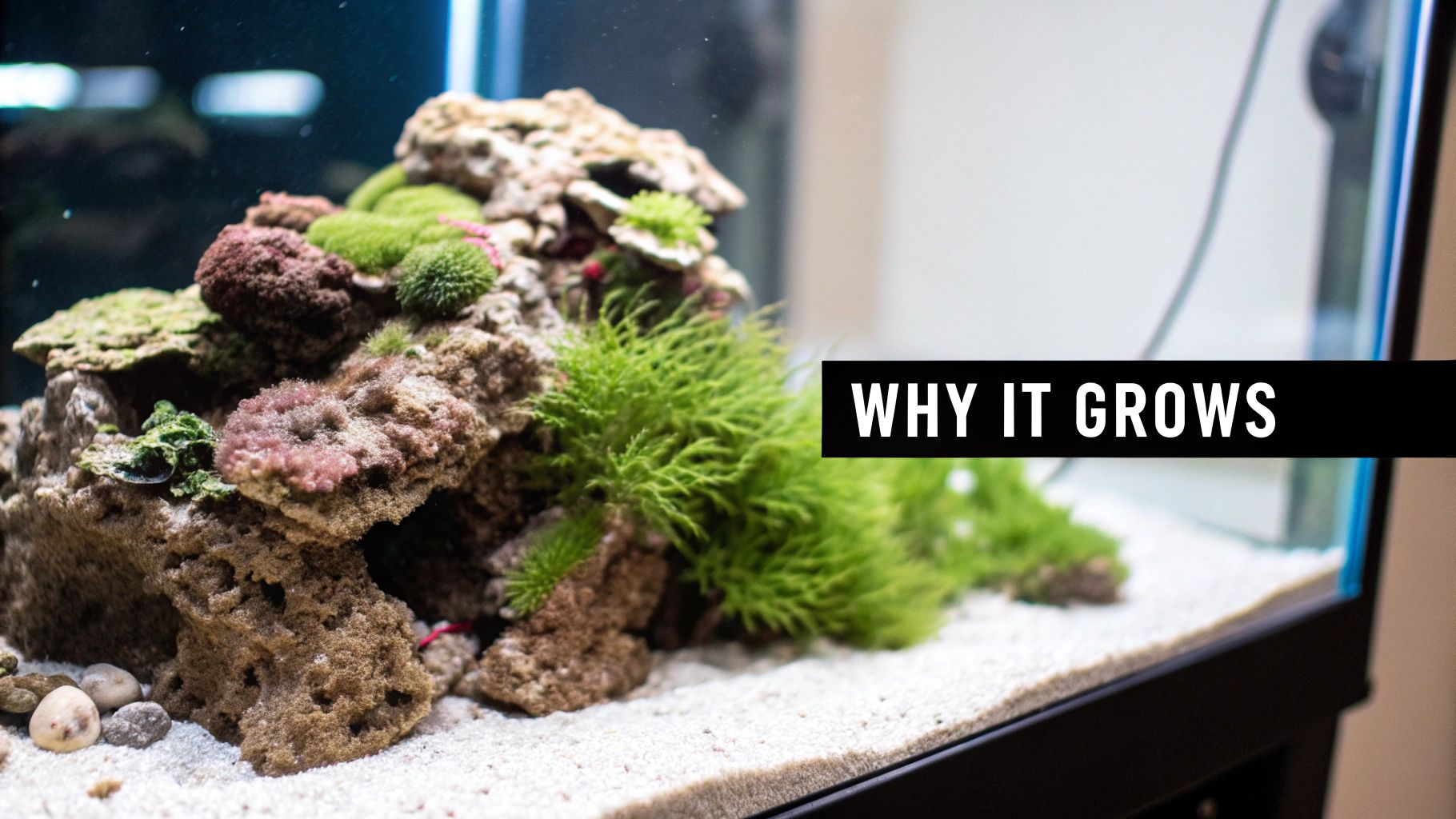
Seeing hair algae isn't a sign that you’ve failed as a reefer. It’s simply a sign of opportunity—an opportunity for this fast-growing algae to exploit the resources in your tank. Think of your aquarium as a tiny ecosystem where everything is competing for food and light. When certain resources get out of whack and become too abundant, the balance tips, and the fastest growers win. In this case, that’s your nuisance algae.
Before we dive into solutions, let's break down the common culprits behind these outbreaks. The table below outlines the core problems we see time and time again and the ideal parameters you should be aiming for to keep hair algae at bay.
Primary Causes of Hair Algae Outbreaks
Factor | Problem Condition | Ideal Parameter |
|---|---|---|
Nutrients | Nitrates (>10-20 ppm) and Phosphates (>0.05 ppm) are too high. | Nitrates: <5 ppm / Phosphates: <0.03 ppm |
Lighting | Photoperiod is too long (>10 hours), or the light spectrum is off. | Photoperiod: 8-9 hours; PAR appropriate for corals. |
Water Flow | "Dead spots" with low or stagnant flow allow detritus to settle. | Sufficient, randomized flow to keep detritus suspended. |
Husbandry | Irregular water changes, overfeeding, or using tap water. | Weekly water changes; feed sparingly; use RO/DI water only. |
This isn't just about tweaking one thing; it's about seeing how all these factors work together. A tank with slightly high nutrients might be fine until you also have a dead spot in your flow, creating the perfect storm for an algae farm.
The Nutrient Connection
Every single thing you do impacts your tank’s nutrient levels. Overfeeding your fish, failing to rinse frozen foods, skipping water changes, or using unfiltered tap water all dump phosphates and nitrates into the system. These nutrients accumulate and become a 24/7 buffet for hair algae spores, which are always present, just waiting for the right conditions to explode.
I see this all the time: a reefer insists their nutrients are "zero" because that's what their test kit says. But in a tank choked with algae, the algae itself is consuming the nitrates and phosphates as fast as they appear. The algae is your positive test result, effectively hiding the true nutrient load from your kit.
Lighting and Flow Dynamics
Your lighting schedule and the type of lights you use are a huge piece of the puzzle. Running your lights for more than 8-10 hours a day is just giving algae extra time to photosynthesize and spread. Older T5 or metal halide bulbs are also notorious for shifting their light spectrum over time, often moving into a range that algae loves far more than your corals do.
Water flow is the final, critical element. Those stagnant areas in your tank, usually behind the rockwork or in the corners, are algae’s best friends. They become collection points for fish waste and uneaten food. Without enough flow to kick that detritus up into the water column for your filtration to grab, it just sits there, breaks down, and feeds the algae right at the source.
Understanding how these elements interact within the broader coral reef food web is the first step. Once you get it, you can start building an environment that naturally starves out algae instead of feeding it.
Pinpointing Your Tank's Algae Fuel Source
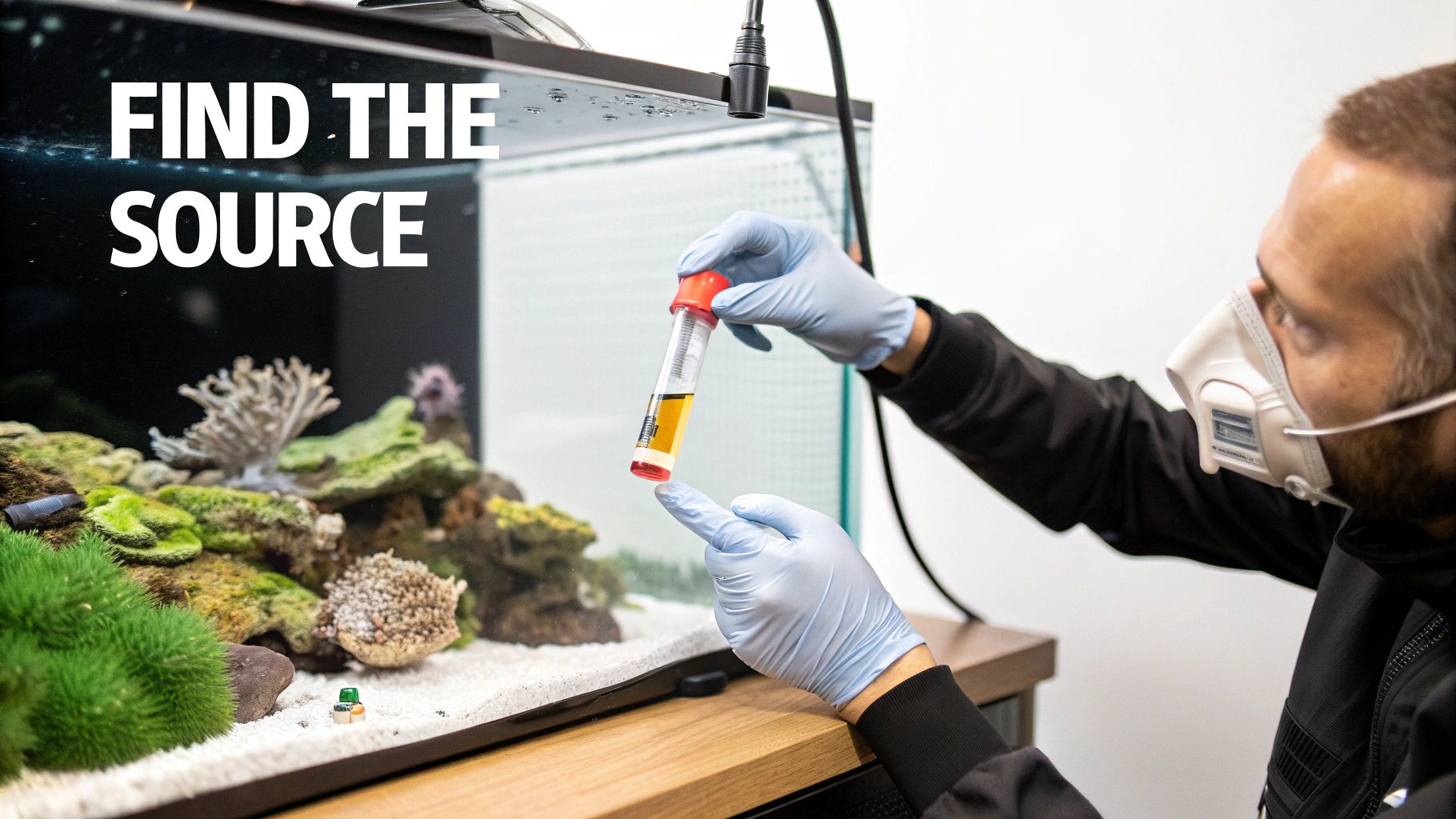
To win the war against hair algae, you have to think like a detective. Simply yanking the stuff out without figuring out what’s feeding it is a battle you'll never win. It’s just a temporary fix. You need to investigate every part of your system to find the specific fuel source, and it almost always goes beyond a single water test.
Think of your nitrate and phosphate test kits as your first clues. If you get high readings, you’ve probably found your smoking gun. But here's the trap many fall into: a tank completely overrun with algae might show deceptively low or even zero readings. Why? Because the algae is eating those nutrients as fast as they appear. Your first real step is to look past the vial and into your daily habits.
Scrutinizing Your Nutrient Inputs
More often than not, the root cause of excess nutrients is something in our own husbandry routine. Small, overlooked habits can stack up and have a massive impact over time.
Start with how you feed your tank. Are you just dumping food in and letting it float around, or are you target-feeding your fish? A classic mistake is failing to rinse frozen foods like mysis shrimp. That cloudy liquid it's packed in? It’s pure phosphate juice, going straight into your water column.
Next, look at your water source. Using tap water for top-offs or water changes is a huge red flag. It’s often loaded with nitrates, phosphates, silicates, and other junk that acts like rocket fuel for algae. A quality Reverse Osmosis Deionization (RO/DI) unit isn't a luxury; it's a non-negotiable piece of equipment for long-term success.
Finally, check your mechanical filtration. Are those filter socks or sponges being cleaned every couple of days? If not, they stop being filters and turn into nitrate factories, slowly leaching all the gunk they trapped right back into the system. Our detailed guide on how to reduce nitrates in a saltwater aquarium offers a deeper dive into tackling this.
I once helped a reefer who was tearing his hair out over a relentless algae outbreak, even though his water parameters tested "perfect." The culprit? He was meticulously cleaning his filter socks but tossing them back in the sump while still damp. That tiny bit of moisture allowed bacteria to break down micro-particles of waste, creating a slow, steady nutrient drip that his hair algae absolutely loved.
Assessing Your Lighting and Flow
Your lighting is another critical piece of the puzzle. It’s not just about how long your lights are on, but also their age and spectrum. The link between lighting and algae is well-documented. For instance, studies have shown that tanks using older T5 or metal halide bulbs—past the 9-12 month mark—had a 70% higher incidence of green hair algae. As these bulbs age, their light spectrum shifts toward the red end, which nuisance algae uses for photosynthesis way more efficiently. This proves that swapping bulbs on schedule isn't just a suggestion; it's a measurable way to prevent problems.
Poor water flow creates another golden opportunity for algae. Grab a turkey baster and gently puff some water around your rockwork, especially in the corners and behind structures. If you see clouds of detritus lift off, you've found a dead spot. These low-flow zones let waste settle and decompose, creating a localized, all-you-can-eat buffet right where hair algae loves to set up shop. A strategically placed powerhead can make all the difference.
By methodically checking these three areas—nutrients, lighting, and flow—you can build a complete picture of your tank's weaknesses and create a targeted plan of attack.
Putting Your Algae Removal Plan into Action
Alright, you've figured out what's feeding the beast. Now it's time to get your hands wet and start winning the war. This phase is all about direct, immediate action—getting that ugly green stuff out of your tank so you have a clean slate to work with. A smart combination of manual removal and, if needed, targeted treatments can turn the tide surprisingly fast.
But here’s the key: the goal isn’t just to make the rocks look pretty again. Every strand of hair algae is a little bag of nutrients. If you just scrub it loose, it breaks apart, floats around, and releases all those nitrates and phosphates right back into the water to fuel the next bloom. You have to be strategic.
Going Hands-On with Manual Removal
Your best friends at the start of this battle are remarkably low-tech: a toothbrush, some tweezers, and your trusty siphon hose.
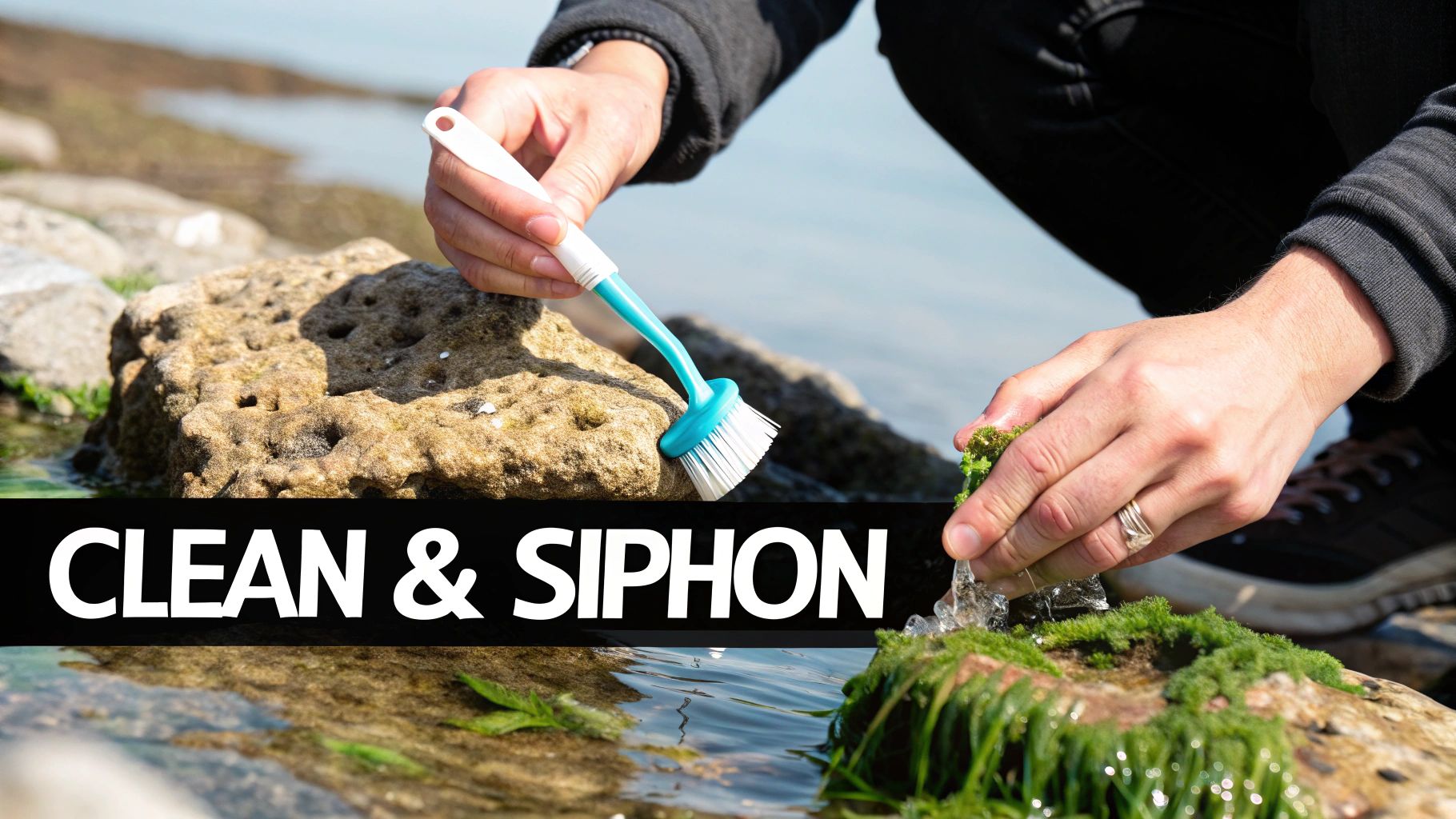
For those thick, ugly mats of algae covering your rockwork, a firm-bristled toothbrush is your go-to weapon. Get in there and scrub it loose. For the more delicate work, like picking strands from the base of a coral, a pair of tweezers will give you the precision you need without causing any damage.
Now for the most important part of the process. Do not just scrub and call it a day. The real trick is to time your manual removal with a water change. As you scrub the algae off the rocks, immediately follow with your siphon hose, sucking up all the floating green debris. This one-two punch physically removes both the algae and the nutrients locked inside it from your system for good.
Pro Tip: Before you start scrubbing, turn off your powerheads and return pump. This kills the water flow and stops you from creating an algae snow globe. The dislodged clumps will hang in the water, making them ridiculously easy to siphon out before they can settle somewhere else.
By making aggressive siphoning part of your scrubbing routine, you're doing more than just a surface clean. You're actively exporting the very nutrients that caused the problem.
Targeted Chemical Treatments
Sometimes, manual removal just won't cut it. For the really stubborn stuff, especially the dreaded Bryopsis, a targeted chemical intervention can be a game-changer. But let's be clear: these are a "reset button," not a long-term solution or a substitute for fixing the root cause.
Two of the most common approaches are a localized hydrogen peroxide dip or a tank-wide fluconazole treatment.
Hydrogen Peroxide Dip: This is strictly for treating individual rocks outside your display tank. Pull an affected rock out and place it in a bucket of tank water. Using a pipette or syringe, apply 3% hydrogen peroxide directly to the hair algae. You'll see it fizz and bubble immediately—that's the algae oxidizing. After a few minutes, give the rock a good rinse in a second bucket of clean saltwater before putting it back. Never, ever add hydrogen peroxide directly into your display tank.
Fluconazole Treatment: This antifungal medication is the go-to for Bryopsis and can be effective against other tough green hair algae strains. It works by blocking an enzyme the algae needs to maintain its cell walls. The standard dose is 20 mg per gallon, with a full treatment course running for about 14 days.
Using Fluconazole the Right Way
If you decide fluconazole is the right move, you have to do the prep work. This is a potent medication, and cutting corners can have serious, unintended consequences for your reef.
Before you add a single drop, you must take these steps:
Pull Your Chemical Filtration: Get rid of any activated carbon, GFO, or other chemical media. They will absorb the fluconazole right out of the water, making the treatment useless.
Turn Off Your Skimmer & UV: A protein skimmer can pull the medication out, and a UV sterilizer can break it down. It’s best practice to turn them both off for at least the first few days.
Boost Your Aeration: As all that algae dies off, the decomposition process will chew through oxygen. Since your skimmer is off, you need to make sure you have plenty of surface agitation from your powerheads or even an air stone to keep oxygen levels stable.
During the 14-day treatment, you should see the algae weaken, turn white, and start to fall apart. Once it's complete, do a solid water change (20-30%) and put fresh chemical media back in your system to mop up any leftover medication. Fluconazole is generally considered reef-safe, but remember, it only treats the symptom. If you don't fix the underlying nutrient problem, the algae will be back.
Assembling Your Ultimate Algae Clean-Up Crew
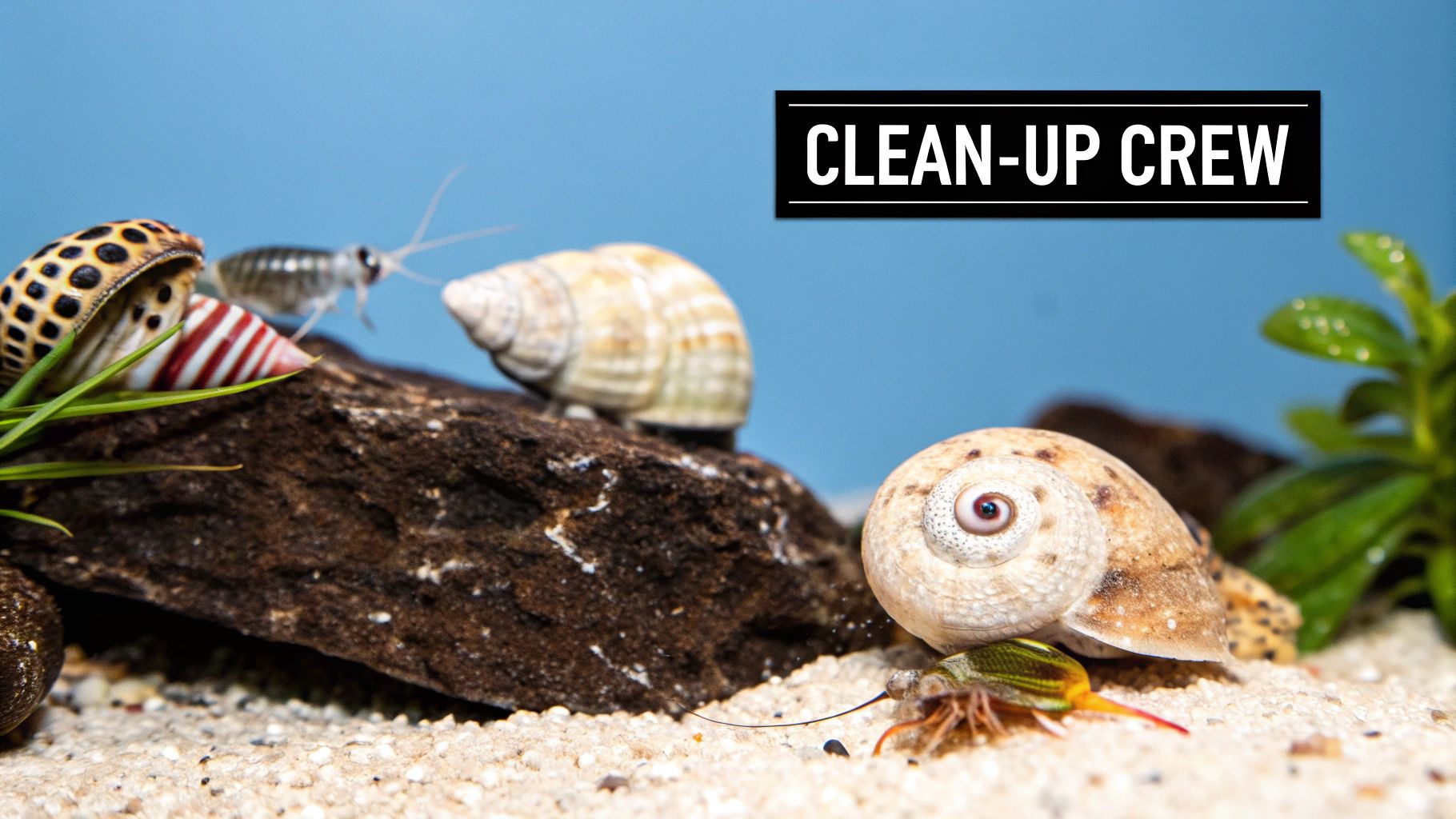
You’ve done the hard part—all that scrubbing and siphoning—and you can finally see your rockwork again. Now comes the critical next step. It’s time to bring in a living, breathing maintenance team—your clean-up crew—to make sure that hair algae in your saltwater tank doesn't just creep right back.
Putting herbivores to work isn't a shortcut; it's a core part of building a balanced, resilient reef ecosystem. A well-chosen crew grazes around the clock, picking off tiny, invisible bits of new algae long before they become a problem you can see. This is biological control at its best, and it's far more sustainable than constantly battling algae by hand. The real secret is diversity, since different critters are specialists at cleaning different surfaces.
The Foundation: Your Snail and Crab Brigade
Think of snails and crabs as the infantry of your clean-up crew. They are the tireless ground troops, methodically covering every inch of your tank, from the glass panels to the deepest crevices in your live rock.
Trochus Snails: These pyramid-shaped snails are absolute champions on rockwork. Their mouths are perfectly shaped for scraping algae off uneven surfaces, and they have the huge advantage of being able to flip themselves over if they fall.
Mexican Turbo Snails: When you’ve got a serious hair algae problem, these are the heavy-duty lawnmowers. A single Turbo can mow down a thick patch of algae overnight. Just be warned, they're like little bulldozers and can easily knock over unsecured coral frags.
Cerith Snails: These smaller snails are fantastic for cleaning both the rocks and the sandbed. Their long shells allow them to burrow slightly, which helps aerate the sand while they munch on detritus and algae in hard-to-reach spots.
Blue Leg Hermit Crabs: While they don't exclusively eat hair algae, these little hermits are amazing scavengers. They'll constantly pick at algae films and gobble up leftover food before it can break down and fuel the next outbreak.
Building a crew isn't just about throwing numbers at the problem; it's about strategy. You want a mix where some snails prefer the glass (like Nerites), others tackle the rocks (Trochus), and a few work the sand (Ceriths). This creates comprehensive coverage with no weak spots for algae to exploit.
Bringing in the Specialist Grazers
While snails and crabs form the backbone of your crew, some situations call for specialists—animals with a unique appetite or the ability to handle severe algae invasions. These aren't necessary for every tank, but in the right circumstances, their impact can be massive.
The power of biological controls is no joke. A 2021 survey showed that reef tanks with a diverse mix of herbivores saw a 50–70% reduction in visible hair algae over just three months. Some specialists are even more dramatic. The wedge sea hare (Dolabella auricularia), for example, has been documented reducing hair algae biomass by over 90% in a 200-gallon system in under a month, consuming nearly twice its body weight in algae every single day. The data is clear: a solid clean-up crew is one of the most significant factors in winning this fight.
The Heavy Hitters: Fish and Urchins
For larger tanks with stubborn issues, adding herbivorous fish and urchins can provide the extra grazing pressure needed to keep hair algae gone for good. Of course, these bigger animals require more thought when it comes to tank size and compatibility.
A Lawnmower Blenny (Salarias fasciatus), for instance, is a fish loaded with personality that spends its days scraping algae from rocks and glass with its comb-like teeth. They are fantastic workers but need a well-established tank of at least 30-40 gallons to ensure they have enough natural food to graze on.
If you want to explore a wider variety of animals that can help, take a look at our complete guide on the best hair algae eaters for your marine tank.
Tangs, like the ever-popular Yellow or Kole Tang, are also relentless grazers. Adding one comes with a major responsibility, though. These are active, open-water swimmers that demand large tanks—we're talking 100 gallons or more for most common species—to truly thrive. Never put a Tang in a small tank planning to upgrade "later." That's a surefire way to end up with a stressed, unhealthy fish.
Finally, you might consider a Pincushion or Tuxedo Urchin. These mobile grazers are literal algae-eating machines, clearing perfect, clean paths across rockwork. Their only real downside is a quirky habit of picking up and carrying around loose frags or shells as camouflage. So, if you add one, make sure your corals are glued down securely! By layering these different specialists, you build a multi-pronged defense that keeps your reef sparkling clean from the sandbed to the highest peaks of your aquascape.
Top Hair Algae Clean-Up Crew Comparison
Choosing the right combination of herbivores is key to long-term success. Not every animal is suited for every tank, so it's important to match the crew to your specific system size and inhabitants. This table breaks down some of the most popular and effective options.
Organism | Effectiveness on Hair Algae | Minimum Tank Size | Reef Safe? |
|---|---|---|---|
Trochus Snail | High | 10 Gallons | Yes |
Mexican Turbo Snail | Very High | 20 Gallons | Yes (but clumsy) |
Cerith Snail | Moderate | 5 Gallons | Yes |
Lawnmower Blenny | High | 30 Gallons | Yes |
Tuxedo Urchin | Very High | 20 Gallons | Yes (will move frags) |
Yellow Tang | High | 100 Gallons | Yes |
Foxface Rabbitfish | High | 75 Gallons | With Caution |
Sea Hare | Extreme | 30 Gallons | Yes (short-term specialist) |
By picking a few options from this list that fit your tank's needs, you can create a diverse team that works together. The combination of different grazing styles and preferences ensures that no single type of algae can gain a foothold, keeping your reef clean and healthy without constant manual intervention.
Creating a Bulletproof Reef Tank for Good
Alright, you’ve put in the elbow grease. You've scrubbed the rocks and sicced a clean-up crew on the leftovers. Now for the real work: making your tank a place where hair algae simply can't make a comeback.
This is where you stop playing defense and start playing offense. We're going to architect an ecosystem that naturally starves out nuisance algae before it ever gets a chance. The goal isn't just a clean tank for a week—it's building a stable, vibrant reef that shrugs off algae outbreaks for years.
The whole strategy boils down to one simple concept: nutrient control. Every single frustrating strand of hair algae is just a symptom of excess fuel in your water. If we cut off the fuel supply for good, the problem solves itself.
The Unbreakable Rule: Start with Pure Water
Let's get one thing straight from the start. Your number one commitment has to be using high-quality Reverse Osmosis Deionization (RO/DI) water for every top-off and water change. Period.
Using tap water, even if you treat it, is like pouring fertilizer directly into your tank. It’s often packed with nitrates, phosphates, and silicates—an invisible buffet for hair algae. This is probably the single most common mistake I see reefers make.
Sticking to a weekly water change of 10-20% with pure RO/DI water does more than just dilute nutrients. It also replenishes the crucial trace elements your corals need to grow strong and healthy. And when your corals are thriving, they naturally outcompete algae for light and space. Your RO/DI unit isn’t just a piece of gear; it’s the absolute foundation of a stable reef.
An algae-resistant tank isn't sterile. It’s a balanced ecosystem where the rate of nutrient export (removal) is consistently higher than the rate of nutrient import (feeding). When export wins, algae loses.
Supercharge Your Nutrient Export
Water changes are essential, but in a well-fed tank, they're often not enough to keep up. That’s where you need some heavy hitters working around the clock to pull those nitrates and phosphates out of the water.
You've got a few fantastic options here, and they work best in combination:
Granular Ferric Oxide (GFO): This stuff is a phosphate magnet. Phosphates are often the key ingredient algae needs to explode, and GFO media actively binds with it, pulling it out of circulation. Running it in a dedicated media reactor is the most efficient way to maximize its contact with your tank water.
Protein Skimmers: A good, oversized protein skimmer is your first line of defense. It yanks organic gunk out of the water before it has a chance to break down into nitrate and phosphate. Just be sure to clean that collection cup religiously—a dirty skimmer isn't doing its job.
Refugiums: This is my personal favorite for natural, long-term stability. A refugium is just a dedicated space (usually in your sump) where you grow beneficial macroalgae, like Chaetomorpha. This "spaghetti algae" is a direct competitor to hair algae, consuming the exact same nutrients. As it grows, you simply harvest a chunk of it, physically removing those locked-up nitrates and phosphates from your system for good.
Unleash the Micro-Janitors
Here’s a piece of the puzzle that too many reefers overlook: a thriving population of microfauna, especially copepods. Think of these tiny crustaceans as the invisible clean-up crew working in every nook and cranny of your reef.
Copepods are constantly scurrying over your live rock and sand, munching on detritus, leftover food, and biofilm before it can rot and fuel an algae bloom. They tackle the problem at the source, preventing the buildup of that organic sludge that every hair algae in saltwater tank outbreak feeds on.
Actively seeding your tank and refugium with a quality live culture, like PodDrop, establishes a self-sustaining army of these tiny janitors. This microscopic clean-up crew is the final, crucial layer in a truly balanced system. You can get a better sense of how these critters support your tank by exploring the role of live nutrition in a reef ecosystem.
When you combine these strategies—pristine water, powerful nutrient export, and a booming microfauna population—you build a multi-layered defense. Your tank transforms from a fragile environment on the edge of disaster into a resilient, self-regulating reef where your corals flourish and nuisance algae simply doesn’t stand a chance.
Tackling Your Toughest Hair Algae Questions
Even with a battle plan, hair algae can throw some curveballs. It’s one of those things that leads to some serious head-scratching moments for reefers, new and old. Let's dig into a few of the most common questions I hear and get you some straight, no-nonsense answers.
Can I Ever Completely Get Rid of Hair Algae Spores?
Let's be realistic: no. Hair algae spores are everywhere in a marine environment. They’re microscopic hitchhikers that can catch a ride on anything wet you add to your tank—a new frag plug, a snail's shell, you name it. The goal isn't to create a sterile, algae-free box. Frankly, that's impossible.
The real goal is to build an ecosystem so balanced and healthy that those spores never get the chance to take hold. Think of it like a garden. You can’t stop weed seeds from blowing in from next door, but you can create conditions where your prize-winning tomatoes grow so well they completely outcompete everything else. Long-term victory is all about consistent nutrient management and having a vigilant clean-up crew that nips any new growth in the bud.
Why Do I Have Algae If My Nutrients Test Zero?
Ah, the classic reefing paradox. This is the one that drives hobbyists absolutely bonkers. Your tank is covered in thick, green hair algae, yet your fancy nitrate and phosphate test kits are both screaming 0.00 ppm. So, what gives?
This doesn't mean you don't have a nutrient problem—it means you have a massive one.
The algae itself has become a giant, green nutrient sponge. It’s sucking up nitrates and phosphates the second they’re produced from fish waste or uneaten food. Your test kit reads zero because there are no free-floating nutrients left in the water for it to measure. The algae has already gobbled it all up and locked it away in its own tissue.
In this situation, the algae is your positive test result. It’s the most accurate indicator you have. Once you start pulling that algae out and exporting the nutrients it contains, you’ll probably see your nitrate and phosphate levels finally show up on your tests. Only then can you start tackling the source.
Will a Blackout Period Kill My Hair Algae?
Going "lights out" for 2-3 days can definitely knock back a hair algae outbreak. By cutting off its light source for photosynthesis, you can weaken and kill a good amount of it. This is a great tactic to use right before a big manual removal session, as the weakened algae will practically fall off the rocks.
But a blackout is a temporary tactic, not a permanent solution. It’s a setback for the algae, but it also stresses your corals and other photosynthetic critters. More importantly, if you haven’t fixed the underlying nutrient problem, the hair algae will roar back—often worse than before—as soon as the lights come on.
Think of a blackout as a strategic weapon to gain the upper hand. Use it to make your cleaning efforts more effective, but never rely on it as a standalone fix. Without fixing the root cause, you're just signing up for another round in a fight you can't win.
At PodDrop Live Aquarium Nutrition, we know that a thriving microfauna population is the bedrock of an algae-resistant reef. Seeding your tank with our live copepods helps break down detritus before it can ever become algae fuel, building a cleaner, more stable ecosystem from the ground up. Find out more on our website.
Comments