

Mandarin Dragonet Diet: what do mandarin dragonets eat?
Mandarin Dragonets are true specialists, the kind of fish that makes you rethink how a reef tank really works. They are micro-predators, and their entire world revolves around hunting live, microscopic crustaceans. Their absolute favorite, and the cornerstone of their diet, is copepods.
This is the make-or-break detail for keeping them. Unlike your clownfish or tangs, a Mandarin will almost always turn its nose up at standard flake or pellet foods. Their survival in an aquarium hinges entirely on having a constant, self-sustaining population of live food to graze on.
The Specialized Diet of Mandarin Dragonets
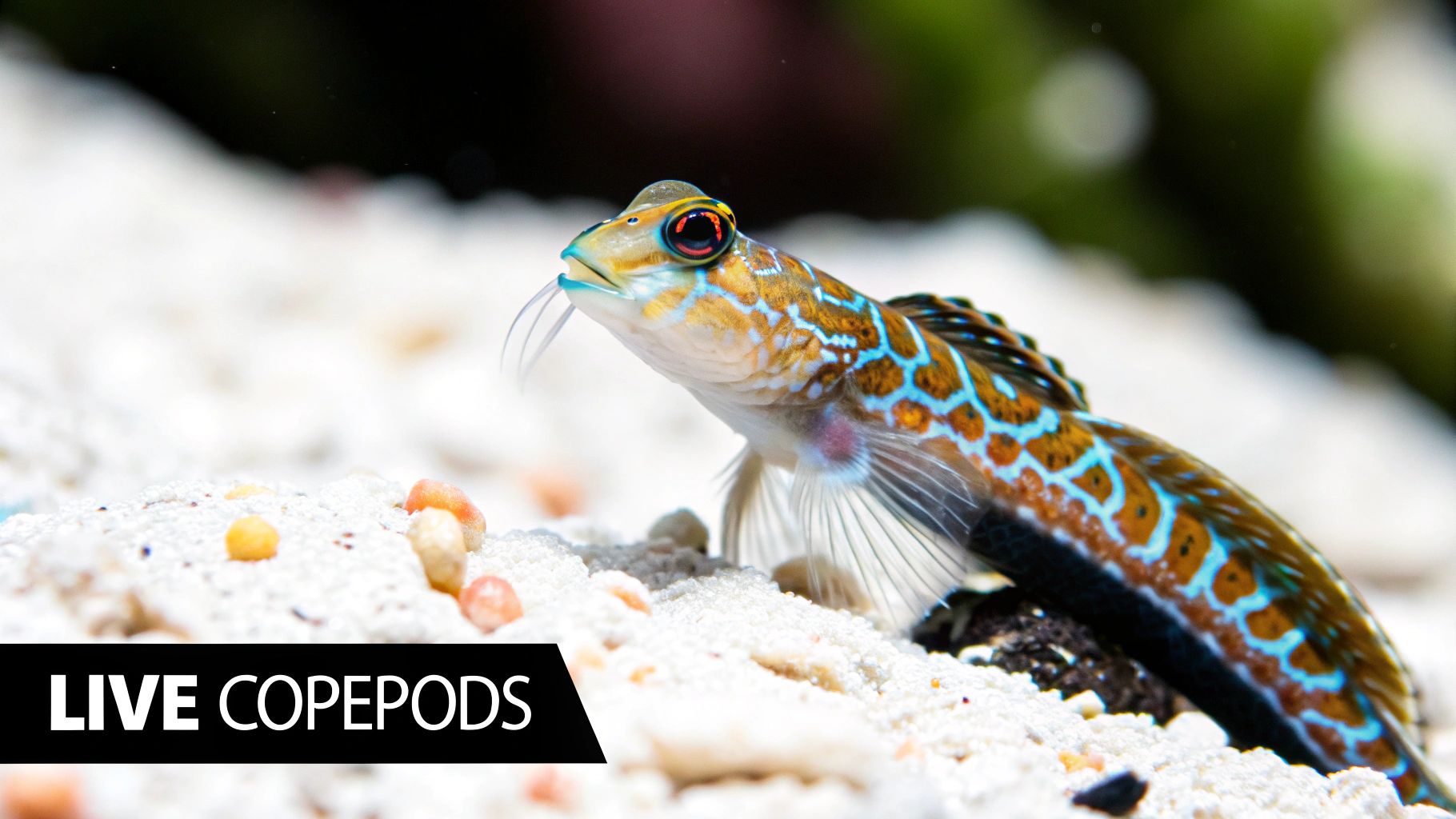
Many of the most popular fish in the hobby are opportunistic—they’ll happily gobble up whatever you offer. The Mandarin Dragonet is the polar opposite. They aren’t "meal-eaters"; they are constant, meticulous grazers.
All day long, you’ll see them methodically scanning every inch of live rock and sand. With their unique, protrusible jaws, they precisely suction up tiny prey that most of us can’t even see. This isn't just a preference; it's a deep-seated biological instinct.
It’s precisely this behavior that makes a brand-new, sterile tank a death sentence for a Mandarin. They don't just live in an ecosystem; they need to be part of a mature, living one that's already buzzing with microfauna.
What Is Their Natural Prey?
Out on the wild reef, a Mandarin's menu is surprisingly diverse, but it's made up almost entirely of tiny, living critters. Let's take a closer look at what they're hunting for in their natural habitat.
Natural Diet of a Mandarin Dragonet
| Food Source | Type of Prey | Importance in Diet |
|---|---|---|
| Harpacticoid Copepods | Bottom-dwelling copepods (Tisbe, Tigriopus) that crawl on surfaces. | Primary Food Source - The absolute staple of their diet. |
| Calanoid Copepods | Free-swimming copepods (Acartia) found just above the sand and rock. | Important secondary food source. |
| Amphipods | Slightly larger crustaceans that also live in the rockwork and sand. | A significant part of their diet, especially for larger Mandarins. |
| Other Microfauna | Tiny worms, small shrimp, and various invertebrate larvae. | Provides dietary variety and supplemental nutrition. |
This table really drives home one critical point: it’s all about the live prey. A Mandarin’s hunting instinct is triggered by the subtle movements of these tiny crustaceans. This is why they so often ignore motionless, processed foods like flakes or pellets—it simply doesn't register as food to them.
This specialized feeding strategy is why adding a Mandarin to your tank is a final step, not a first one. You have to cultivate their food source before they arrive. It's been well-documented that Mandarin Dragonets (Synchiropus splendidus) hunt continuously with a unique suction-feeding mechanism, relying on the natural microfauna of the reef.
To truly set your Mandarin up for success, you need to appreciate the incredible nutritional power packed into these tiny crustaceans. For a much deeper dive, you should explore the complete nutritional profile of copepods to see why they are the perfect fuel for these vibrant fish. Grasping this is the first real step toward successfully keeping one of the reef aquarium's most stunning, and rewarding, inhabitants.
Building a Living Pantry in Your Aquarium
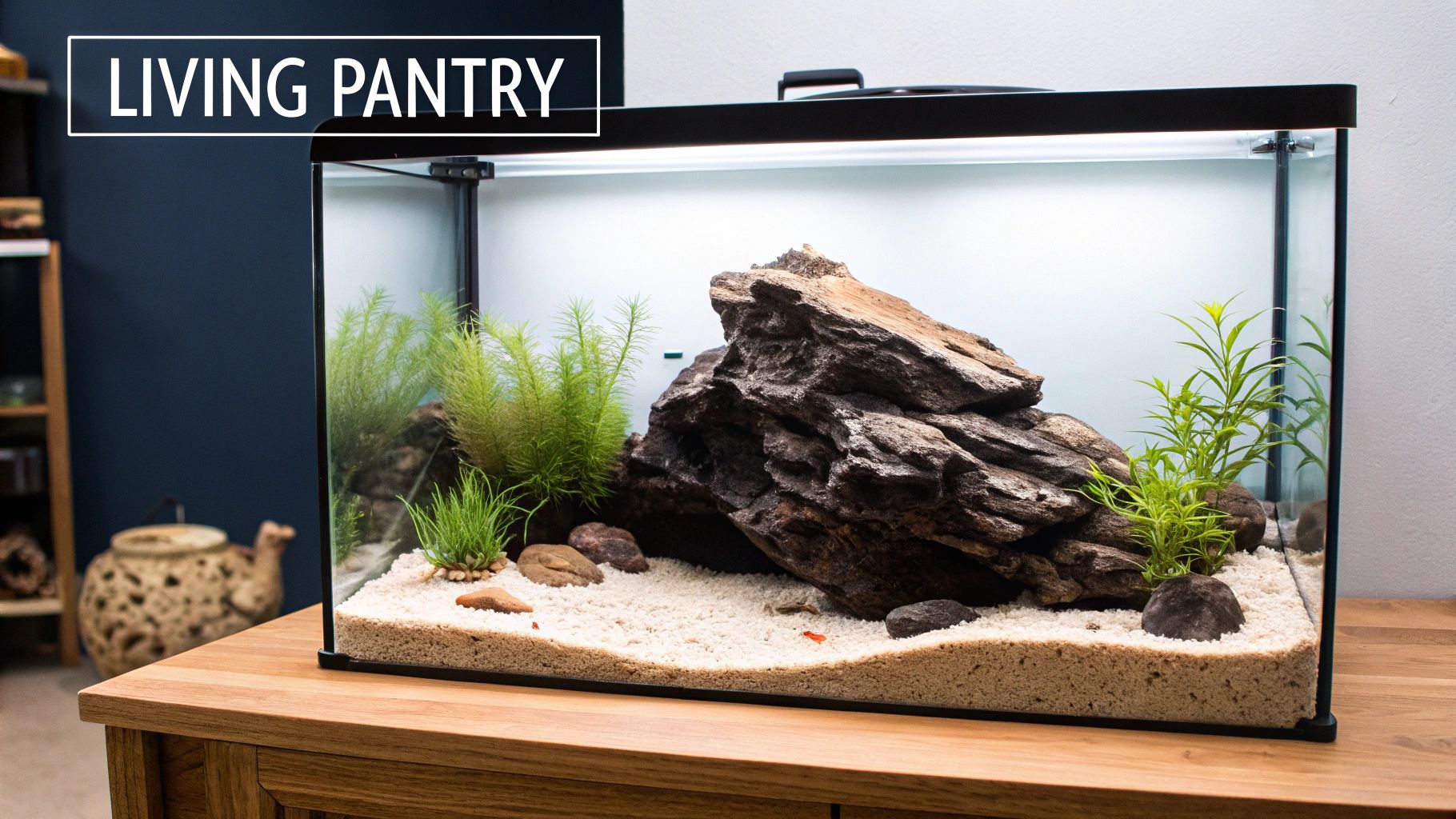
Knowing what mandarin dragonets eat is only half the battle. The real trick is recreating that all-you-can-eat buffet inside a glass box. You’re not just adding a fish; you're cultivating a microscopic food web. This is exactly why a brand-new, sterile aquarium is the worst possible home for a mandarin.
Success hinges on establishing a mature ecosystem—a "living pantry" that constantly restocks itself. Don't think of your live rock and sand bed as just decorations. They're the bustling metropolis where your mandarin's dinner lives and thrives. Porous live rock provides an endless maze of nooks and crannies for copepods to breed, safe from other hungry mouths.
A tank is generally considered “mandarin-ready” once it’s been running for at least six to twelve months. This gives the microfauna populations time to become stable and well-established.
The Foundation of a Mandarin-Ready Tank
So, what do you need for a thriving pod population? It boils down to two things: surface area and stability. A deep sand bed paired with a healthy amount of live rock is completely non-negotiable. These elements create the perfect breeding ground for the copepods and amphipods that make up the bulk of a mandarin's diet.
Want to know if your tank is ready? Turn off the pumps and grab a flashlight. Shine it on the glass and rockwork after the lights go out. If you see dozens of tiny white specks scurrying around, congratulations—you have an active copepod population. Those little critters are the sign that your living pantry is open for business.
Creating a Food Factory with a Refugium
One of the best ways to guarantee a constant food supply is to set up a refugium. Think of a refugium as a protected, predator-free apartment complex connected to your main tank. It’s a dedicated copepod breeding sanctuary.
A refugium isn't just another piece of gear; it's a food-production engine. By giving pods a safe haven with macroalgae like Chaetomorpha, you let them reproduce without pressure. This creates a steady stream of offspring that gets passively fed into the main tank for your mandarin to hunt.
In the hobby, people often say mandarins need a minimum tank size of 30 gallons, but the maturity of the ecosystem is infinitely more important. These fish need a constant supply of live copepods, which make up a staggering 70-90% of what they eat. It's estimated that a stable system needs to support a population of thousands upon thousands of copepods just to sustain a single mandarin.
This relentless need for food is why just having pods isn't enough. You have to create an environment where they reproduce faster than they get eaten. If you're just starting out, our guide on how to start with live copepods will help you build your living pantry from the ground up.
Culturing Live Foods for a Thriving Mandarin
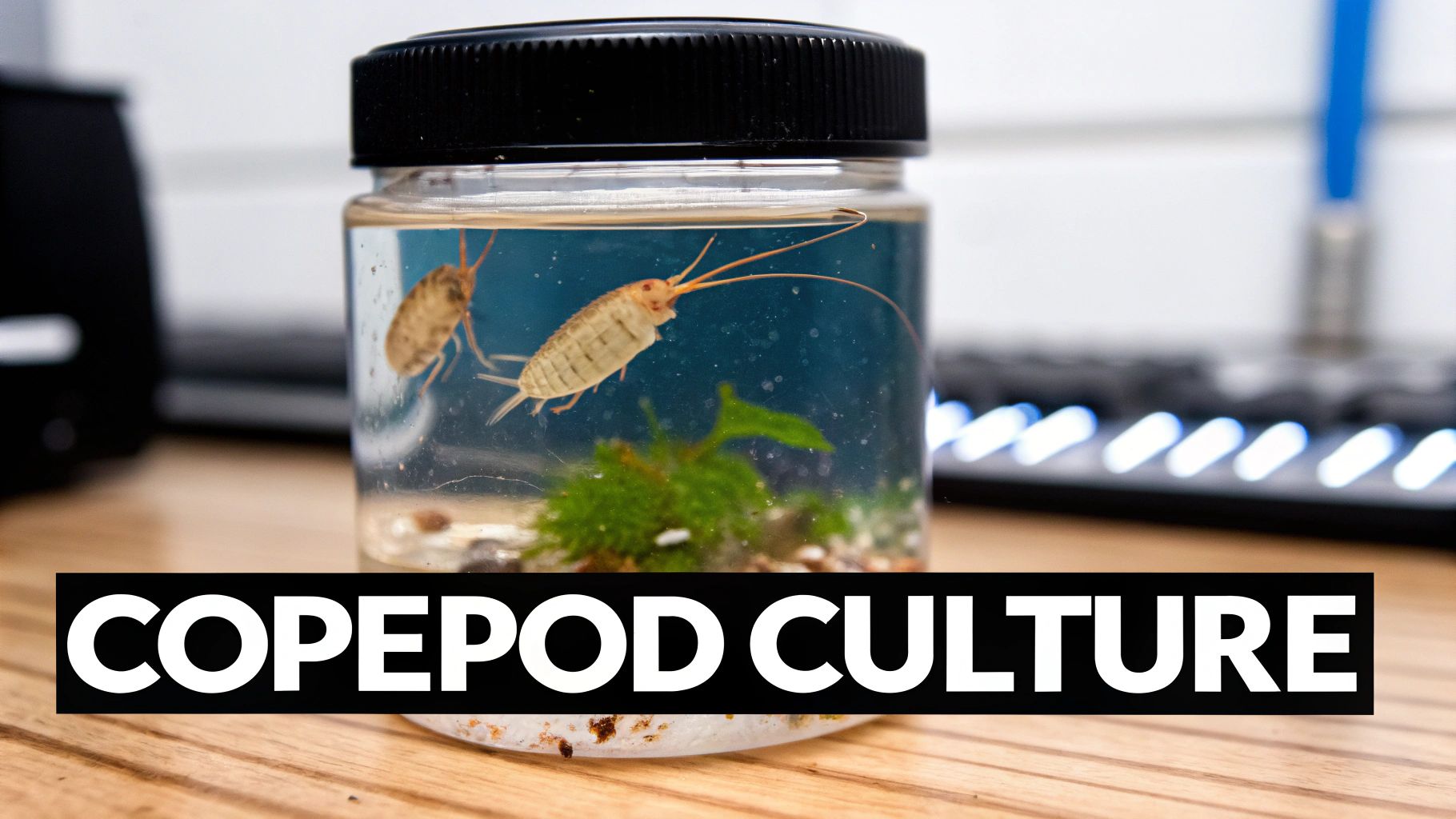
Relying on your tank’s natural microfauna is a good start, but it’s a gamble. To really give your mandarin the best shot at a long, healthy life, you need to think less like an aquarium owner and more like a farmer. Actively seeding your tank with live food cultures transforms it from a passive environment into a self-renewing buffet.
Honestly, this proactive approach is the single biggest key to success with these fish.
Think of it like tending a garden. You wouldn't just hope for wild tomatoes to sprout in your backyard. You plant seeds, you water them, and you give them fertilizer. It’s the exact same principle here: you need to seed your aquarium with copepods and then make sure those copepods have plenty to eat.
Choosing Your Copepod Cultures
Not all copepods are created equal. Different species play different roles in your tank's ecosystem, a bit like having different players on a sports team. Getting the right mix is crucial for giving your mandarin a varied and constantly available food source.
Here are the two most popular and effective types you'll find:
- Tisbe Copepods (Tisbe biminiensis): These guys are the ultimate colonizers. As benthic (bottom-dwelling) creatures, they spend their lives crawling through your live rock and sand, reproducing like crazy. They are the perfect species for seeding a refugium and establishing a permanent, self-sustaining population that just keeps on giving.
- Tigriopus Copepods (Tigriopus californicus): Think of these as the high-energy, free-swimming snack. They’re larger, much more active in the water column, and incredibly nutritious. While they won't establish a permanent colony as easily as Tisbe, they are a fantastic direct food source that mandarins absolutely love to hunt.
Most seasoned keepers use a combination approach. Use Tisbe pods to build the foundational, always-on food web in your rockwork and sand, and then add Tigriopus pods as a regular, nutritious treat that gets your mandarin actively hunting.
The Missing Link: Feeding Your Pods
Here’s the secret that separates the tanks where mandarins merely survive from the ones where they truly thrive: you have to feed the food. A healthy copepod population can't sustain itself long-term on just fish waste and leftovers. They need a primary food source, and in the ocean, that's phytoplankton.
Dosing live phytoplankton is like adding fertilizer to your copepod farm. It gut-loads your pods with the essential fatty acids and nutrients they need, turning them into tiny, swimming vitamin packs for your mandarin. Without this crucial step, your pod population will eventually boom, bust, and crash.
Adding phytoplankton like Nannochloropsis directly fuels this entire micro-ecosystem, making sure your copepods are healthy, plump, and constantly reproducing. You can get the full rundown on its benefits by learning more about why Nannochloropsis is an aquarium's best-kept secret in our detailed guide. It’s a small step that makes a world of difference for your mandarin's health.
Getting Your Mandarin to Eat Prepared Foods
While a healthy, reproducing pod population is the gold standard for mandarin care, getting your fish to accept prepared foods is an insurance policy you can't afford to skip. It provides a fantastic supplement to their natural diet, especially if you have other pod-eaters in the tank.
But let's be real: this is easily one of the trickiest training jobs in the entire saltwater hobby. It demands a level of patience that can test even the most seasoned aquarist.
Your odds of success go way up before you even bring the fish home. Captive-bred mandarins are, without a doubt, the easier path. They've likely been raised on prepared diets from day one, so they already know what that stuff is. Wild-caught mandarins, on the other hand, have spent their whole lives hunting tiny, wiggling prey—getting them to see a lifeless flake as "food" is a monumental task.
For these wild individuals, the secret is tricking their natural hunting instincts. You need to connect the dots for them, moving slowly from what they know (live food) to what you want them to eat. It's a slow, gradual transition, not a switch you can flip overnight.
A Step-by-Step Game Plan
The entire goal is to bridge the gap between live, wriggling critters and the frozen stuff in your freezer. You have to be methodical, moving from one food to the next only after the first is enthusiastically accepted. Think of it as a marathon, not a sprint.
-
Start with Live Brine Shrimp: Kick things off with live, newly hatched baby brine shrimp. Their jerky, frantic swimming is almost impossible for a mandarin to ignore. This gets your fish to see you as the source of a delicious meal appearing from thin air.
-
Mix in Frozen Brine: Once your mandarin is hammering the live brine shrimp, it's time for the first big step. Start mixing in a small amount of frozen baby brine shrimp with the live ones. The familiar look and smell often tempt them into trying the stationary food.
-
Upgrade to Mysis Shrimp: After your mandarin reliably eats the frozen brine, you can start introducing more nutritious options like frozen mysis shrimp. Begin by mixing just a few pieces in with the brine, and over days or weeks, slowly shift the ratio until mysis is the main event.
Tools and Tricks for Success
Simply dropping food into the tank and hoping for the best is a recipe for failure. Mandarins are slow, deliberate hunters; they need their meal presented right in front of them, away from the chaos of faster tank mates.
Target feeding is absolutely non-negotiable. Grab a turkey baster or a feeding pipette and gently squirt a small cloud of food right near your mandarin’s head. This is the only way to prevent lightning-fast fish like wrasses from stealing every last bite.
Another brilliant trick is to create a dedicated "feeding station." Find a small glass jar or a clear plastic cup and lay it on its side in a quiet corner of the tank. Use your baster to squirt the food inside the jar.
Your mandarin will quickly learn it can swim inside to eat in peace, protected from the tank's bullies. It creates a safe, predictable spot where it knows an easy meal is waiting.
How to Spot a Healthy Versus a Starving Mandarin
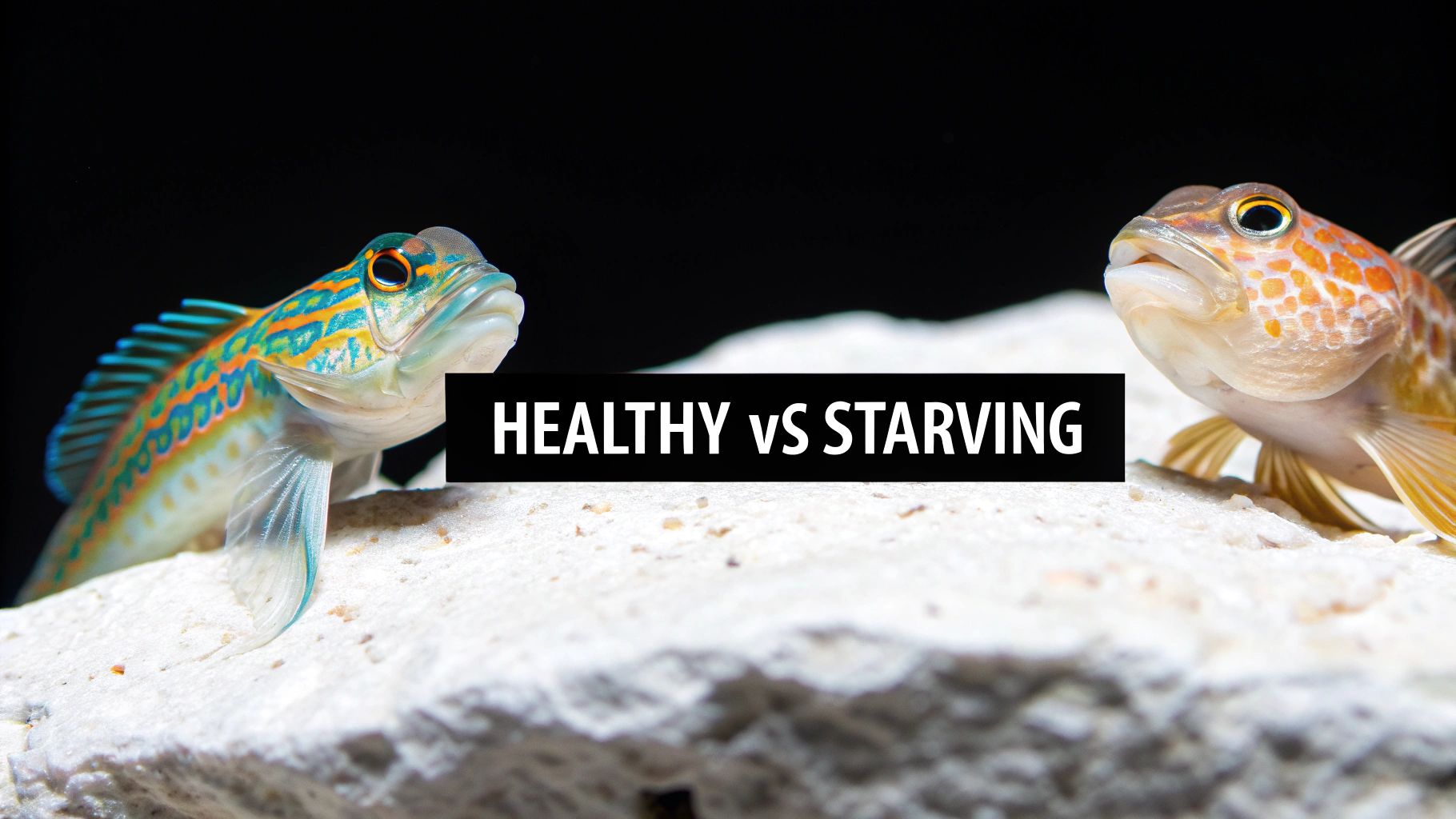
A mandarin dragonet’s body condition is the most honest report card you’ll ever get on its diet and the health of your tank’s microfauna. For any reefer who keeps one, learning to read the subtle visual cues between a thriving fish and one that’s struggling is an absolutely essential skill. A healthy mandarin practically tells a story of abundance.
The most telling sign is its stomach. A well-fed mandarin will always have a gently rounded, convex belly. It shouldn't look bloated or swollen, but it should never, ever look flat or pinched in. That little round belly is direct proof that it's successfully finding more than enough food as it grazes throughout the day.
This steady supply of food also fuels their famously intense coloration. A healthy mandarin’s blues, oranges, and greens will look deep and almost electric. You'll also see it constantly and deliberately pecking at the rockwork and sand, which is another great sign—it shows they are actively hunting the copepods and amphipods that sustain them.
Recognizing the Red Flags of Starvation
On the flip side, a starving mandarin shows unmistakable signs of distress that are hard to miss once you know what to look for. The first and most alarming is a pinched or concave stomach. When you look at the fish from the side, its belly will actually curve inward instead of outward. This is a five-alarm fire, signaling that the fish is burning through its last energy reserves and can't find enough to eat.
Lethargy is another major red flag. Instead of actively hunting, a starving mandarin might just hover listlessly in one spot. Sometimes, you'll see it frantically pacing the glass—a behavior often mistaken for energy but is actually a desperate, panicked search for any scrap of food. At the same time, their once-brilliant colors will begin to look faded and washed out as their health plummets.
A pinched stomach is the aquarium equivalent of a flashing red warning light. By the time this is visible, the mandarin has likely been underfed for weeks. Immediate and decisive action is required to reverse the decline and save the fish.
Mandarin Dragonet Health Checklist
Understanding what these fish need to eat is one thing, but connecting that to their physical appearance is what makes you a successful keeper. This simple checklist can help you make a quick and accurate health assessment every time you look at your tank.
| Indicator | Healthy Mandarin | Malnourished Mandarin |
|---|---|---|
| Stomach | Full and gently rounded (convex) | Pinched or caved-in (concave) |
| Coloration | Vibrant, deep, and electric colors | Dull, faded, or washed-out appearance |
| Behavior | Confident, constant, and deliberate pecking at surfaces | Lethargic hovering or frantic pacing along the glass |
| Activity Level | Methodically explores the entire tank | Hides excessively or stays in one spot for long periods |
By performing this quick visual check daily, you can ensure your mandarin is truly thriving. Spotting any negative changes early gives you the time you need to boost your tank's pod population or adjust your feeding strategy before the fish's health is ever seriously at risk.
Of course. Here is the rewritten section, designed to sound like an experienced, human expert while following all your specified requirements.
Your Mandarin Feeding Questions, Answered
Even when you've done all your homework, keeping these jewel-like fish can throw some curveballs. Let's tackle some of the most common questions and sticking points that pop up when you're trying to keep a mandarin fat and happy.
Can a Mandarin Survive Only on Frozen Food?
This is a tempting shortcut, but it's a risky gamble that almost never pays off. The short answer is no, not really.
Think of frozen food as a great insurance policy, a helpful supplement, but never the main course. Some mandarins, particularly captive-bred ones, can eventually be coaxed into accepting frozen mysis or enriched brine shrimp. That's fantastic! But it doesn't change their fundamental biology. They are hardwired to hunt and graze on living microfauna all day long. Their super-fast metabolism demands a constant source of live food.
A mandarin’s need for live food isn’t just a preference; it’s a biological imperative. Trying to keep one on frozen food alone, even if it looks like it's eating, often ends in a slow decline from malnutrition.
How Often Should I Add More Copepods?
This is the classic "it depends" question, but we can break it down. How often you need to replenish your pod population comes down to a few key variables in your unique system.
- Tank Maturity: A brand-new tank is like an empty pantry; it needs a heavy initial stocking. A system that's been running for over a year has a much more established, reproducing population.
- Tank Size: Simple math—a bigger tank can support a bigger buffet of microfauna.
- The Competition: This is a big one. How many other fish in your tank are also hunting for pods?
A good rule of thumb is to seed a new tank generously and then plan on adding a smaller maintenance dose every month. But the best method? Use your eyes. Once a week, grab a flashlight and scan the tank glass an hour or so after the main lights go out. If you don't see those tiny white specks scurrying around, it’s time for a top-up.
Will Other Fish Eat All the Copepods?
You bet they will. In fact, this competition for food is one of the biggest challenges to keeping mandarins successfully.
Wrasses, gobies, blennies, and many other popular reef fish are voracious micro-predators. They'll happily gobble up every last pod they can find, often out-competing the slower, more methodical mandarin.
This is exactly why a refugium is such a game-changer. It's a protected zone, a safe house where copepods can breed without being hunted down. This little sanctuary acts like a pod factory, constantly overflowing and sending a fresh supply of live food into the main display for your mandarin to find.
Ultimately, the goal is to build a thriving, self-sustaining microfauna population that acts as a living pantry. PodDrop Live Reef Nutrition provides lab-cultured, high-quality copepods and phytoplankton to get you there. Give your delicate fish the continuous nutrition it needs to truly flourish by exploring the live food options at https://www.getpoddrop.com.