


What Do Copepod Eat: what do copepod eat for beginners
- fabianbehague
- 5 days ago
- 11 min read
What Do Copepods Eat In Nature And Captivity
In the open ocean, copepods graze on seasonal blooms of phytoplankton and motile microzooplankton. In a home aquarium, they adapt quickly to cultured microalgae blends and the ever-present biofilm coating tank surfaces.
Here, we’ll explore the four primary diet groups that fuel wild and captive copepod populations. By understanding each component, hobbyists can craft feeding routines that mimic natural conditions and keep pod cultures thriving.
Key Diet Components
Phytoplankton: Tiny, photosynthetic algae that form the foundation of marine food chains. Common culture strains include Nannochloropsis and Isochrysis.
Microzooplankton: Miniature grazers like rotifers and ciliates. Wild copepods actively pursue these moving targets for a protein-rich meal.
Detritus: Decaying organic matter—from leaf litter to fish waste—that supports bottom-dwelling species in refugiums and reef tanks.
Tiny Metazoans: Microscopic animal prey such as protozoans and copepod nauplii. Predatory species like Oithona rely on these for growth spurts.
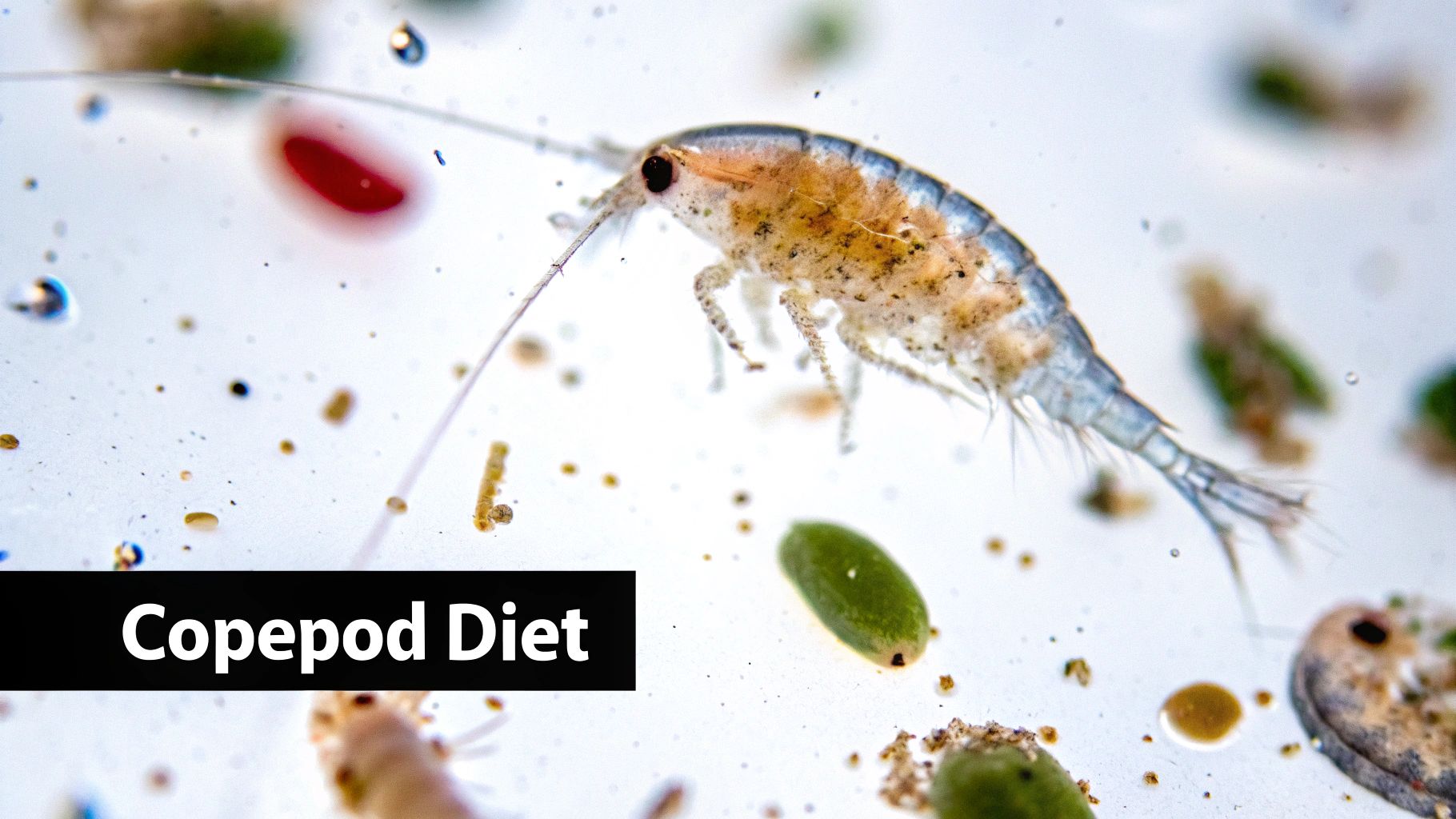
The image highlights a variety of body shapes and feeding appendages, illustrating how copepod morphology adapts to different diets and habitats.
Below is a quick reference to see how these diet groups stack up in both wild and aquarium settings.
Key Diet Categories Of Copepods
Diet Component | Description | Examples |
|---|---|---|
Phytoplankton | Base of marine food web; rich in lipids and protein | Nannochloropsis, Isochrysis |
Microzooplankton | Active, motile prey boosting nutrition | Rotifers, ciliates |
Detritus | Decaying organic particles and waste | Film algae, fish waste |
Tiny Metazoans | Small invertebrates offering dietary variety | Copepod nauplii, protozoans |
With this snapshot in hand, you can tweak your feeding strategy to suit the species you’re culturing. Mix and match these components to mirror natural cycles and keep your copepod populations buzzing.
Copepods thrive on small, frequent feedings—aim for a few tiny doses spread throughout the day. Keep an eye on water clarity and pod activity; those are your best indicators for dialing in the perfect feed rate. Next, we’ll dive into species-specific preferences and advanced culture methods that boost reproduction and population stability.
Understanding The Core Copepod Diet Concept
Copepods are more like selective diners than passive grazers. They scout the water column for the richest bites, adjusting their menu as the seasons roll by.
Spring brings massive diatom blooms, loaded with energy-dense fats.
Winter–Spring sees dinoflagellates rise, packing essential fatty acids.
Late Summer kicks in a urochordate surge, offering a protein punch.
Natural Diet Shifts
Copepods don’t eat randomly; they zero in on what’s most nutritious and available. In spring, diatoms fuel rapid growth and egg production. As plankton thins out, dinoflagellates step up, supporting cell membranes when nutrients are scarce. By late summer, urochordates deliver a crucial protein boost for young cohorts.
A closer look at field data makes this clear:
Season | Prey Type | Approx. % of Diet |
|---|---|---|
Spring | Diatoms | 43% |
Winter–Spring | Dinoflagellates | 15–17% |
Late Summer | Urochordates | 20% |
This table shows how energy flows from microplankton up to larger marine life—an elegant food-web relay.
Implications For Captive Feeding
Wild patterns are the blueprint for aquarium success. By mimicking nature’s rotations, you give cultured copepods the variety they crave.
Key steps for a balanced feed regimen:
Introduce Nannochloropsis to copy spring’s diatom feast.
Rotate in Isochrysis for that winter–spring dinoflagellate mix.
Offer crushed macroalgae as a stand-in for urochordate detritus.
Maintain small, frequent feedings to prevent overgrowth or crashes.
Matching feed types and timing to natural cycles builds robust populations and mirrors wild nutritional profiles.
Seasonal Buffet Analogy
Imagine your fridge restocked every season with different staples. Spring is all butter and oils (diatoms); winter waves in creamy yogurts (dinoflagellates); summer serves lean meats (urochordates).
Water temperature dictates which “dishes” flourish.
Nutrient levels set the bloom schedule.
Currents scatter food patches unevenly.
These regional quirks teach us how to fine-tune feeding routines to local tank conditions.
You might be interested in our guide on phytoplankton vs copepods and which live food benefits corals most.
Copepods thrive when their diet varies seasonally, reflecting the dynamic shifts found in nature.
Grasping these rhythms helps hobbyists design feeding strategies that keep pod populations healthy—whether in cultures or reef displays.
Ecosystem Implications
Copepods do more than feed themselves—they keep algal blooms in check. Their selective grazing:
Links primary producers (phytoplankton) to higher trophic levels (fish, corals).
Balances nutrients by targeting overabundant species.
Enhances biodiversity through steady energy transfer.
In reef tanks, following these feeding patterns stabilizes water quality and nurtures a resilient ecosystem. By understanding what copepods eat in the wild, aquarists craft feeding methods that sustain healthy populations and vibrant marine communities.
Exploring Species Specific Feeding Preferences
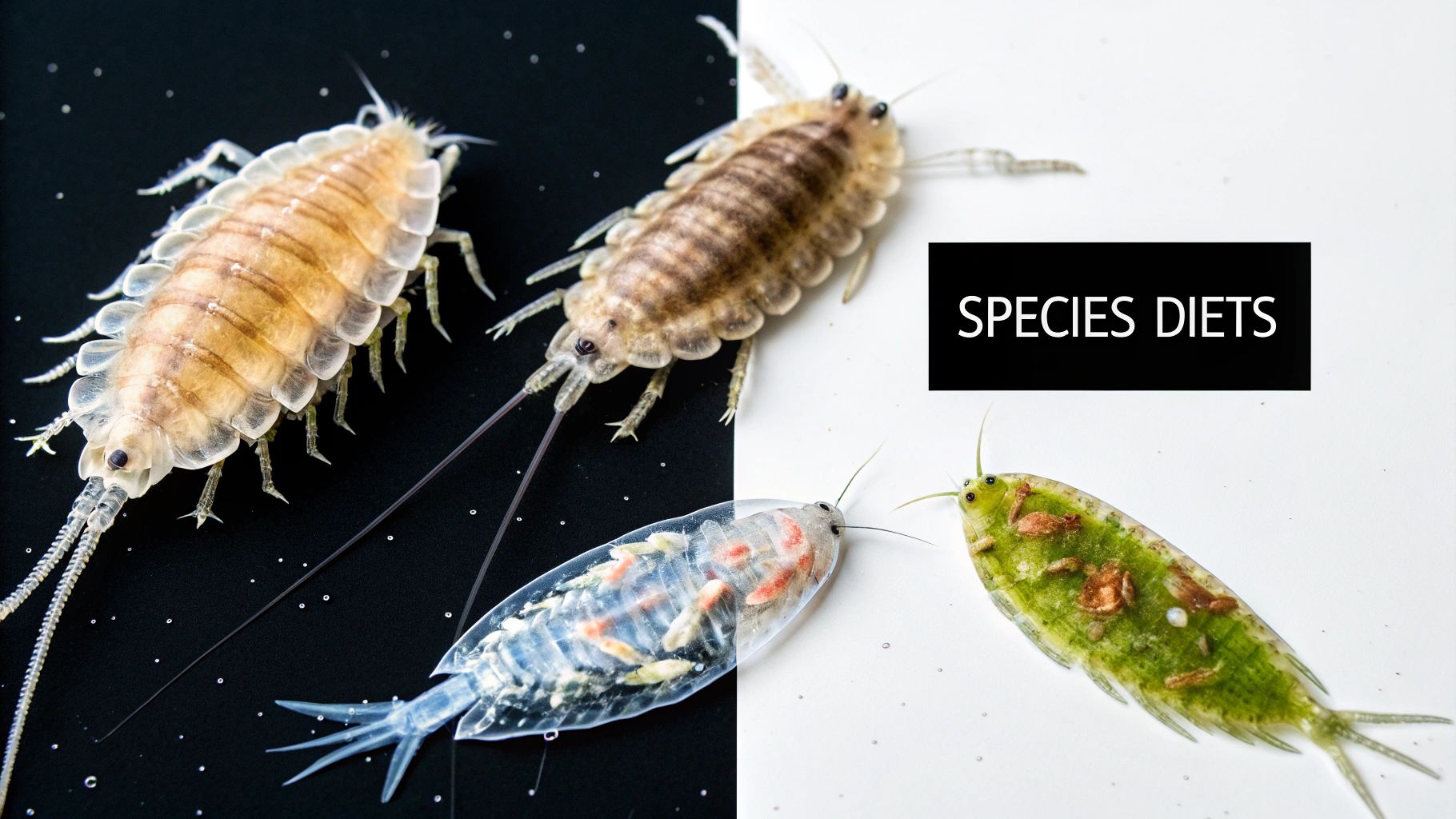
Copepod mouthparts are as varied as tools in a mechanic’s garage. Depending on where they live, some species gently sieve food, while others chase it down.
Think of herbivorous copepods as little nets drifting in the current, scooping up microalgae. Meanwhile, carnivorous types act more like miniature hunters, snapping up protozoans or bits of detritus.
Tisbe biminiensis uses feathery setae to filter nanoalgae in slow-moving water.
Apocyclops panamensis darts through midwater, grabbing rotifers with lightning-fast strokes.
Tigriopus californicus lies in wait at the surface, then makes quick, twitchy lunges at prey.
“Each species refines its feeding gear to match prey size and behavior”
Feeding Strategies By Species
Herbivorous copepods flourish on microalgae blends such as Nannochloropsis and Isochrysis. Their setae nets—typically 5–20 µm wide—are perfect for trapping plant cells and thin biofilms.
Diet Type | Mouthpart Gear | Preferred Prey |
|---|---|---|
Herbivore | Setae Brushes | Microalgae, Biofilm |
Omnivore | Grasping Claws | Detritus, Protozoans |
Carnivore | Hooked Mandibles | Microzooplankton |
Implications For Cultures
Knowing each species’ favorite food can lift your culture’s productivity by 30%. Matching diet to mouthparts means you waste less feed and see stronger pod growth.
Offer high-quality microalgae to filter-feeders for steady populations.
Introduce fine detritus layers when cultivating omnivores for balanced nutrition.
Seed surface-dwelling carnivores with live protozoans to jumpstart their hunting instincts.
Regular checks on prey consumption help you avoid both underfeeding and algal overgrowth. By dialing in feed sizes that match appendage spacing, you’ll see more efficient capture and healthier pods.
Case Study Of Common Genera
Oithona copepods are stealthy omnivores, cruising midwater and snapping up tiny ciliates. Their small profiles let them slip through crowded tanks without drawing unwanted attention.
Acartia species illustrate true dietary flexibility, grazing on everything from phytoplankton to detritus. They adjust their grip width to handle particles between 2 µm and 30 µm as food patches shift.
Oithona Adaptation: Their diminutive size supports covert feeding in dense cultures.
Acartia Flexibility: Broad, comb-like appendages tackle a wide particle range.
Oithona Speed: Capable of capturing more than 50 individuals per minute under the right conditions.
“Efficient feeders help maintain reef microfauna balance,” notes one seasoned aquarist.
Seeing these strategies in action lets hobbyists pair species to tank goals, creating robust populations and smoother nutrient cycling.
Connecting Feeding Preferences To Success
When species diets align with your tank’s flow patterns and feed schedules, cultures become self-sustaining. Small adjustments yield big gains.
Direct food into preferred water flow zones to match each species’ hunting style.
Rotate particle sizes from 2 µm up to 30 µm for comprehensive coverage.
By syncing feed type, timing, and quantity, you mimic wild conditions and set the stage for thriving copepod communities.
Next, we’ll dive into crafting the perfect feeding schedule.
How To Feed Cultures And Reef Tanks
Finding the right combination of feeds can feel tricky, but it’s the foundation of every healthy copepod culture and reef refugium. You’ll want to match the natural grazing habits of your target species, whether you’re filling a lab flask or a display sump.
You can rotate between live phytoplankton, blended microalgae, detritus layers and biofilm coatings to hit the nutritional sweet spot. Each option brings its own set of advantages, depending on your system’s flow, lighting and resident species.
Here’s a real-world snapshot of microalgae distribution to dial in your dosing accuracy.

The image above illustrates a uniform spread of cells and ideal concentration ranges—key factors that drive rapid pod reproduction.
Feed Types And Usage
Below is a quick overview of common feeds and how they fit into different setups:
Live Phytoplankton: Boosts DHA content and encourages initial grazing in new cultures.
Microalgae Blends: Flexible nutrition for mixed populations, from flasks to display tanks.
Detritus Layers: Continuous, slow-release nourishment on refugium substrates.
Biofilm Coatings: Mimics natural reef surfaces, giving pods surfaces to graze.
Feed Types For Cultures Vs Reef Tanks
Feed Type | Usage In Cultures | Usage In Reef Tanks | Benefits |
|---|---|---|---|
Phytoplankton | Primary green & flagellate algae | Weekly dosing under low flow | Enhances fatty acid profiles & growth |
Microalgae Blends | Daily top-ups for mixed species | Frequent refugium injections | Supports diverse nutritional requirements |
Detritus | Sediment tray supplementation | Substrate layer in refugiums | Steady food source, promotes reproduction |
Biofilm | Coating on container walls | Rockwork & macroalgae clumps | Continuous grazing, habitat enrichment |
This table lays out the core differences so you can choose feeds that align with your goals, whether in a sterile lab or a bustling reef display.
Choosing Container And Flow
The ideal vessel holds enough water to avoid overcrowding yet remains small enough for easy maintenance. Aim for a gentle circulation that keeps algae in suspension without sweeping pods out of the system.
A turnover rate of 1–2× per hour usually strikes the right balance between nutrient distribution and pod safety. Too much flow and your pods become tumbleweeds; too little and algae will settle and decay.
Dosing And Seeding Techniques
Measure microalgae density with a cell counter or hemocytometer for precision.
Introduce feed slowly near low-flow zones to avoid clumping.
Seed fresh containers at a 1:10 ratio of mature pods to new media.
Perform weekly water changes to reset nutrient levels and prevent waste buildup.
You might be interested in our article on how to culture copepods at home with simple feeding and care.
Small, consistent daily doses mimic the natural ebb and flow of plankton blooms, cutting down crashes and keeping reproduction humming.
Healthy pods reproduce best when they receive steady, moderate nutrition rather than sporadic large feedings.
Monitoring Pod Health
Regular observation reveals early warning signs of feeding problems:
Egg-sac counts dropping below 10 per female often point to nutritional stress.
Persistent cloudiness after dosing usually means overfeeding.
Lethargic behavior signals they might be hungry or the environment is off balance.
Long Term Maintenance
Over the weeks, swap out culture medium once a month to clear accumulated waste. Tailor your feeding calendar to match peak reproductive cycles, then log dates, dosages and pod counts to spot trends.
Track feed types and volumes in a simple spreadsheet.
Adjust based on turbidity checks and pod activity.
Fine-tune particle sizes (most copepods capture 2–20 μm cells best).
With consistent practice and close observation, you’ll cultivate a self-sustaining copepod population that thrives day after day.
Feeding Frequency And Particle Size Guide
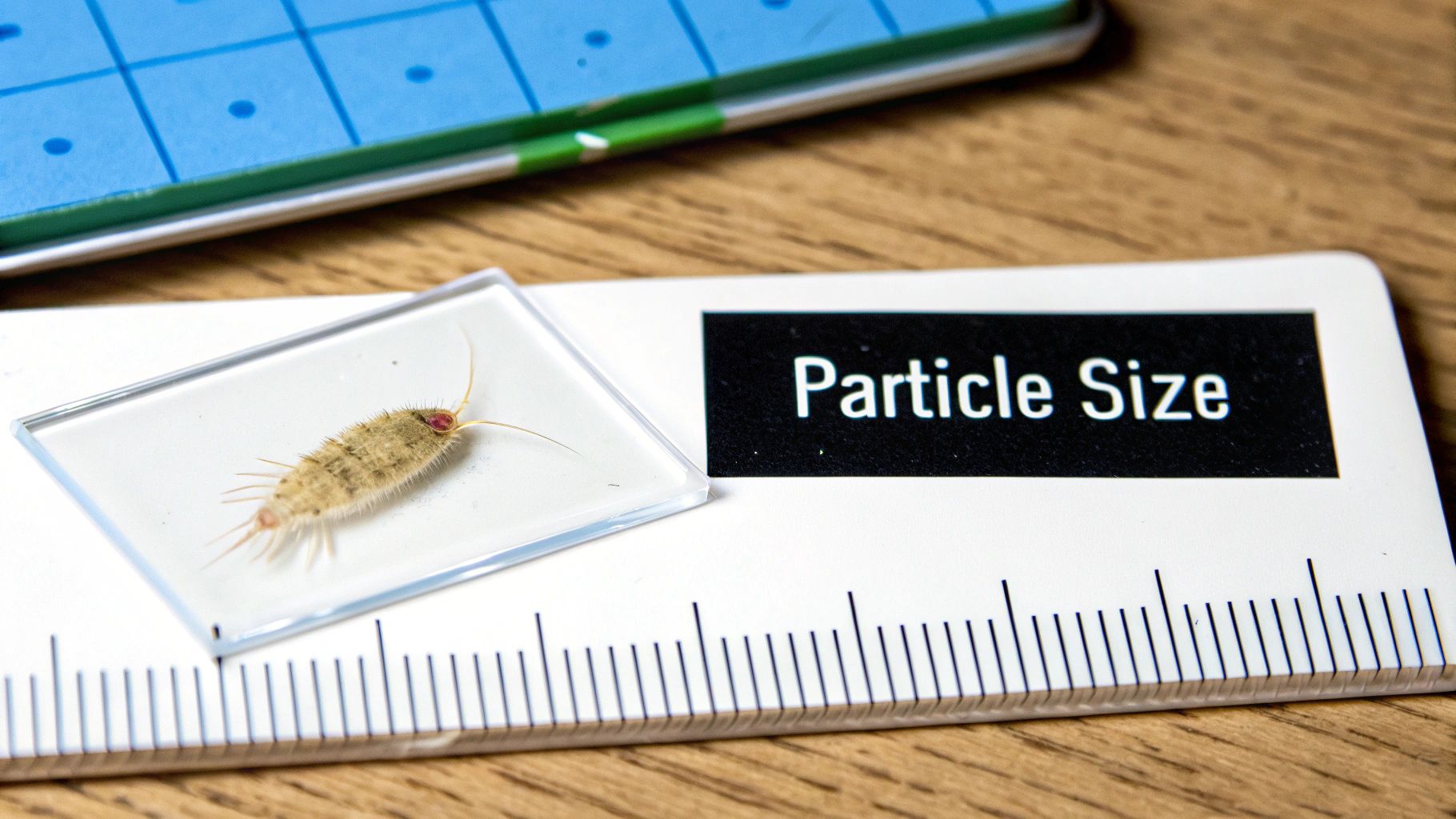
Fine-tuning your feed schedule is like dialing in a radio for the clearest station. With copepods, small, steady pulses of food outperform a single, massive dose. This approach prevents hungry gaps and keeps water clarity crisp.
Equally critical is matching feed size to your copepod’s filter. Most species graze most efficiently on particles between 2 μm and 20 μm. Staying within this window keeps pods well-fed without clouding the water.
Ideal Particle Sizes
Below is a quick reference for how copepod life stages handle different particle ranges:
Life Stage | Particle Size Range |
|---|---|
Nauplii | 2–5 μm |
Juveniles | 5–10 μm |
Adults | 10–20 μm |
Adjusting feed to these sizes can boost clearance rates by up to 25%, turning your culture into a productivity powerhouse.
Recommended Feed Densities
Knowing how dense your phytoplankton or microalgae should be is half the battle. The sweet spot lies between:
500–1,000 cells/mL for steady growth with minimal waste
1,000–2,500 cells/mL to amplify reproduction (watch for water-quality changes)
2,500–5,000 cells/mL as a short-burst strategy during population spikes
Keep an eye on water clarity and pod activity to dial in the perfect concentration.
Getting nutrient ratios right isn’t just science jargon—it changes how fast copepods eat. Experiments reveal ingestion rates differ dramatically at around 516 cells/mL versus 2,091 cells/mL when phosphorus is limited. Copepods ramp up consumption on P-poor prey, shifting clearance and ingestion in measurable ways.Discover insights about these feeding metrics in this NOAA study.
Feeding Schedule Tips
Training your pods with a predictable routine boosts health and reproduction. Try this calibration plan:
Feed 2–4 times daily in small doses
Observe water clarity; tweak density as needed
Shift feed times by 2–3 hours to mimic plankton pulses
Log schedules and pod counts for trend analysis
“Small, frequent feedings match copepod grazing rhythms and prevent crashes”
Start gently. Use visual cues—active swimming and bright water—to guide increases. If growth stalls, bump up density in small increments.
These steps give hobbyists and aquaculture labs a clear path to healthy pods. By synchronizing particle size, feeding frequency, and nutrient balance, you’ll see thriving populations and a happier reef.
Calibrating And Monitoring Systems
Regular checks keep everything humming along. Track pod density and water clarity every day:
Record turbidity before and after feeding with a Secchi slide or first-break tube
When clearance rates slip by more than 15%, cut back on feed density or tighten intervals. One reef lab achieved a 50% population boost by shifting particle size from 20 μm to 10 μm over a week.
Think of calibration like tuning a piano in your tank: small tweaks prevent nutrient buildup and stabilize biomass. Review data monthly to spot seasonal shifts and refine your routine.
Monitor results for improvements.
Common Underfeeding Signs And Troubleshooting
Underfeeding can lurk in your copepod culture unnoticed, chipping away at pod health until it’s too late. It’s often the slow fade, not a sudden crash. Keeping an eye on subtle clues prevents nasty surprises.
Look first for slowed growth. You’ll see fewer nauplii hatching each day, and egg production will taper off. Track hatchling counts with a simple grid or notebook to catch dips early.
You might also spot sticky debris piling up—uneaten detritus that pods neglect. It’s like walking into a dusty room: something’s off. When water clarity suffers and filters strain, feeding gaps are usually to blame.
Slow population increase or stagnant numbers
Fewer egg sacs attached to females
Excess uneaten detritus and cloudy water
Reduced feeding activity during dosing
Identifying Early Warning Signs
Make a habit of quick daily inspections. Note any drop in swimming vigor or egg sac counts. Jot down basic observations so patterns jump out over time.
“Early diagnosis can mean the difference between recovery and collapse of a culture.”
Troubleshooting Feed Strategies
Not all pods eat the same diet. Adjust your feed type and timing in small, deliberate steps. This is less about dumping more food in and more about smart, targeted adjustments.
Parameter | Suggested Change |
|---|---|
Feed Type | Add Nannochloropsis or Isochrysis |
Dosing Frequency | Move from once to twice daily |
Particle Size | Aim for 2–20 μm |
Water Flow | Gentle 1–2× turnover per hour |
Combine two or more of these tweaks for a quicker rebound. Tweak one variable at a time to find your culture’s sweet spot.
Step By Step Troubleshooting Checklist
Double-check your feeding schedule and add small increments.
Confirm gentle water flow—avoid dead spots.
Rinse or replace old media to keep waste levels down.
Seed new pods at a 1:10 ratio into fresh culture.
Log egg sac counts and turbidity every morning.
Hobbyists report amazing turnarounds with modest tweaks. One reef keeper revived a Tisbe batch by adding daily microalgae pulses and boosting flow—counts doubled in a week. Stories like these underscore how minor shifts in diet and flow are often game-changers.
You might be interested in our guide on why live copepods die and how to keep pods thriving. It’s a must-read for anyone looking to preempt common pitfalls.
Regular upkeep seals the deal. Replace 10–20 % of water weekly and scrub surfaces to curb biofilm. Treat water changes as both a cleaning ritual and a data check.
Watch your numbers and act fast. By spotting underfeeding signs early and fine-tuning your routine, you’ll keep cultures vibrant. You’ll catch small dips before they morph into full-blown culture collapses.
Use a microscope or magnifier to inspect egg sacs and neonate counts for accuracy. Even a simple hand lens reveals plenty about brood size and health.
Frequently Asked Questions
Managing wild or captive copepods often brings up the same set of questions. This FAQ tackles feed choices, behavior clues, and practical fixes in bite-sized chunks.
What Do Copepods Eat at Different Life Stages—and Why It Matters?Tiny nauplii flourish on 2–5 µm phytoplankton, while adults switch over to 10–20 µm microalgae. Matching particle size to their mouthparts is the fastest route to better ingestion and steady growth.
How Can You Spot Feeding Behavior in Your Tank?Watch for pods grazing along rock surfaces or cruising midwater. Clear water paired with lively pod movement usually means your dosing is on point.
What About Seasonal Adjustments?When temperatures dip, crank up the feed a bit to offset slower metabolisms. Conversely, if your culture blooms then crashes fast, scale back to prevent nutrient overload.
Key Points
Select feed sizes tailored to each life stage
Learn to read natural grazing and swimming habits
Adjust rates for seasonal shifts and culture changes
Adjusting Feed Rates
Dial in your dosing by matching density to your pod count. For consistent, gradual growth, aim for 500–1 000 cells/mL in small, regular feedings. If you’re chasing a population boom, try 1 000–2 500 cells/mL, then track the results.
What If Underfeeding Occurs?Fewer egg sacs on females or a drop in nauplii are clear warning signs. A few extra microalgae pulses and a slight bump in water flow can often bring a struggling culture back to life.
Early intervention prevents collapse and saves culture time.
Keep a daily checklist to monitor water clarity, egg counts, and pod activity. Spotting issues early makes all the difference in avoiding crashes.
Ready to fuel your tank with live pods? Get PodDrop Live Aquarium Nutrition now!
Comments