


Mandarin Dragonet Food: Tips on mandarin dragonet food for a thriving reef
- fabianbehague
- 5 hours ago
- 17 min read
The absolute key to keeping a mandarin dragonet happy and healthy is a constant, live buffet of copepods and amphipods. These aren't just snacks—they are the only thing on the menu. Mandarins are specialized micro-predators, spending their entire day picking these tiny crustaceans off rocks and sand. This means a mature aquarium with a thriving, self-sustaining "pod" population isn't just a recommendation; it's non-negotiable.
Why Mandarin Dragonets Have Such a Specialized Diet
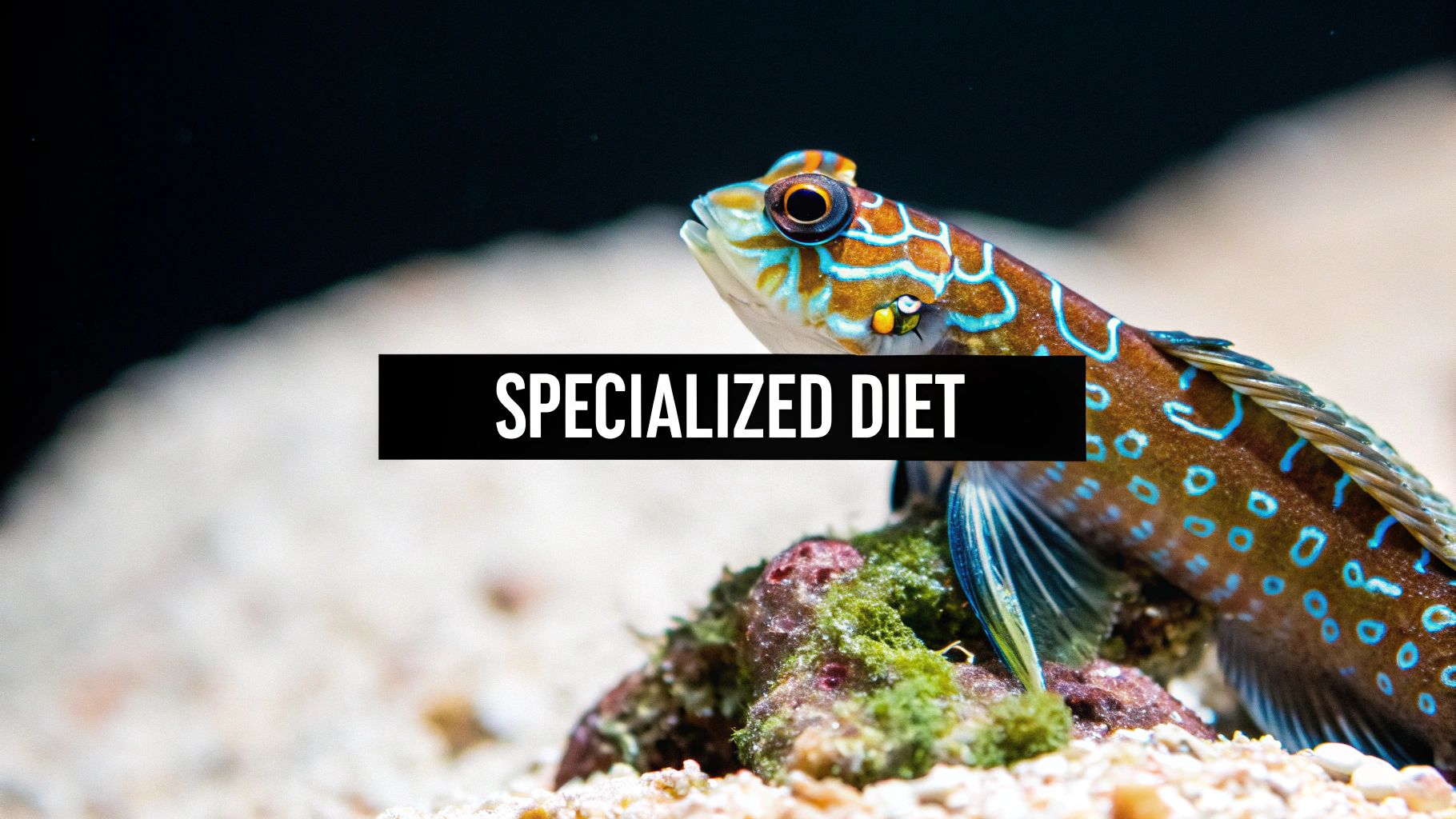
It’s impossible not to be drawn in by a mandarin's psychedelic colors and graceful, hovering flight. But that stunning beauty hides a highly specialized hunter with a diet that makes it one of the most challenging fish for new hobbyists. They aren't just "picky" in the way other fish might be; their entire biology is hardwired for a very specific way of eating.
Unlike a clownfish or tang that darts out for flakes and pellets, mandarins are slow, methodical grazers. They spend all day meticulously scanning the live rock and sand, using their incredible eyesight to spot the nearly invisible movements of copepods. Their tiny, protrusible mouths are perfectly evolved to peck these microcrustaceans off surfaces, one by one.
This isn't just a preference. It's a biological necessity. Their fast metabolism demands a steady stream of tiny meals throughout the day to keep them from starving.
The Constant Hunt for Live Prey
So, what truly drives a mandarin to eat? Movement. It’s the primary feeding trigger. A mandarin simply doesn’t recognize a stationary pellet or flake as food. It’s the tiny, jerky motion of a live copepod that flips the "hunt" switch in their brain.
This is exactly why dropping a mandarin into a new or immature aquarium is almost always a death sentence. A new tank is a sterile environment, completely devoid of the microscopic ecosystem the fish depends on. Without thousands of pods to hunt, the mandarin will starve, often in just a couple of weeks, no matter what other foods you offer.
A mature aquarium, one that has been running for at least 6-12 months, is the only place a mandarin can thrive. This timeframe is critical for building a robust, self-replenishing copepod population that can support a mandarin’s relentless appetite.
Understanding the Food Web
Before you bring a mandarin home, it helps to understand the aquarium's food web. These fish sit at a very specific spot, relying on a healthy foundation of microfauna. That microfauna, in turn, feeds on detritus and algae. This is why a refugium—a dedicated, protected space for cultivating pods and macroalgae—is one of the best tools for anyone serious about keeping these fish long-term.
To give you a clearer picture, let's break down the primary food sources for mandarins in a typical reef tank.
Mandarin Dragonet Food Sources At a Glance
The table below summarizes the key live foods your mandarin will be hunting for. While they might eventually learn to accept prepared foods, their core diet will always be live microcrustaceans.
Food Type | Description | Role in Diet |
|---|---|---|
Benthic Copepods | Tiny crustaceans (like Tisbe species) that live on surfaces like rock and sand. | Primary Food Source. This is what they hunt for all day, every day. |
Pelagic Copepods | Copepods (like Apocyclops species) that swim more in the water column. | Secondary Food Source. Eaten opportunistically, especially in lower-flow areas. |
Amphipods | Slightly larger crustaceans that also inhabit the rockwork. | Supplemental Food. Mandarins will readily eat smaller amphipods they encounter. |
Having a mix of these organisms creates a more resilient and diverse food source, which is exactly what a healthy reef ecosystem needs.
Interestingly, while the mandarin dragonet in our hobby is a delicate specialist, its namesake in other parts of the world has a very different story. The mandarin fish (Siniperca chuatsi) is a major food fish in Asian markets, with Chinese aquaculture production hitting over 17,500 tonnes back in 1993.
This stark contrast really drives home the unique challenges of keeping our beautiful ornamental species. Digging into the nutritional profile of copepods helps you appreciate why they are the perfect, complete food source for mandarins. By grasping these fundamentals, you’re taking the most critical step toward successfully keeping one of the reef hobby's most iconic fish.
How to Cultivate a Sustainable Copepod Population
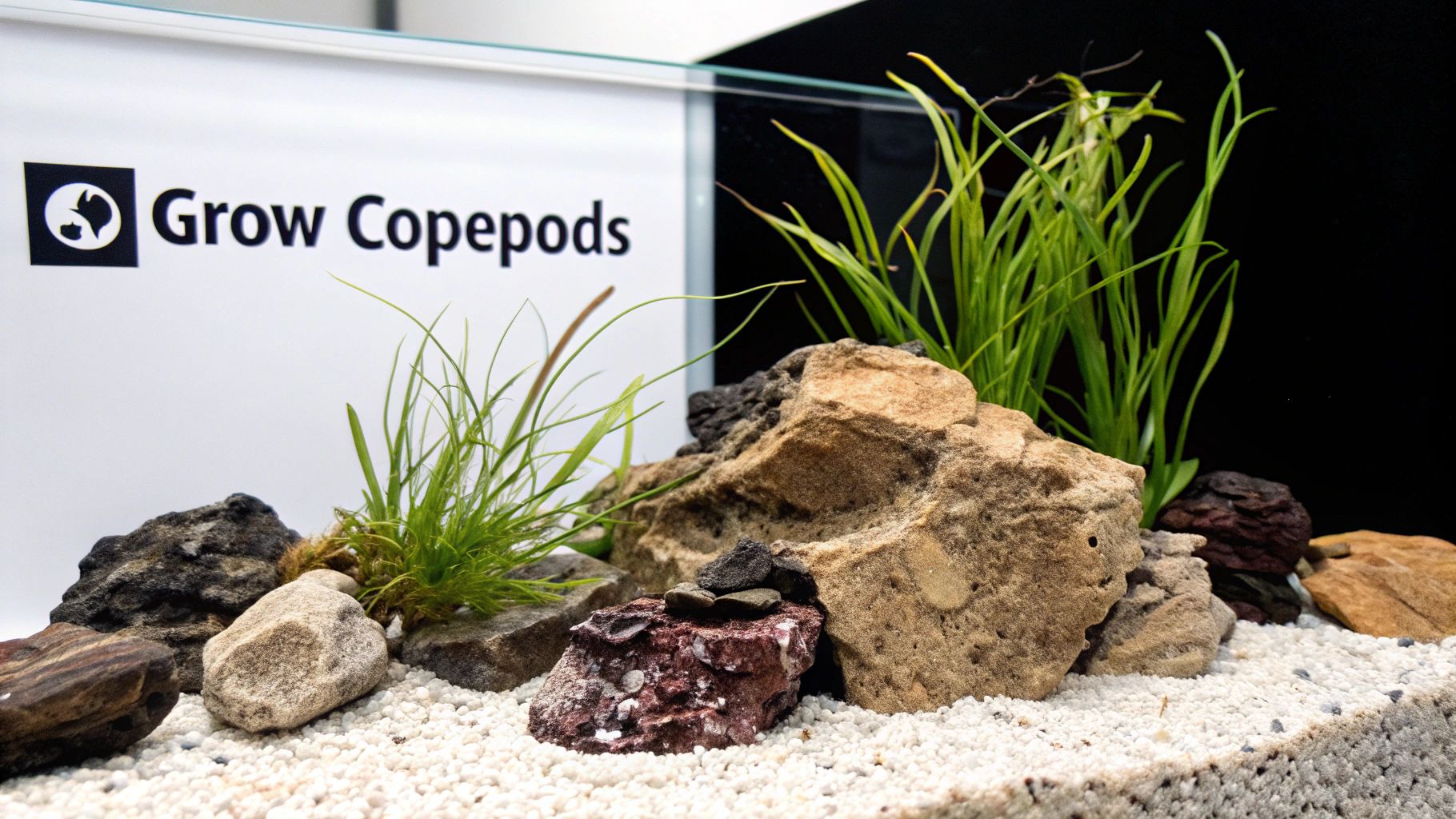
The single most important thing you can do for a mandarin is to turn your reef tank into a self-sustaining food factory. This isn't about just dumping in food now and then; it's about building a genuine ecosystem. Your goal is a thriving, stable copepod population that constantly replenishes itself, giving your mandarin the endless buffet it needs to survive.
This whole process has to start long before you even think about bringing a mandarin home. Patience is everything here. You need to seed your tank with live copepods months ahead of time, letting them multiply and spread throughout your rockwork and sand without the constant pressure of a predator.
Adding a bottle of pods and a mandarin to a new tank a week later is a classic recipe for disaster. You really want to seed a mature tank—one that's been running for at least six months—and then give it another one to two months for the pods to establish before you even consider adding the fish.
Choosing the Right Copepods for the Job
Not all copepods are created equal, especially when you're trying to build a breeding population. Different species have their own quirks and behaviors that make them better suited for certain roles in your tank's food web. Getting a handle on these differences is the key to creating a diverse and resilient menu for your mandarin.
These are the heavy hitters you should look for:
Tisbe biminiensis: This is the gold standard for seeding a reef. They are benthic, meaning they live on the bottom, crawling all over the rocks and sand. This makes them the perfect, easily-hunted meal for a mandarin. As a bonus, they're also fantastic detritivores, pitching in with your cleanup crew.
Tigriopus californicus: Often just called "Tig" pods, these guys are a bit larger and more pelagic—they tend to swim around in the water column more. While mandarins will definitely snack on them, they're especially great for stocking a refugium where they can breed like crazy without being eaten right away.
Apocyclops panamensis: This species is incredibly resilient and reproduces very quickly. They are smaller and also more pelagic, creating a fantastic secondary food source that drifts out of your sump or fuge and into the main display.
Honestly, a mix of all three gives you the best shot at success. You'll create layers of food availability throughout the entire system. Tisbe populates the rocks, while Tigriopus and Apocyclops create a constant "rain" of snacks from the water column.
Building the Perfect Pod Habitat
Copepods don't just need a place to live; they need a safe place to breed. This is where a refugium becomes one of the most valuable tools in your arsenal. A refugium is basically a protected zone, usually in your sump, that's completely free of predators and designed to be a microfauna factory.
To turn your refugium into a five-star pod hotel, you just need two things: complex hiding spots and a food source.
Key Takeaway: The whole point of a refugium isn't just growing macroalgae; it's creating a predator-free safe house where copepods can reproduce faster than they get eaten. This protected breeding ground is the engine that drives your mandarin's food supply.
For structure, nothing beats a mix of live rock rubble and a healthy clump of Chaetomorpha algae. The porous rock and the tangled mess of "Chaeto" create an endless network of surfaces for pods to live and breed on, totally safe from being picked off.
Fueling the Food Chain with Phytoplankton
Your new pod army needs to eat, too. The main course for most copepod species is phytoplankton, the microscopic algae that form the very base of the ocean's food web. Dosing high-quality live phytoplankton regularly is like throwing fertilizer on a garden—it fuels explosive growth in your copepod population.
Dosing phyto doesn't just feed your pods; it's also a direct food source for many of your corals and other filter feeders. It's a simple step that benefits your entire ecosystem. If you're serious about creating a never-ending supply of mandarin food, feeding your pods is non-negotiable. For a deeper dive, our guide on how to culture copepods at home breaks down even more advanced techniques.
It’s interesting to see this same principle applied in large-scale aquaculture. In China, carnivorous mandarin fish are fed live prey like carp fry to achieve highly efficient growth, with feed conversion ratios (FCR) around 1.5-2.0. You can read more about these efficient feeding practices on fao.org. We're basically doing the same thing, just on a much smaller scale.
Once your system is up and running, it's time to check your work. Wait about an hour after your tank lights go out, then grab a flashlight and shine it on the aquarium glass. If you've done it right, you'll see dozens, maybe even hundreds, of tiny white specks scurrying away from the light. That's it. That's your living, breathing mandarin buffet.
Sourcing and Selecting High-Quality Live Foods
Once your tank is a thriving, pod-friendly ecosystem, it's time to get a steady supply of high-quality live food. This is about more than just grabbing a bottle of pods off a shelf; it's about knowing what you’re buying, where it’s from, and how it will actually benefit your mandarin. Making the right choices here can be the difference between a pod population that just gets by and one that truly supercharges your reef.
You've really got two options: an online vendor that specializes in aquaculture or your local fish store (LFS). While it’s always great to support local, online suppliers often ship fresher, more concentrated cultures that are packed right when you order. That bottle at the LFS might have been sitting on a shelf for weeks, meaning fewer live pods, whereas a solid online source ships straight from their culture tanks to your door.
When your bottle of copepods arrives, give it a quick look. A healthy, dense culture will have tiny "specks" zipping around everywhere. You shouldn't smell anything foul or see a bunch of gunk at the bottom—those are red flags that the culture may have crashed. A good vendor will also be completely transparent about their culturing methods and the exact species they’re sending you.
The Best Copepod Species for Mandarins
Picking the right kind of copepod is absolutely essential for building a food source that lasts. Different species hang out in different parts of the tank, and mixing them up is almost always the best way to go. This creates a much more resilient food web that perfectly plays into a mandarin's natural, all-day-long hunting behavior.
Here’s a rundown of the heavy hitters for your reef:
Tisbe Pods (Tisbe biminiensis): These are the undisputed champs for seeding a display tank. As benthic critters, they live and breed right on your rocks and sand, making them the perfect, always-available snack for a mandarin.
Tiger Pods (Tigriopus californicus): These guys are a bit larger, more energetic, and swim around in the water column. Their bright red color makes them easy to spot. They are an awesome choice for stocking a refugium, where they can reproduce like crazy without getting eaten, letting their offspring overflow into the main display.
Apocalypse Pods (Apocyclops panamensis): A tough, fast-breeding pod that also spends most of its time in the water column. Their resilience and incredibly fast life cycle make them a fantastic way to supplement your pod numbers and keep them high.
If you want to get into the nitty-gritty of what makes each species tick, check out our guide on the best copepods for a marine aquarium. It offers a much deeper dive into their specific benefits.
Pro Tip: When adding pods to your tank or refugium, kill the flow. Turn off your pumps, protein skimmer, and any UV sterilizers for at least an hour. This gives the copepods a chance to settle onto the rockwork and find cover instead of getting blasted into the filter floss immediately.
Comparing Popular Copepod Species for Your Reef
Picking the right mix of copepods is key to establishing a robust, self-sustaining food source for your mandarin. Different species have unique behaviors and sizes that make them better suited for different parts of your system. This table breaks down the most popular choices to help you build the perfect pod buffet.
Copepod Species | Size | Behavior (Benthic/Pelagic) | Best For |
|---|---|---|---|
Tisbe biminiensis | Small (~0.5 mm) | Benthic (lives on surfaces) | Seeding display tanks and providing a constant grazing source |
Tigriopus californicus | Medium-Large (~1.0 mm) | Pelagic (swims in water) | Stocking refugiums and feeding larger fish and corals |
Apocyclops panamensis | Small-Medium (~0.7 mm) | Pelagic (swims in water) | Rapidly boosting pod populations due to fast reproduction |
By combining these species, you create a multi-layered food web. Benthic pods provide a constant food source directly where mandarins hunt, while pelagic pods from a refugium ensure a continuous resupply, keeping the population strong and resilient.
Beyond Copepods: Supplemental Live Foods
While copepods are the bread and butter of a mandarin's diet, other live foods can be game-changers, especially for a new fish in quarantine or one that needs to pack on some weight. These foods can kickstart a feeding response and add some welcome variety.
One of the most valuable tools in the arsenal is live baby brine shrimp. Their jerky swimming motion is often completely irresistible to mandarins and can be a fantastic way to get a picky eater interested in food. They aren't a complete nutritional powerhouse on their own, but they are absolutely brilliant for conditioning and training.
Another, less common option that works wonders is white worms. You can easily culture them at home in a simple container with soil. These little worms are loaded with fat and protein, making them a lifesaver for a skinny mandarin. They provide a calorie-dense meal that helps a fish put on weight fast. Just place them in a small glass dish on the sandbed so they don't get lost in the substrate.
Transitioning Your Mandarin to Prepared Foods
While a bustling, self-sustaining copepod population is the gold standard for mandarin care, getting your fish to accept prepared foods is a massive win for its long-term health. Think of it as a crucial nutritional safety net. It ensures your mandarin never goes hungry, even if your pod populations take a temporary dip.
Be warned, though: this is a game of patience. Mandarins are hardwired to hunt tiny, skittering prey. Your job is to slowly, methodically convince them that the weird, motionless stuff you're offering is actually food.
Setting the Stage for Success
Before you even think about the food itself, you have to control the environment. Trying to train a mandarin in a busy display tank packed with faster, more aggressive fish is a recipe for failure. Your mandarin will get outcompeted for every single scrap, leading to stress and zero progress.
This is where a little isolation becomes your best strategy. Using an in-tank breeder box or an acclimation box works wonders. It keeps the mandarin contained and safe from nosy tank mates, letting you focus its attention entirely on the new food. The fish can still see its surroundings, which cuts down on stress, but you're in complete control of its dinner plate.
Another fantastic technique is to create a dedicated "feeding station." This is as simple as placing a small glass jar, petri dish, or feeding cone right on the sandbed. By using a turkey baster or pipette to place food in that exact spot every time, you're training the mandarin to associate that area with a meal. It keeps the food concentrated and prevents it from blowing all over the tank.
The Gradual Introduction Method
Patience is everything here. You can't just toss in a cube of frozen mysis and hope for the best. The transition has to be slow, building on foods and behaviors your mandarin already knows.
This is the general progression that has worked for me and countless other hobbyists:
Start with Live Foods: Your first move is to target-feed live baby brine shrimp. Their jerky, frantic swimming is an irresistible feeding trigger for most mandarins. This step gets them used to the idea of eating from a feeding tool or a specific dish.
Mix in Frozen: Once your mandarin is hammering the live brine, start mixing in a tiny amount of thawed, frozen baby brine shrimp or cyclops. Your initial ratio might be 90% live to just 10% frozen. The movement of the live shrimp will lure the mandarin in, and it'll likely slurp up some of the frozen bits by accident.
Adjust the Ratio: Over several days—or more likely, weeks—you'll gradually shift that balance. Slowly dial back the live food while upping the frozen portion. The goal is to get the mandarin to recognize the scent and shape of the frozen food as a legitimate meal.
Introduce New Foods: After your mandarin is reliably eating frozen baby brine or cyclops, you can start introducing more nutrient-packed options like finely chopped frozen mysis shrimp or calanus. Use the same mixing trick: add a small amount of the new food to the familiar frozen stuff.
A common mistake is moving too quickly. If the mandarin stops eating, take a step back. Revert to the previous ratio of live-to-frozen food for a few days before trying to advance again. This isn't a race.
Tips to Stimulate a Feeding Response
Sometimes, a mandarin needs a little extra nudge to try something new. A few tricks can help pique its interest and trigger that all-important first taste.
Garlic Additives: Soaking the frozen food in a garlic supplement can make it much more appealing. For whatever reason, the strong scent often stimulates a feeding response in picky eaters.
Mimic Live Prey: Use your turkey baster to gently puff the thawed food near where the mandarin is perched. This subtle movement can sometimes be just enough to trick its brain into thinking the food is alive.
Feed During Quiet Times: Try offering the new food first thing in the morning before the tank gets busy, or just after the main lights go out. With less activity from other fish, a shy mandarin may feel more confident to venture out and investigate.
While our goal is a healthy ornamental pet, it's interesting to note the global importance of mandarin fish nutrition in aquaculture. Production, primarily in China, surpassed 17,500 tonnes by 1993, contributing to the country's staggering 2023 output of 29.8 million metric tons. You can read more on these large-scale fisheries insights on dialogue.earth. It just goes to show that whether for food or for our aquariums, the core principle of providing optimal nutrition is universal.
Troubleshooting Common Mandarin Feeding Problems
Even the most carefully planned mandarin setup can hit a few snags. You might notice your dragonet looking a bit thin, or maybe the copepods that once swarmed your glass seem to have vanished. When this happens, it's time to put on your detective hat, not panic. Getting to the bottom of feeding issues is all about sharp observation and taking the right steps.
The most common and frankly, heartbreaking, problem is seeing a mandarin with a pinched, concave belly. This is a five-alarm fire. It’s a clear sign of starvation, meaning the fish is burning through its own muscle and fat to survive. If you see this, you need to act immediately, because the clock is ticking.
Your very first move should be an honest assessment of your tank's microfauna. The tried-and-true method is the "flashlight test." Wait an hour or two after the tank lights go out, then grab a flashlight and scan the glass and rockwork. A tank with a healthy pod population will look like a starry night, with dozens, if not hundreds, of tiny white specks scattering from the beam. If you only spot a few stragglers, you've found the root of your problem: the mandarin has eaten its way through the entire buffet.
My Mandarin Looks Thin, What Should I Do?
A skinny mandarin is an emergency that requires immediate action to boost its calorie intake. Your top priority is getting food into its belly right now, while you simultaneously work on the long-term fix of rebuilding your tank's pod population.
Run through this diagnostic checklist to figure out what's gone wrong and how to fix it:
Assess the Pod Population: Start with the flashlight test. If you see very few pods, the first thing on your list is to order a major restock of live copepods. Focus on benthic species like Tisbe biminiensis, which are rock-dwellers and a mandarin favorite.
Check for Competition: Is anyone else in the tank a pod-eating machine? Fish like Six Line Wrasses, Melanurus Wrasses, and certain gobies can wipe out a pod population, leaving nothing for your slower, more methodical mandarin. You might face a tough decision about rehoming a competitor.
Observe for Bullying: A stressed fish is a fish that won't eat. Spend some time just watching the tank dynamics. Is another fish, even one that seems peaceful, constantly harassing the mandarin and chasing it away from prime grazing spots?
Isolate and Target-Feed: If the fish is dangerously thin, it's time for an intervention. Move it to an in-tank breeder box along with a few small pieces of live rock. This creates a safe space, free from competition, where you can target-feed high-nutrient live foods like baby brine shrimp or white worms.
Key Insight: A thin mandarin is a symptom of an ecosystem that's out of balance. While emergency feeding in a breeder box is a crucial life-saving step, the only true long-term solution is to restore a sustainable, thriving food web in the main display tank.
What if My Pod Population Crashed?
A sudden crash in your copepod numbers can be baffling. It could be caused by a new piece of equipment—like a high-flow filter sock—stripping them from the water faster than they can reproduce. Sometimes, a temperature swing or a medication used in the tank can disrupt their life cycle.
Recovering from a pod crash requires a two-pronged attack. First, re-seed your tank and refugium heavily with a diverse mix of live copepods. Second, you have to find and fix the underlying issue that caused the crash in the first place. At the same time, start dosing live phytoplankton every other day. This provides a rich food source for your new pods, kicking their reproductive cycle into high gear.
My Mandarin Stopped Eating Prepared Foods
It’s a special kind of frustrating when a mandarin that was happily eating frozen mysis or pellets suddenly turns up its nose at them. More often than not, this happens because the fish has discovered a new, booming patch of natural copepods in the tank and simply prefers hunting for live food. This isn't necessarily a bad thing, but you don't want it to completely forget about prepared foods.
To get it interested again, you have to go back to basics. Try mixing a tiny bit of the frozen food with live baby brine shrimp to get that instinctual feeding response going. Soaking the frozen food in a garlic additive can also work wonders to entice a picky eater. The key is consistency. Keep offering a small amount of the prepared mandarin dragonet food every day, even if it only takes one or two bites. The goal is to keep it on the menu as a reliable backup plan.
Your Mandarin Dragonet Questions, Answered
Even after getting the basics down, a few specific questions always pop up when you're gearing up to care for one of these incredible fish. Let's tackle some of the most common ones I hear from fellow reefers.
How Long Does a Reef Tank Need to Mature Before Adding a Mandarin?
You'll want to let your reef tank mature for a bare minimum of 6 to 12 months before even thinking about adding a mandarin dragonet. This isn't just about water parameters; this is about biology. That crucial waiting period gives a robust, self-sustaining population of copepods and other micro-critters time to get properly established deep in your live rock and sand bed.
A great way to check is the good old "flashlight test." Wait about an hour after your tank lights go out, then scan the glass with a flashlight. If you see dozens of tiny white specks scurrying away from the beam, you've likely got a healthy enough pod population to support a mandarin. Rushing this step is, without a doubt, the number one reason people struggle with these fish.
Can I Keep a Mandarin Dragonet in a Nano Tank?
Honestly, this is incredibly difficult and not something I'd recommend for most hobbyists. A single mandarin plucks thousands of copepods from the rockwork every single day. A tank smaller than 40-50 gallons simply doesn't have the surface area or biological stability to keep up with that relentless appetite.
Sure, I've seen a few advanced aquarists pull it off by plumbing in an oversized, dedicated refugium and constantly adding live pods. But even then, the risk of the fish slowly starving is exceptionally high in these smaller systems. A larger, mature aquarium provides a much more stable and forgiving buffet.
Key Takeaway: A mandarin’s survival is directly tied to the tank's biological real estate—the surface area available for food to grow. Nano tanks are beautiful, but they just don't have the sheer volume and stability to sustain a healthy pod population for such a constant grazer.
What Are the Best Tank Mates for a Mandarin Dragonet?
The best tank mates are chill, peaceful fish that won't compete with your slow-moving mandarin for food. The most critical thing to avoid is any other fish that is also a voracious pod-eater.
Good Choices: You can't go wrong with fish like Clownfish, Firefish, Cardinalfish, and Royal Grammas. They tend to stick to the water column and completely ignore the microfauna crawling on the rocks.
Fish to Avoid: Be extremely cautious with certain wrasses. A Six Line or Melanurus Wrasse, for example, is a hyper-aggressive pod hunter and will strip your rockwork clean, leaving nothing for the mandarin.
Do Captive-Bred Mandarins Still Need Live Food?
Yes, but they are worlds easier to manage and a much more sustainable choice for our hobby. Captive-bred mandarins are weaned onto prepared foods like frozen baby brine shrimp and specialized pellets from a very young age.
They will still instinctively graze on any copepods they find in the tank—which is fantastic for their health—but they aren't solely dependent on them to live. This makes them a far more suitable and ethical pick for the average home aquarium. Before you buy, always ask the vendor exactly which prepared foods the mandarin is readily eating.
At PodDrop Live Aquarium Nutrition, we culture the high-quality, live copepods that are essential for building a thriving ecosystem for your mandarin. From benthic Tisbe to pelagic Tigriopus, our fresh cultures are packed to order, ensuring your reef gets the biodiversity it needs. Seed your tank for success and give your mandarin the endless buffet it deserves at https://www.getpoddrop.com.
Comments