


How to Feed Fish on Vacation Without Worry
- fabianbehague
- 1 day ago
- 14 min read
The real secret to a worry-free vacation has less to do with what happens while you're away and everything to do with the groundwork you lay before you go. When it comes to leaving your aquarium, success starts with a stable, clean environment before you even think about packing.
Your Essential Pre-Vacation Aquarium Prep
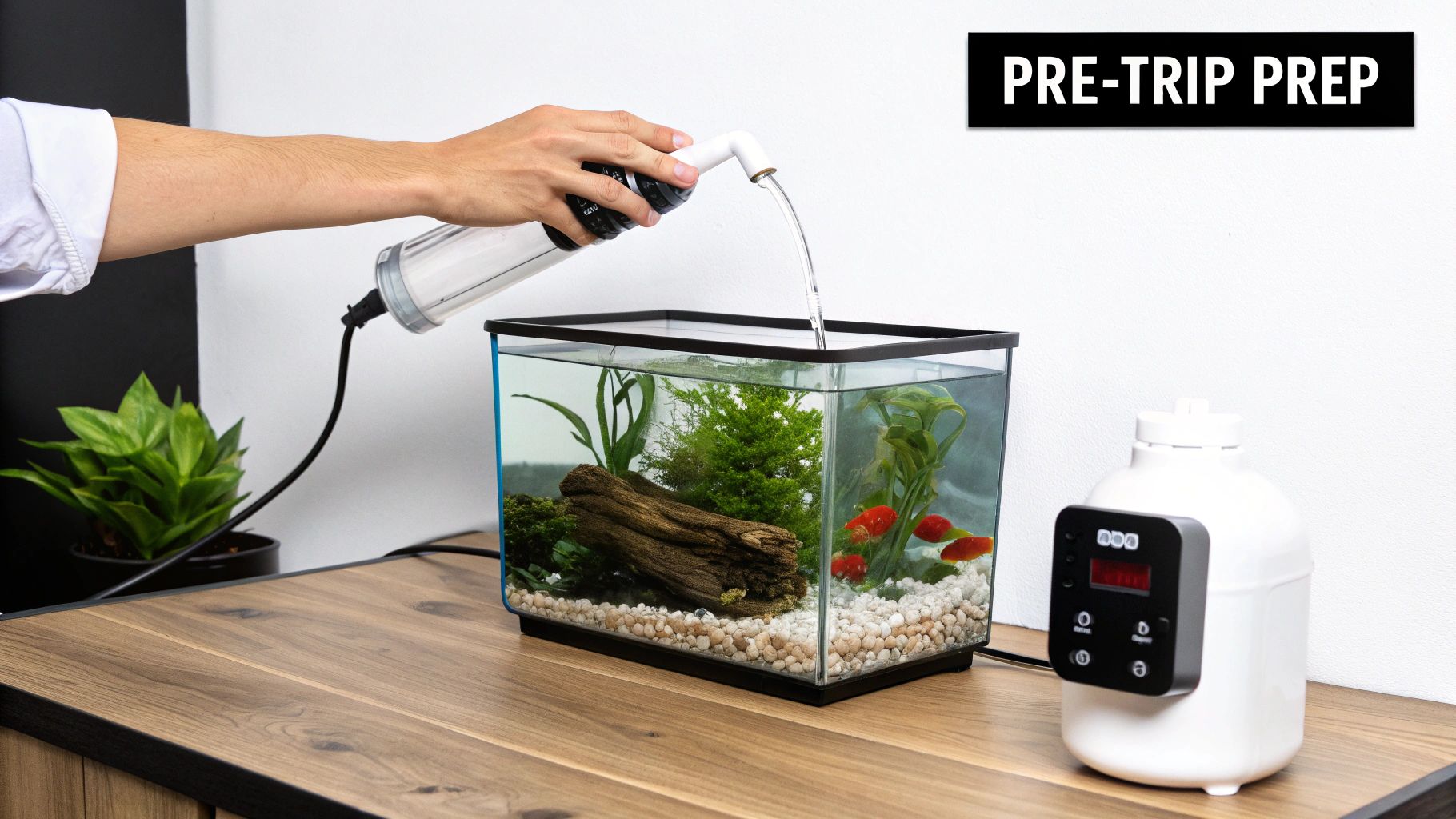
Here's the single biggest mistake I see people make: a massive, last-minute overhaul right before leaving town. Big water changes, deep substrate cleaning, or adding new fish can completely shock the system. This messes with your water chemistry and puts a ton of stress on your tank's inhabitants. A stable environment is a resilient one.
Your goal is to get the aquarium into peak condition a few days ahead of your trip. This gives the whole ecosystem time to settle down, ensuring you aren't leaving behind a ticking time bomb of fluctuating parameters. Think of it as preventative maintenance that pays off in pure peace of mind.
Stabilize Your Water Parameters
About three to five days before you leave, do a routine water change. I stick to around 25%—it’s just enough to lower nitrates and freshen things up without causing a drastic shift. Anything more than that and you risk messing with the beneficial bacteria colonies that are so critical for breaking down waste.
While you're at it, give your filter media a gentle cleaning. And please, don't replace it all at once. Just swish the sponges or cartridges in the old tank water you've siphoned out. This knocks off the gunk without killing the essential bacteria living inside. A clean filter means you’ll have optimal water flow and filtration while you’re gone.
Tweak Your Lighting to Combat Algae
Algae blooms are usually fueled by two things: excess nutrients and too much light. Since you might be adding food with an auto-feeder but won't be there to manage waste, it's smart to get a handle on the other side of the equation—the light.
A simple but incredibly effective trick is to shorten your light timer's schedule. If your lights normally run for eight hours, cut them back to five or six. This small change makes a huge difference in slowing down algae growth, helping you come home to a clear tank instead of a green one.
This little adjustment won't harm your fish or most corals for a week or two, but it's a game-changer for preventing nuisance algae from staging a takeover. It's a key step in creating a more self-sustaining aquarium ecosystem for while you're away.
Conduct a Final Equipment Check
The day before you head out, do one last walkthrough of all your gear. This isn't the time for major fixes, just a final confirmation that everything is humming along as it should.
Heater: Is the temperature stable and where it should be?
Filter: Is the outflow strong and consistent? No gurgling or weak flow.
Power: Are all the plugs pushed in firmly, ideally into a surge protector?
Lids and Covers: Is everything secure? You don't want any jumpers or excessive evaporation.
Making sure all your life-support systems are running perfectly is the last piece of the puzzle. By setting up a stable, clean, and reliably functioning environment, you're paving the way for any vacation feeding method to succeed. Your fish will be safe and sound until you get back.
Choosing the Right Vacation Feeding Method
There’s no single, perfect answer for feeding your fish while you're on vacation. The best game plan really boils down to how long you'll be gone, what kind of critters you have in your tank, and frankly, your budget. Getting this wrong can lead to a tank full of overfed, stressed-out fish and terrible water quality, or worse, underfed ones.
Let's walk through the most reliable options so you can head out the door with confidence. We'll look at automatic feeders, those slow-release blocks, and the old-school fish sitter to give you a clear picture of what works best and when.
The Reliable Automatic Fish Feeder
For any trip longer than a weekend, an automatic fish feeder is usually the gold standard. These little gadgets are designed to dish out a pre-measured amount of dry food, like pellets or flakes, right on schedule. They bring a level of consistency and control that’s absolutely essential for keeping your tank stable while you’re away.
Now, the absolute key to success with an auto feeder is testing it first. Don't just set it and forget it. At least a week before you leave, get it running. You need to be sure it's dropping the right amount of food and that it actually works reliably. Moisture is your biggest enemy here; position the feeder away from any splashing from filter outputs or air stones to keep the food from clumping up and jamming the whole thing.
When to Consider Slow-Release Feeders
Slow-release vacation blocks and gels are another common go-to, especially for shorter trips up to a week. The idea is that they slowly dissolve over a few days, releasing bits of food for your fish to graze on.
But, a serious word of caution here. The old-school plaster-based blocks can be a disaster waiting to happen. They often crumble way too fast, fouling your water with a nutrient bomb that can cause a dangerous ammonia spike. If you go this route, stick with the modern gel-based feeders. They're much more stable and won't turn your tank into a cloudy mess. They can work for a community tank with hardy fish, but I'd never trust one with sensitive species or a delicate reef setup.
Key Takeaway: Always, always test a slow-release block in a separate container with some tank water before you leave. This is the only way to see how fast it actually dissolves and if it clouds the water, helping you dodge a vacation catastrophe.
The need for precise, consistent feeding isn’t just a hobbyist concern; it’s a massive focus in the commercial aquafeed industry. That global market is projected to swell from USD 57.2 billion in 2025 to USD 73.7 billion by 2030, all driven by the need to deliver exact nutrition for healthy stock. For us at home, simple battery-powered timers that drop precise portions are what stand between us and the malnutrition or obesity issues that plague up to 40% of unattended tanks. Take a look at the global aquafeed market trends to see how the pros approach it.
The Fish Sitter: The Human Touch
For a lot of reefers, especially those with complex tanks or picky eaters, nothing beats the peace of mind that comes with a trusted fish sitter. This could be a fellow hobbyist, a family member, or even a professional aquarium service. It's the best option for any trip length and becomes pretty much non-negotiable for extended time away.
The real secret to making this work is leaving crystal-clear instructions. You can't leave anything up to interpretation.
Pre-portion all the food. This is the most important tip. Use one of those daily pill organizers and measure out the exact amount of food for each day. It’s the single best way to stop a well-meaning sitter from nuking your tank with too much food.
Leave detailed notes. Write down everything. Feeding times, what "normal" fish behavior looks like, and who to call in an emergency (both you and a local fish store).
Do a live walkthrough. Before you go, show them the ropes. Point out the main shut-off valves for your equipment and demonstrate exactly how and where to put the food in.
When you prep your sitter this well, you get the best of both worlds: the consistency of an automated system with the invaluable ability of a human to spot trouble and actually do something about it.
Vacation Feeding Methods Comparison
Deciding between these methods can be tough, so here’s a quick breakdown to help you match the right solution to your trip and your tank. This table lays out the pros, cons, and ideal scenarios for each approach.
Method | Best For (Trip Length) | Pros | Cons |
|---|---|---|---|
Automatic Feeder | 3 days to 2 weeks | - Highly consistent and reliable- Precise portion control- Relatively inexpensive | - Only works with dry foods- Can clog from moisture- Requires pre-trip testing |
Slow-Release Feeder | 2-7 days | - Very easy to use- Inexpensive and widely available | - Can foul water quality- Unpredictable release rate- Not for sensitive fish or reef tanks |
Fish Sitter | Any length (essential for 2+ weeks) | - Can handle complex feeding- Can spot and fix problems- Best for reef tanks and finicky eaters | - Relies on human reliability- Potential for overfeeding if not pre-portioned- Can be costly if professional |
Ultimately, the best choice is the one that lets you relax on vacation without worrying about what’s happening in your tank. For many, a combination works well—like an auto feeder for the basics and a sitter who just pops in every few days to check on things.
Getting Your Automatic Feeder Dialed In
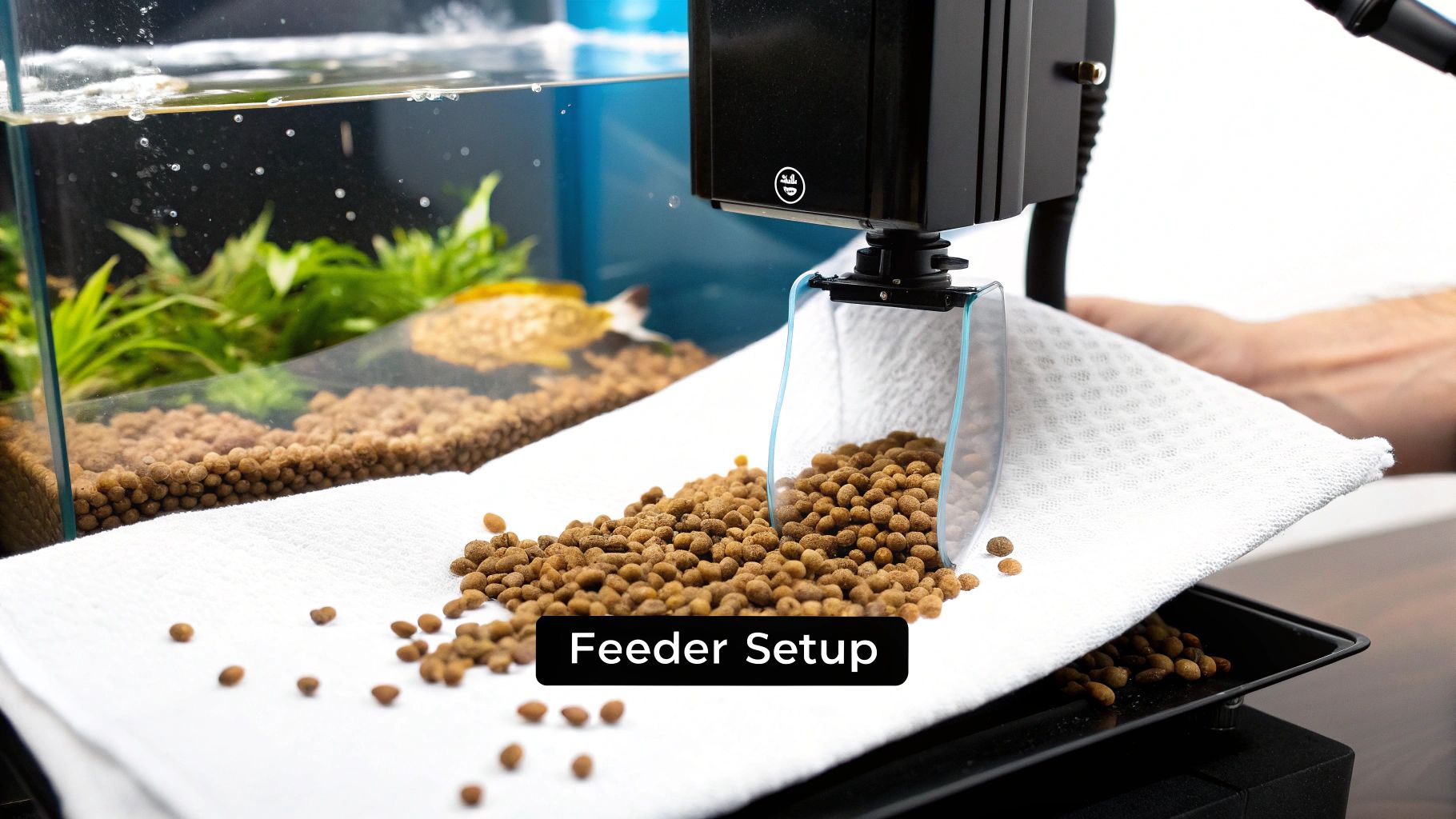
An automatic feeder is a lifesaver for any aquarist heading out of town, but it’s only as reliable as your setup. A poorly calibrated or badly placed feeder can go from a helpful gadget to a vacation-ruining disaster in a hurry, dumping food and nuking your water quality.
Think of this process as your insurance policy for a healthy tank while you’re gone. Taking the time to get it perfect now will buy you a ton of peace of mind later.
Choosing the Right Food for Your Feeder
First thing's first: you need a food that plays well with automation. While plenty of fish love flakes, they are a terrible choice for most automatic feeders. Flakes are delicate, oddly shaped, and they soak up moisture from the air like a sponge. This makes them clump together and jam the whole mechanism.
Your best bet is a high-quality pellet or granule. These foods are uniform in size and density, so they flow freely through the feeder’s moving parts. This consistency makes portion control far more accurate and dependable. You can explore some of the best saltwater fish food top picks for reef health that come in pellet form, ensuring your fish get great nutrition that actually works with your gear.
Calibrating the Perfect Portion Size
With your food selected, the next mission-critical task is dialing in the portion size. "Guessing" is not an option. Even a small miscalculation can lead to massive over- or under-feeding over the course of a week. This is where a little pre-vacation dry run becomes non-negotiable.
Here’s my tried-and-true method. It's simple but it works.
Set up the feeder exactly as you plan to use it over the tank.
Place a dry, white paper towel on a flat surface directly under the dispenser.
Let the feeder run on its intended schedule for at least two to three days.
This test run shows you precisely how much food is being dropped at each feeding. From there, you can tweak the feeder's settings up or down until it's dispensing the exact amount your fish would normally polish off in a minute or two.
Pro Tip: Don't just eyeball the pile. Seriously. Count the pellets or use a tiny measuring spoon to quantify the portion. This data-driven approach removes all the guesswork and ensures your fish get the same meal they're used to.
This level of precision isn't just for hobbyists; it mirrors practices in large-scale aquaculture. In markets like Asia-Pacific, where China alone produces over $15 billion in aquaculture, automatic feeders are vital for sustaining the fish that supply over 50% of global seafood. Improper feeding schedules cause around 70% of aquarium fish mortality, so investing in a properly calibrated vacation feeder that dispenses 1-2% of body weight daily is a proven strategy. Discover more insights about these fish feed market dynamics.
Conquering Moisture: The Feeder’s Arch-Nemesis
The single biggest enemy of an automatic feeder is moisture. Humidity rising from your aquarium's surface can creep into the feeder's drum, turning your perfectly dry pellets into a solid, useless brick of fish food. Stopping this is all about smart placement.
Here’s how to set it up for success:
Avoid Airstones and Filters: Position the feeder away from any areas with high surface agitation, like bubble wands or filter outflows. The constant splashing and mist will quickly turn your food to mush.
Use a Feeding Ring: A simple floating feeding ring placed on the water's surface directly below the dispenser creates a neat barrier. It contains the food and helps block some of that rising humidity.
Ensure Good Ventilation: If your tank has a tight-fitting lid, you might need to prop a small section open or even cut a custom hole for the feeder. This ensures air can circulate, keeping the food dry.
By nailing the food choice, portion size, and moisture prevention, you can actually trust your automatic feeder to do its job. This careful prep is the final step in making sure your fish are well-fed and your tank stays stable, letting you truly unplug and enjoy your time away.
Caring for Reef and Planted Tanks While You Are Away
Reef tanks and high-tech planted aquariums aren't just fish tanks; they're delicate, living ecosystems where stability is everything. For these setups, figuring out how to feed the fish while you're gone is just one piece of a much bigger puzzle. You’re not just keeping fish fed—you’re maintaining a precise balance of light, chemistry, and nutrients that corals and plants absolutely depend on.
Automating these systems is the real key to a stress-free trip. It definitely requires some upfront investment in gear and a bit of testing, but the payoff is huge: coming home to an aquarium that didn't just survive your absence, it continued to thrive.
Automating Your Reef Tank’s Core Needs
A reef tank's health hinges on rock-solid water parameters, especially calcium, alkalinity, and magnesium. Corals are constantly consuming these elements, and even a few days of neglect can lead to visible stress or bleaching. This is where automatic dosing pumps become your best friend.
Before you head out, make sure your dosing pumps are properly calibrated and that the reservoirs are filled to the brim. Program them to deliver small, frequent doses of your two-part or three-part solutions all day long. This approach is far superior to a single large daily dose because it mimics the natural, slow uptake by corals.
The whole point of vacation automation is consistency. Dosing by hand once a day creates a wild sawtooth pattern in your water chemistry. Dosing pumps smooth out those peaks and valleys, maintaining the unwavering stability your corals crave.
Automating your water top-offs is just as critical. An auto top-off (ATO) system is a non-negotiable piece of equipment that replaces evaporated water with fresh RODI water, keeping your salinity perfectly locked in. A drop in the water level, especially in a smaller tank, can cause a massive salinity swing—a major stressor for corals and inverts.
Supporting a Planted Tank Ecosystem
For those of us with planted tanks, the vacation checklist looks a little different. Here, the focus shifts to managing light, CO₂, and liquid fertilizers. Algae is always the enemy, and an imbalance in any of these three areas while you're gone can give it a serious head start.
Lighting: Just like any other tank, dial back your photoperiod. Cutting it by 25-30% (say, from 8 hours down to 6) limits the energy available for algae to grow.
CO₂: Do a quick check to ensure your CO₂ tank has enough gas to last the whole trip. Keep it on a timer that switches on one hour before your lights come on and off one hour before they shut down.
Fertilizers: If you're running an auto-doser for liquid ferts, it’s a good idea to reduce the dosage slightly to match the shorter lighting schedule. This prevents a buildup of unused nutrients that algae would love to feast on.
For reef keepers looking to make their systems even more resilient and self-sufficient, learning more about a refugium in sump guide can unlock new strategies for long-term health. By embracing automation, you ensure your delicate ecosystems get the precise, consistent care they need, letting you actually relax and enjoy your time away.
Your Post-Vacation Aquarium Recovery Plan
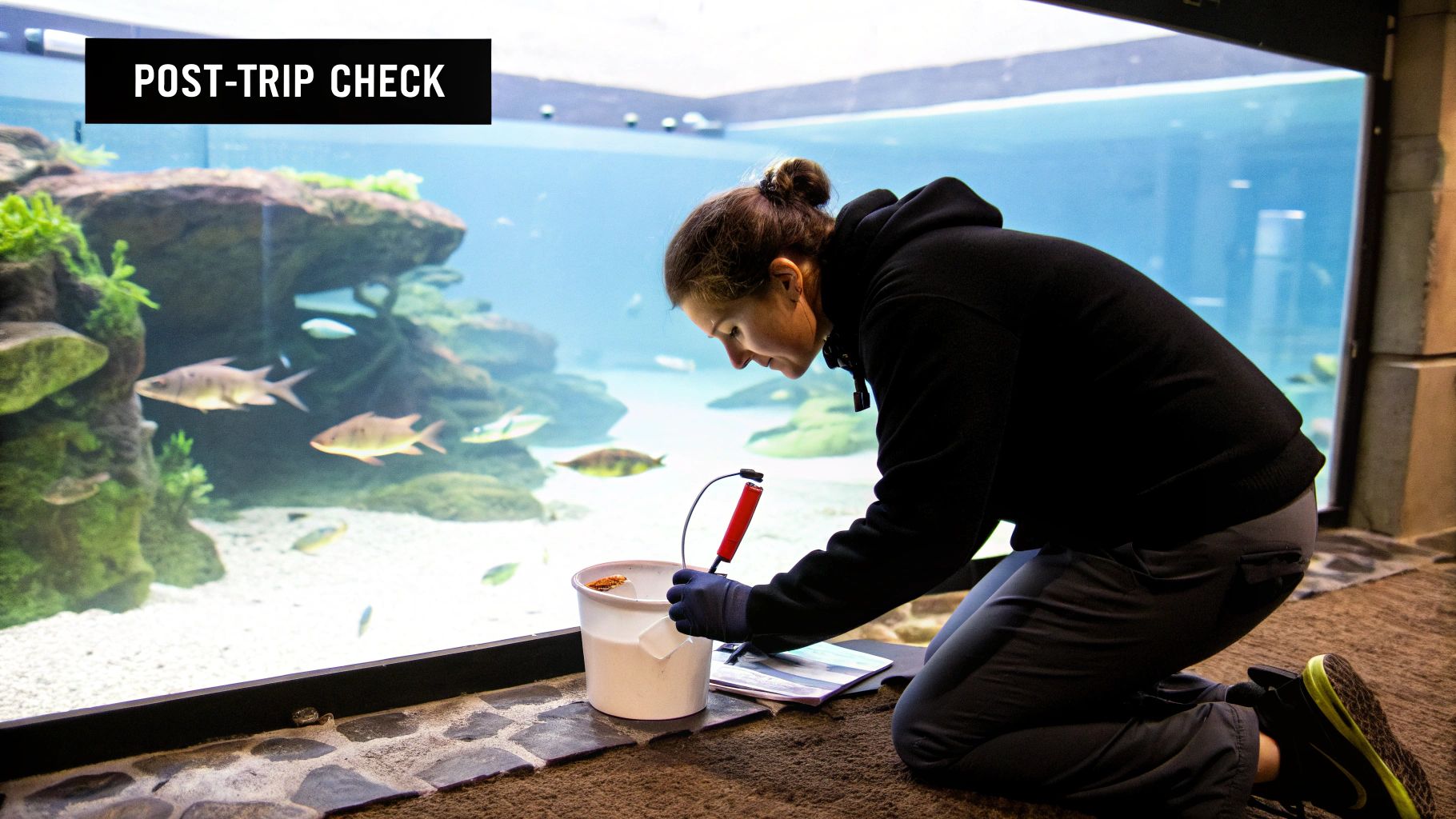
You just walked in the door and dropped your bags. I know the feeling—the first thing you want to do is rush over to the tank. But before you do anything else, just stop and watch for a minute. The absolute most important first step is to simply observe. Resisting that powerful urge to immediately start tinkering is your key to a smooth welcome home for your aquarium.
Give the tank a good, methodical once-over with your eyes. Are the fish showing any signs of stress, like clamped fins, hiding in weird spots, or breathing heavily? Is all the equipment—heaters, filters, powerheads—humming along like it should be? Check the water line, too; a bit of evaporation is normal, but a major drop could signal a bigger issue.
Easing Back into Routine
The single biggest mistake you can make right now is shocking the system. Whatever you do, don't dump in a massive "I'm home!" feeding or launch into a huge water change. Your aquarium found a sort of equilibrium while you were gone, and any sudden, dramatic shift can do way more harm than good.
Think of it as a gentle re-entry. The goal here is to gradually guide the tank back to its normal state without freaking out your fish and corals.
A small 10-15% water change is a fantastic place to start. It helps dilute any nitrates that might have built up, but it's not drastic enough to cause a major swing in your water chemistry. Once that's done, it's time to grab your test kits. Get a reading on your ammonia, nitrite, and nitrate levels to get a clear, data-driven picture of how things are going.
Coming home to a tank in crisis is a reefer's nightmare, and it's often tied to a flawed vacation feeding plan. In fact, some estimates suggest up to 60% of vacation-related fish deaths are linked to starvation or, just as often, algae blooms from decomposing food blocks. This really drives home the need for precision feeding—a principle that also scales up to the global fish processing market. You can read more about these fish processing market insights and see why consistency is king.
Resuming Your Feeding Schedule
When it comes to that first meal back, less is more. Seriously. Start with a feeding that’s about half the normal portion size. Your fish's digestive systems have likely adjusted to a lighter schedule, and a small meal prevents uneaten food from fouling up the water.
The next day, you can go back to your normal feeding schedule. Just make sure to watch closely and confirm that everything gets eaten within a couple of minutes. This calm, measured approach will help your little ecosystem transition back seamlessly, keeping your fish healthy and stress-free.
Answering Your Top Vacation Feeding Questions
Whenever a trip is on the horizon, it's totally normal for that little voice in your head to start firing off "what if" scenarios about your tank. These questions pop up for just about every hobbyist, but the good news is, the answers are usually pretty simple.
Let's get straight to it and tackle the most common concerns. A solid plan means you can actually relax on your trip, knowing everything back home is taken care of.
Can Fish Survive a Week Without Food?
This is the big one, and the short answer is: probably, yes. Most healthy, adult aquarium fish can easily go three to seven days without a meal. Think about it—in the wild, dinner isn't served on a predictable schedule. They're built to handle short fasts without any real harm.
That said, making them fast isn't an ideal strategy, especially if you're gone for more than a long weekend. It can be stressful for them. It's also a definite no-go for tiny fish, baby fish, or high-energy species like some wrasses that burn through calories. For any trip longer than a few days, setting up a reliable feeding plan is always the safer, kinder choice.
Are Vacation Feeder Blocks Bad for Water Quality?
They absolutely can be, and it's one of the biggest risks with vacation care. Those old-school, chalky white plaster blocks are infamous for dissolving erratically. They might fall apart and dump a week's worth of food into the tank at once, causing a massive ammonia spike that could wipe everything out.
The modern gel-based feeders are a huge step up and a much safer bet if you're going this route. They're designed not to cloud your water. Still, any kind of block feeder introduces a variable you just can't control. If you have to use one, do yourself a favor and test it in a separate bucket with some tank water first to see how it behaves.
What Is the Best Way to Prevent Automatic Feeder Clogs?
Moisture. That's the undisputed enemy of every automatic feeder out there. The absolute best thing you can do is be smart about where you put it.
Always position your feeder over an open spot in the tank, well away from the splash zone of your filter output or the fine mist from an airstone. This one simple move is critical. What you put inside it matters, too. Dry, uniform pellets or granules are far less likely to clump up than delicate flakes. A clogged feeder is a useless feeder, so keeping the food bone-dry is your top priority.
Should I Turn My Aquarium Lights Off for Vacation?
Nope, don't plunge your fish into a week of total darkness. A much better approach is to just shorten the photoperiod.
Grab a basic outlet timer and cut the "on" time from your usual 8-10 hours down to just 5-6 hours a day. This gives your fish enough light to keep their natural day-night rhythm but seriously slows down algae growth by starving it of the light it needs to explode. It's a tiny tweak that can mean the difference between coming home to a clean tank and a green, soupy mess.
For a truly self-sustaining solution that keeps finicky eaters like mandarins fed and your reef ecosystem thriving, consider seeding your tank with live nutrition. PodDrop Live Aquarium Nutrition delivers fresh, lab-cultured copepods and phytoplankton that provide a continuous food source, boosting the health of your entire system. Explore the benefits of live food at https://www.getpoddrop.com.
Comments