


A Reefer's Guide to Food for Mandarin Goby
- fabianbehague
- Nov 18
- 16 min read
For a mandarin goby, the only meal that matters is a live one. Their diet isn't a preference; it's a biological requirement. These fish are specialized micro-predators, and a constant supply of live copepods and amphipods is non-negotiable for their survival. Forget flakes and pellets—they just don't register as food to these meticulous hunters.
Why Mandarin Gobies Have a Specialized Diet
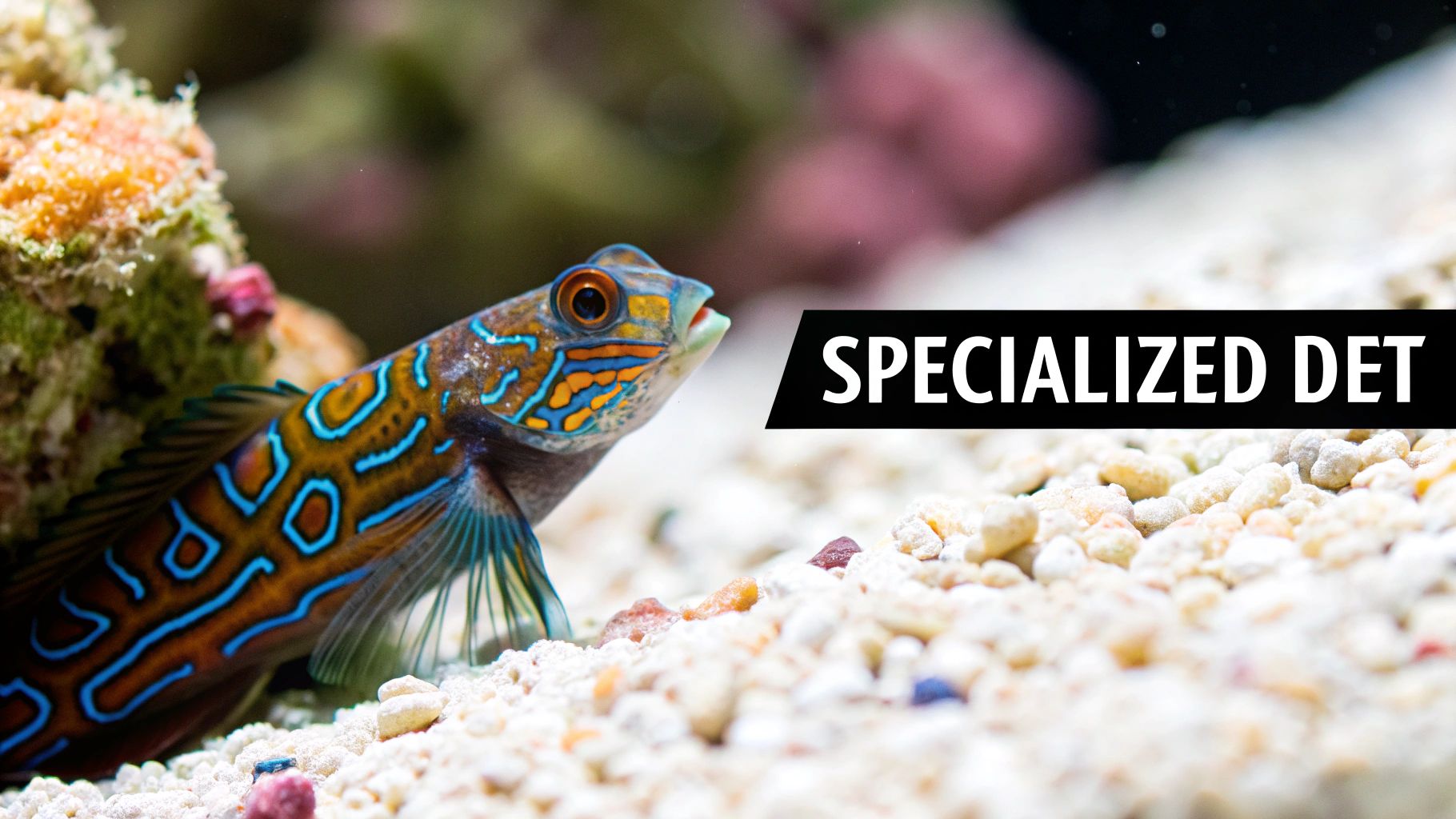
To really get why mandarins are so demanding, you have to watch how they operate. Unlike a clownfish that aggressively snatches food from the water column, a mandarin is a slow, methodical grazer. It spends its entire day scanning every inch of live rock and sand, meticulously pecking at any microscopic crustacean it finds.
This isn't just a quirky personality trait. It’s a behavior dictated by their anatomy. Mandarins have tiny, protrusible mouths perfectly engineered for slurping up copepods from surfaces. Their digestive system is equally specialized, built for a continuous trickle of small, live meals—not for processing the binders and fillers in commercial fish food.
The Myth of Flakes and Pellets
It's a common hope among new owners: "Maybe my mandarin will eventually learn to eat pellets." While you might hear a rare success story, especially with captive-bred fish, banking on this is a huge gamble. The vast majority of mandarins, particularly wild-caught ones, will starve to death while completely ignoring a pile of flakes or frozen mysis shrimp.
Their hunting instinct is triggered by the specific, jerky movements of live prey. A motionless pellet simply doesn't set off that "food" signal in their brain. This is the single biggest reason these gorgeous fish have such a poor survival rate in aquariums—keepers fail to provide the one thing they are biologically programmed to eat.
It's a classic mistake to think a mandarin is just being picky. In reality, its feeding response is hardwired. It’s not choosing to ignore the pellets; its brain literally doesn’t recognize inert stuff as a meal.
To keep a mandarin happy and healthy, you need to replicate the tiny, bustling ecosystem they'd find on a natural reef. Let’s break down exactly what they're hunting for.
Primary Food Sources for Mandarin Gobies
The table below summarizes the key live foods that a mandarin goby needs to thrive. This isn't a menu of options; it's a checklist for the thriving microfauna population your tank must have before you even consider adding one of these fish.
Live Food Type | Primary Role | Ideal Size | Availability in Tank |
|---|---|---|---|
Copepods (e.g., Tisbe, Tigriopus) | Staple Diet | 0.5 - 2 mm | Must be a large, self-sustaining population living in rockwork and sand. |
Amphipods | Supplemental Food | 2 - 10 mm | Larger prey, often found in mature refugiums and deep sand beds. |
Isopods | Opportunistic Snack | 1 - 5 mm | Commonly found in established reef tanks, contributing to a varied diet. |
Small Polychaete Worms | Natural Foraging | Varies | Inhabit live rock and sand, providing occasional nutritional diversity. |
As you can see, success with a mandarin is entirely dependent on a massive, reproducing population of tiny crustaceans. They don't have three square meals a day; they graze constantly, eating hundreds, if not thousands, of individual pods every single day.
Anatomy Dictates the Diet
The link between their body and their food is absolute. Beyond their specialized mouths, mandarins don't have a true stomach to store big meals. They have a short, simple intestinal tract that needs a constant flow of food passing through it to absorb enough nutrients.
This means they can't just "fill up" and digest later. They have to eat continuously to keep their metabolism going. If the pod population in a tank can't keep up, the mandarin will slowly and tragically waste away. This is why a mature tank, running for at least six to twelve months, is the absolute minimum requirement. You need an environment where the copepods and amphipods can reproduce faster than the mandarin can eat them, creating a truly sustainable, in-tank food source.
Building a Thriving Copepod Population
A healthy, fat mandarin goby is the ultimate sign of a truly mature and stable reef tank. But that health doesn't come from the fish itself—it's a direct reflection of a thriving micro-ecosystem you've carefully cultivated.
Before you even think about bringing a mandarin home, your number one job is to become a copepod farmer. The mission isn't just to dump some pods in and call it a day. You need to build a system where they reproduce faster than they get eaten, creating a permanent, self-sustaining food source. This is the real foundation of keeping mandarins happy for the long haul.
Choosing the Right Copepod Species
When it comes to seeding your tank, not all copepods are created equal. You're looking for benthic species, the ones that live and crawl on surfaces like rock and sand. That’s where your mandarin will be hunting, meticulously pecking at the rockwork all day.
The absolute gold standard for a mandarin tank is Tisbe biminiensis. I recommend this species to everyone for a few key reasons:
They're detritivores, meaning they actively clean your tank by eating waste, which in turn fuels their own reproduction. It’s a win-win.
They are benthic, preferring to live and breed right in the nooks and crannies of your rock and substrate—exactly where a mandarin expects to find its next meal.
Their nauplii (babies) are tiny, providing a great food source for corals and other small inhabitants, while the adults are the perfect size for your mandarin.
Starting your tank with a high-quality culture of Tisbe pods gives you a robust population perfectly suited to a mandarin's needs. You can learn more about the numerous benefits of seeding your tank in our detailed guide.
Creating the Ideal Breeding Grounds
Copepods can't just multiply out of thin air; they need a safe, complex habitat to call home. Think of your rockwork and sand bed as the essential infrastructure for your copepod factory.
A deeper sand bed, at least 2-3 inches, provides a massive surface area for pods to colonize and burrow. Likewise, mature and porous live rock is full of tiny holes and crevices that act as safe nurseries. The more complex and craggy your hardscape, the better your pod population will fare.
Think of your live rock as a high-rise apartment complex for copepods. Each tiny hole and crevice is a safe space for them to live and reproduce, protected from predators. A bare or minimalist aquascape simply won't support the sheer numbers required.
We're essentially running our own small-scale aquaculture systems. The global aquaculture industry reached a staggering 68.1 million tonnes in 2020, and while that's mostly for human food, the core principles of creating ideal breeding conditions apply directly to our tanks. We’re just farming food for mandarin goby.
The Power of a Refugium
If there's one secret weapon in keeping a mandarin happy and well-fed for years, it's a refugium. This is your dedicated, predator-free safe zone, usually in your sump, designed for one primary purpose: cultivating microfauna like copepods and amphipods.
Growing macroalgae like chaetomorpha (we all just call it "chaeto") in a refugium creates the ultimate copepod breeding ground.
The dense, tangled structure of chaeto offers a protected habitat where pods can multiply without constantly being hunted.
As the chaeto tumbles and grows, it pulls nitrates and phosphates out of the water, improving your tank's overall quality.
The water flowing from the 'fuge back to your display tank carries a constant, steady stream of live pods, basically drip-feeding your main tank with a continuous food source.
A well-established refugium is your food bank. It ensures there's always a surplus population ready to replenish whatever your mandarin eats during the day.
Knowing When Your Tank Is Ready
So, how do you know when your copepod farm is officially open for business and can support a mandarin? The best way is a simple nighttime observation I call the "flashlight test."
Wait about an hour after your tank lights have gone out, then grab a flashlight and shine it on the aquarium glass. In a mature, pod-rich tank, you'll see dozens—maybe hundreds—of tiny white specks swarming on the glass and darting through the water.
If you can clearly see this bustling nightlife, it’s a great sign your ecosystem is ready.
But if you shine the light and only see a few lonely specks, you need more time. Don't rush it. Keep seeding with copepods and feeding phytoplankton to fuel their growth. Being impatient at this stage is the single biggest mistake people make, and it almost always ends tragically for the fish. Patience is everything.
So, you’ve decided to keep a mandarin. Awesome. Now let’s talk about keeping it thriving.
Relying on the natural copepod population in your display tank is a bit of a white-knuckle experience, especially if your tank is on the smaller side or hasn't been running for a year or more. Setting up a separate, dedicated live food culture is your insurance policy. It's the best way to guarantee you have a constant supply of nutritious food ready to go.
This isn't as complicated as it sounds. You don’t need a science lab—just a spare bucket, a small air pump, and some basic supplies. A little effort here goes a long way, creating a critical safety net that ensures your mandarin never misses a meal.
Getting a Simple Copepod Culture Going
Culturing copepods is surprisingly low-maintenance. The idea is simple: create a small, stable environment where a starter population can multiply like crazy, giving you a continuous harvest of live food. This is, without a doubt, the most sustainable way to provide food for mandarin goby.
Here's the gear you'll need to get a basic culture running:
A Container: A simple 5-gallon bucket from a hardware store is perfect. Just make sure it’s food-grade plastic and has never seen a chemical.
An Air Pump and Tubing: Any basic, low-power aquarium air pump will do. You just want a gentle bubbling action to keep the water oxygenated and the phytoplankton suspended.
A Starter Culture: Start strong with a quality bottle of live copepods. Tisbe or Tigriopus are great choices. A dense starter culture will get your population booming much faster.
Saltwater: Use freshly mixed saltwater that matches your display tank's salinity, usually around 1.025 specific gravity.
Phytoplankton: This is copepod fuel. A live, concentrated phytoplankton blend is non-negotiable for nourishing your culture and gut-loading the pods with all the good stuff.
Think of your copepod culture like a tiny farm. The pods are your livestock, and the phytoplankton is their feed. The more consistently you feed them, the bigger and better your harvest will be for your mandarin.
Once you’ve gathered your supplies, the setup takes minutes. Fill the bucket with saltwater, pour in the starter culture, and get the airline bubbling gently from the bottom. You won't need a heater unless your room's temperature regularly dips below 68°F (20°C).
If you really want to dive deep, we've put together a full walkthrough on how to culture copepods at home.
The Quick Fix: Hatching Baby Brine Shrimp
While copepods are your long-term, sustainable food source, freshly hatched baby brine shrimp (BBS) are a fantastic supplement. They're packed with nutrition, and their jerky swimming motion is often irresistible, even to a finicky mandarin.
Hatching them is a quick affair, usually taking just 24-48 hours. All you need is a simple hatchery made from a 2-liter soda bottle, an air pump, and some brine shrimp eggs (cysts). The bubbling keeps the eggs suspended until they hatch, and then you can easily harvest the tiny nauplii and feed them directly. They are an amazing tool for fattening up a new or skinny mandarin.
Comparing Home Culturing Options
Deciding what to culture really comes down to your goals. Are you looking for a steady, continuous food supply or a quick nutritional punch? Copepods offer a "set it and forget it" approach, while brine shrimp are more of an on-demand, high-impact meal.
Here's a quick look at how the two stack up.
Live Food Culturing Comparison
Factor | Copepod Culture | Brine Shrimp Hatchery |
|---|---|---|
Setup Time | About 15 minutes | About 15 minutes |
Maintenance | Minimal; weekly feeding | Daily setup and harvest |
Time to Harvest | 1-2 weeks initially, then continuous | 24-48 hours |
Nutritional Value | Excellent, especially when gut-loaded | Excellent, but degrades quickly |
Best Use Case | Primary, sustainable food source | Supplemental or emergency feeding |
Ultimately, many seasoned hobbyists do both. A continuous copepod culture provides the daily grazing opportunities mandarins need, while a batch of baby brine shrimp offers a high-protein treat a few times a week.
By culturing your own live foods, you're taking total control of your mandarin's health and nutrition. It's the most proactive step you can take to ensure this beautiful, delicate fish will thrive in your care for years to come.
Mastering Target Feeding and Weaning Techniques
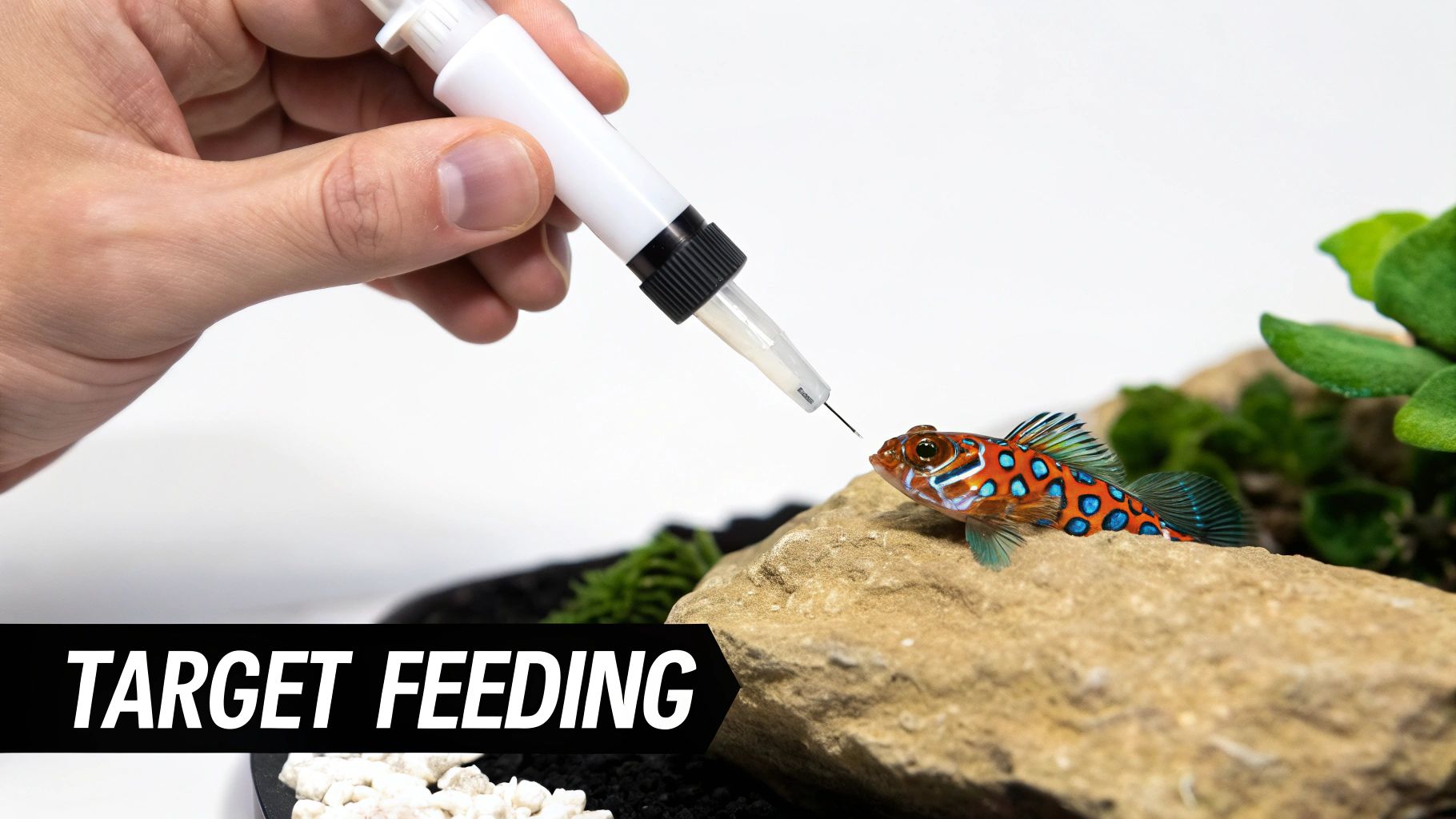
Even with a reef tank teeming with copepods, some mandarins might need a helping hand. This is where target feeding comes in. It’s your go-to move for delivering a concentrated meal right to your fish, which is especially useful if it's looking a bit thin or is still settling into a new tank.
This hands-on approach is also your best shot at the patient game of weaning a mandarin onto frozen foods. Success isn't guaranteed, but getting the technique down can make a huge difference in your fish's long-term health. It’s a direct way to bolster the food supply for your beautiful goby.
Perfecting the Art of Target Feeding
Target feeding is all about precision and a gentle touch. The goal is simple: release a small cloud of live food right in your mandarin's path without spooking it. You also have to be quick enough that faster tank mates don't steal the meal.
A simple turkey baster or a rigid airline tube attached to a syringe will be your best friends for this job. They give you the control needed to place the food exactly where it needs to go.
Here's how I approach it:
Get the Food Ready: You can either thaw a small bit of frozen baby brine shrimp in tank water or use a syringe to suck up live baby brine shrimp or cultured 'pods.
Slow Your Roll: Mandarins are jumpy. Move your hand and the feeding tool into the tank slowly and deliberately. Any sudden movements will send your fish darting for cover in the rockwork.
Read Its Mind: Watch where your mandarin is actively pecking and hunting. You want to position the tip of your feeder a few inches ahead of it, right near the rock or sand it's exploring.
The Gentle Release: Gently squeeze the baster or push the syringe to release a small puff of food. You're aiming to create a "cloud" of opportunity for it to graze through, not blast it with a jet stream.
The real secret to successful target feeding is making the mandarin think it found the food all on its own. A subtle delivery that lets the food settle onto the rocks mimics its natural foraging and works far better than chasing it around the tank.
The Challenge of Weaning onto Frozen Foods
Getting a mandarin goby to accept frozen food is one of those holy grail achievements in reef keeping. It takes an incredible amount of patience. You have to go in with realistic expectations—this process can take weeks, if not months, and many wild-caught mandarins will simply never make the switch.
The trick is to create an association between the new, non-living food and the live food it's already programmed to hunt. Captive-bred mandarins have a huge head start here, as they're often conditioned to eat prepared foods from a very young age.
Introducing the Feeding Jar Method
One of the most effective strategies for weaning is the "feeding jar" method. This clever technique creates a confined space where the mandarin can focus entirely on the food without having to compete with its tank mates.
You just need a small, clear glass jar or even a cut-off plastic bottle. Place it on the sand bed, and then use your turkey baster to add a mix of live baby brine shrimp along with a tiny amount of frozen food, like finely chopped mysis or cyclops.
The movement of the live food will lure the curious mandarin into the jar. As it gobbles up the live stuff, it will inevitably eat some of the frozen bits mixed in. Over many sessions, you can gradually change the ratio, adding less live food and more frozen. This slow-and-steady transition is the key to getting it used to the new food.
Our in-depth guide on feeding reef fish with copepods explains how live foods trigger those essential, natural feeding responses—the very principle this jar method is built on.
In the end, remember that even if you succeed with frozen food, it should only be a supplement, not a replacement. A thriving, self-sustaining copepod population will always be the cornerstone of proper food for mandarin goby, giving this amazing fish the constant grazing it needs to truly flourish.
Of course. Here is the rewritten section, crafted to sound like an experienced human expert, following all your specific instructions and examples.
Solving Common Mandarin Goby Feeding Problems
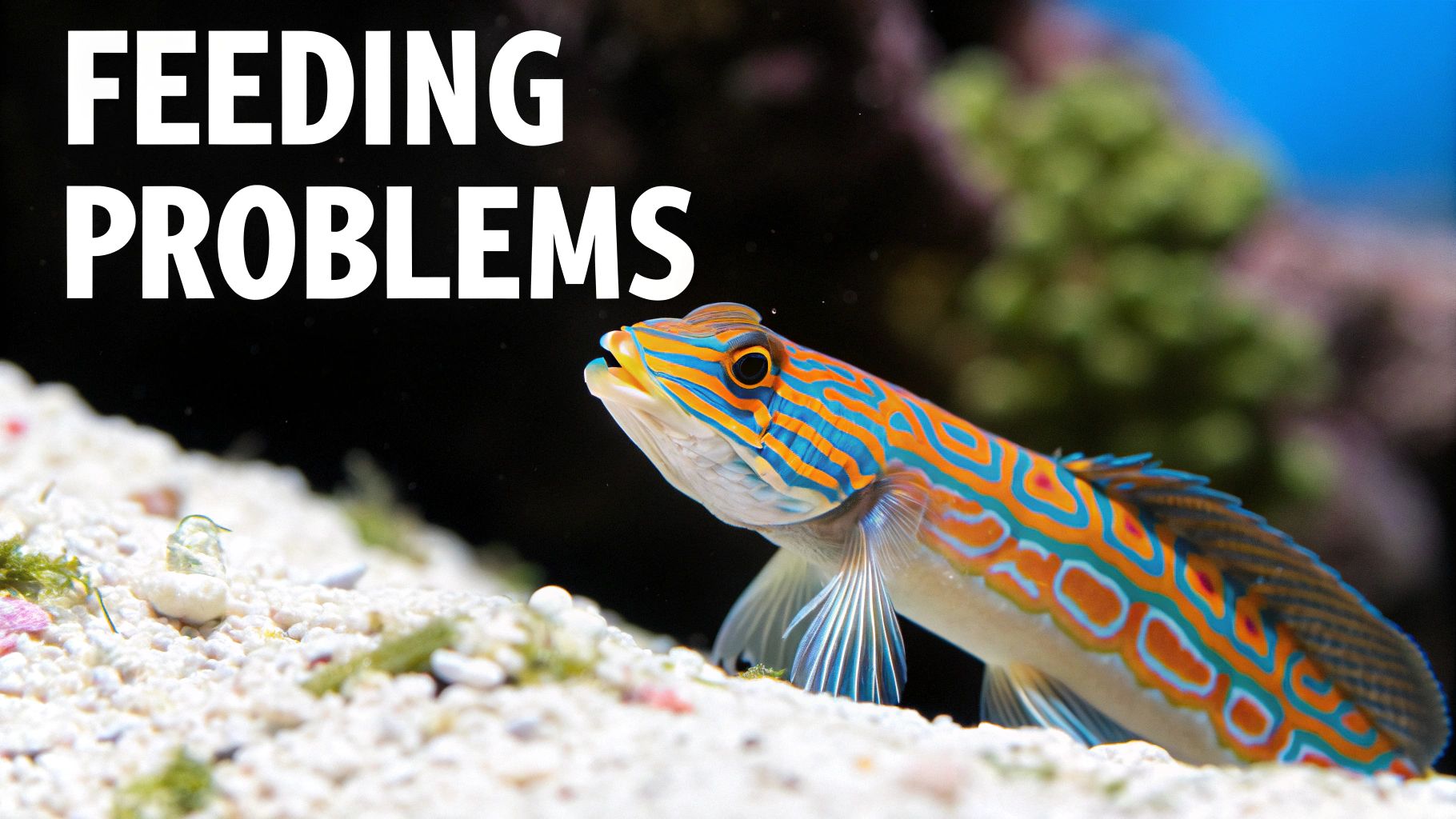
Even with a perfect plan, things can go sideways with a mandarin goby. When they do, it often feels like a race against the clock. Knowing how to spot and solve the common feeding issues is what separates a thriving, plump mandarin from one that's just barely hanging on.
This isn’t about textbook theory. It’s about tackling the real-world problems that can blindside you in any reef tank. We'll walk through what to do when your mandarin suddenly looks thin or your once-booming pod population seems to have vanished overnight.
Diagnosing a Thin Mandarin Goby
It's a uniquely stressful moment: you see your mandarin goby with a pinched stomach, yet you can still spot copepods crawling on the glass and rockwork. What gives? The pods you're seeing might be the wrong size, or worse, a competitor is gobbling them up before your mandarin gets a chance. A fish with a concave belly is a flashing red light—it's burning far more energy than it's taking in.
If you’re in this spot, it’s time to act immediately.
Boost the Pod Population: Don't hesitate. Add a dense, high-quality culture of live copepods like Tisbe right away. Pour them near the rockwork after the lights go out to give them a fighting chance to settle in.
Start Target Feeding: Get a turkey baster or pipette and begin target feeding with live baby brine shrimp or more copepods at least once or twice a day. This ensures a direct, high-calorie meal gets right to your mandarin.
Assess the Competition: Watch your tank like a hawk for a few feeding cycles. Is that feisty six-line wrasse or new scooter blenny constantly picking at the rocks? They could be wiping out the pod population, leaving nothing for your slower mandarin.
Handling a Copepod Population Crash
So, what happens when your pod population just... disappears? A "pod crash" can be triggered by adding a new, hungry fish, a swing in your tank’s parameters, or simply because your mandarin's appetite finally outpaced the pods' reproduction rate. Your first job is to stop the freefall and start rebuilding.
Turn off your protein skimmer for a couple of hours right after adding a new batch of pods. This keeps the tiny critters from being immediately skimmed out, giving them time to find refuge. At the same time, start dosing live phytoplankton to feed the surviving pods and kickstart a new breeding boom.
A pod crash is a silent emergency. You might not see it for days, but for a mandarin, a 48-hour food shortage can be critical. Reacting quickly with a fresh seed culture and phytoplankton is the most effective way to restore the balance.
Managing Competitors for Food
Your mandarin isn't the only fish in the sea—or your tank—that finds copepods delicious. Many wrasses, other gobies, and even some dottybacks are relentless pod hunters. If you have any of these competitors, you need a game plan.
A simple but effective trick is to play decoy. Feed the more aggressive fish first with their favorite food, like mysis or brine shrimp, on one side of the tank. While they're busy, you can target feed your mandarin or add copepods to its favorite hiding spots on the opposite side. This little bit of misdirection can make a huge difference.
These troubleshooting skills are a key part of creating a sustainable ecosystem in our home aquariums. This approach mirrors trends in large-scale aquaculture in Southeast Asia, where specialized cultivation is a major economic driver. For instance, in 2020, Brunei Darussalam reported the highest aquaculture production value at US$7,504 per metric ton. You can dive deeper into this kind of data on regional aquaculture production from SEAFDEC.
Answering Your Top Questions About Feeding Mandarin Gobies
Even for seasoned reef keepers, the unique demands of a mandarin goby can spark a few questions. You might have a tank that looks perfectly healthy, but it's natural to wonder if you're truly providing enough for this specialized feeder.
This section is designed to be your quick-reference guide for those moments of doubt. We'll tackle the most common questions hobbyists have, giving you clear, practical answers so you can care for your mandarin with confidence.
How Can I Tell If My Mandarin Goby Is Getting Enough Food?
The most honest answer is written right on its belly. A well-fed, healthy mandarin will have a visibly rounded, full stomach. It should look plump.
If you glance at it from the side and see a pinched-in or concave area right behind its pectoral fins, that’s a tell-tale sign of starvation. This isn't just a "little hungry" signal; it's a critical warning that requires immediate action.
Beyond its physical shape, watch how it behaves. A happy mandarin is a busy mandarin. It should be actively hunting all day long, constantly pecking at the rockwork and sand bed, exploring every nook and cranny. If your goby is lethargic, hiding all the time, or seems uninterested in foraging, it's a huge red flag that it's not finding enough to eat.
Can I Keep a Mandarin Goby in a New or Small Reef Tank?
This is probably the single most common mistake, and the answer is a hard no. Mandarin gobies are absolutely not for new aquariums. They need a mature, stable tank that has been running for at least 6 to 12 months, minimum. This gives the microscopic life—the copepods—enough time to establish a massive, self-sustaining population.
Tanks under 50 gallons are also a recipe for disaster. A smaller tank simply can't produce enough live food to keep up with a mandarin's constant grazing. The fish is an incredibly efficient hunter and will strip a small tank of its entire pod population in a matter of weeks, leading to starvation. For long-term success, you need a larger, established system, and one with a connected refugium is even better.
The "flashlight test" is your best friend here. At night, shine a flashlight on the glass. If you don't see tiny pods swarming the beam, your tank is not ready for a mandarin. Never add one to a tank that isn't already visibly teeming with microfauna.
Will My Mandarin Goby Eventually Eat Frozen Food?
It's possible, but you should never, ever count on it. Captive-bred mandarins are far more likely to accept prepared foods than their wild-caught cousins. Getting one to switch over takes a ton of patience, consistency, and specific techniques, like using a feeding jar to train them.
But here's the bottom line: never buy a mandarin assuming it will learn to eat frozen food. You must be fully prepared and committed to providing a lifelong supply of live food as its main diet. If you manage to get one weaned onto frozen mysis or brine shrimp, consider it a lucky bonus, not the expectation.
What Are the Best Tank Mates for a Mandarin Goby?
The best tank mates are peaceful fish that won't compete for the same food source. You have to avoid other aggressive pod hunters unless your aquarium is exceptionally large and has a very mature, robust pod population.
Ideal Companions Include:
Clownfish
Firefish
Royal Grammas
Most other small, calm community fish
Tank Mates to Avoid:
Six-Line Wrasses
Leopard Wrasses
Scooter Blennies (they are also dragonets)
Aggressive Dottybacks
These fish are faster, more aggressive hunters. They will easily out-compete a slow, methodical mandarin, leaving it with nothing. Choosing the right neighbors is just as critical as having the right food source.
Ensure your mandarin never goes hungry by seeding your tank with a vibrant, self-sustaining food source. PodDrop Live Aquarium Nutrition offers pure, lab-cultured copepods and phytoplankton to create the thriving ecosystem your specialized fish needs. Explore our live food options at https://www.getpoddrop.com.
Comments